 Whalesbook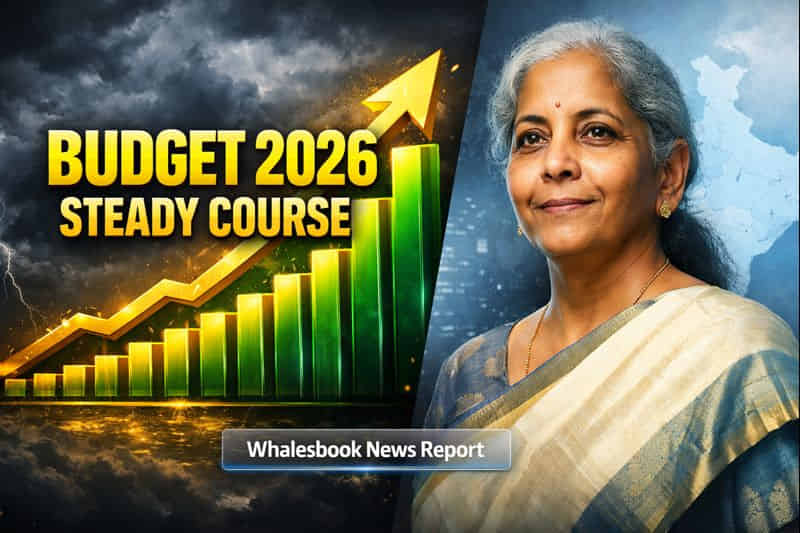
### Strategic Calm Amidst Global Turmoil
Finance Minister Nirmala Sitharaman's Budget 2026 deliberately sidestepped the anticipated largesse for poll-bound states. Unlike the previous year's gestures towards Bihar and Andhra Pradesh, intended to thank allies JDU and TDP, this budget refrains from similar state-specific schemes for West Bengal, Tamil Nadu, Assam, Kerala, and Puducherry. This move appears to heed the Economic Survey's warnings against harmful freebies, signaling a commitment to economic prudence over immediate political gains, though state units may still announce such measures later. This strategic calm is intended to project stability amidst turbulent geopolitics, including challenges posed by trade disruptions and tariffs from economies like the United States.
### The Core Catalyst: Fiscal Prudence and Sectoral Focus
The Union Budget 2026-27, presented on February 1, 2026, has been characterized by a deliberate pivot towards fiscal discipline and targeted growth drivers. While the broader economic outlook remains robust, with projected real GDP growth of 7.4% for FY26 and an estimated 6.8%-7.2% for FY27, the market reacted with volatility. The BSE Sensex and NSE Nifty 50 experienced a sharp sell-off, particularly after the announcement of an increased Securities Transaction Tax (STT) on futures and options trading and the taxation of share buybacks. This immediate market downturn highlights investor sensitivity to changes impacting financial markets, even as the underlying economic strategy focuses on long-term structural growth. The government aims to consolidate its fiscal position, targeting a fiscal deficit of 4.3% of GDP for FY27, down from an estimated 4.4% in FY26.
### The Analytical Deep Dive: Initiatives and Challenges
Despite the restrained approach to state-specific handouts, the budget is not devoid of targeted stimuli. Initiatives like dedicated rare-earth corridors for Odisha, Kerala, Andhra Pradesh, and Tamil Nadu, alongside high-speed rail corridors connecting Chennai and Siliguri, signal regional development focus. The promotion of textiles, leather goods, and ayurveda is intended to appeal to electorates in key southern states and counter narratives of regional discrimination. Significant emphasis is placed on bolstering manufacturing capabilities through schemes like the India Semiconductor Mission 2.0 and the Biopharma Shakti initiative, aimed at developing India into a global hub. The MSME sector receives a dedicated ₹10,000-crore growth fund, intended to be a significant boost.
Addressing the middle class, the budget offers an amnesty-like provision for delayed income or asset disclosures through simplified penalty procedures, aiming to assuage a vocal segment of the population. The new Income Tax Act, 2025, is set to take effect from April 1, 2026, promising simplified rules and forms. The Economic Survey 2025-26 has critically examined the rise of 'freebies', estimating state spending on unconditional cash transfers to reach approximately ₹1.7 lakh crore in FY26 and warning of their potential to strain state finances and crowd out productive capital investment. The budget's strategy appears to align with this cautionary stance, prioritizing long-term fiscal health over immediate political populism.
### The Future Outlook: 'Viksit Bharat' and Global Integration
The Budget aligns with Prime Minister Narendra Modi's vision of 'Viksit Bharat' by 2047, positioning India as a confident nation ready to engage with global challenges. The substantial increase in public capital expenditure to ₹12.2 lakh crore for FY27 underscores a commitment to infrastructure development as a growth engine. Measures to support domestic manufacturing and exports are also intended to mitigate the impact of global trade volatility and US tariffs, fostering self-reliance. The government's commitment to fiscal consolidation and a stable economic environment aims to enhance India's attractiveness as an investment destination, pursuing an ambitious goal of becoming the world's third-largest economy.