 Whalesbook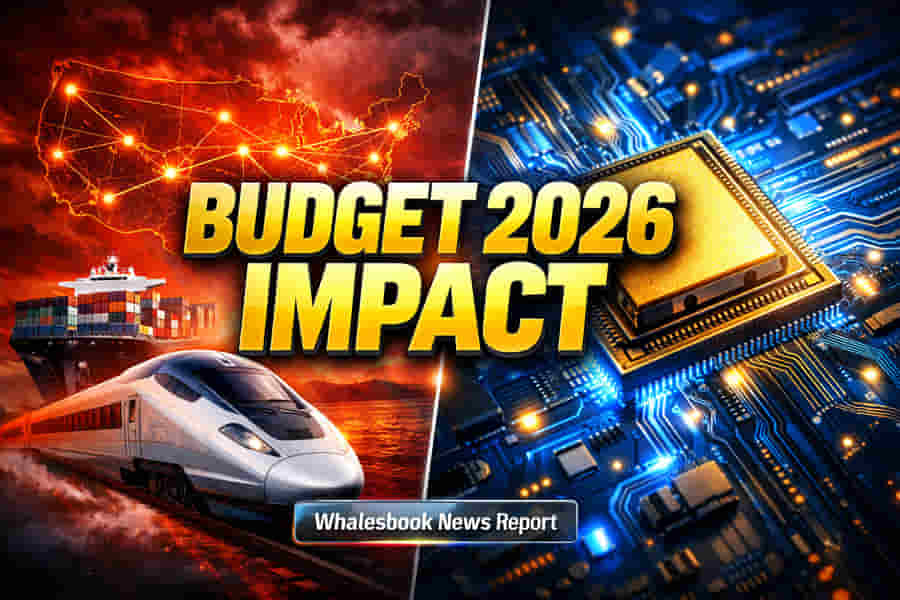
India's Budget 2026: A Strategic Push for Growth and Resilience
The Indian government's Budget 2026, presented on February 1, 2026, signals a deliberate strategy to foster domestic growth and enhance global competitiveness, even as economic uncertainties persist worldwide. The budget prioritizes a significant increase in capital expenditure, alongside targeted interventions across key industrial and technological sectors, aiming to set a robust trajectory for the nation's economy. This approach balances immediate growth imperatives with long-term structural development, underscored by a commitment to fiscal consolidation.
The Capex Engine and Fiscal Anchors
The cornerstone of Budget 2026 is the amplified capital expenditure outlay, reaching ₹12.2 lakh crore, representing 3.1% of GDP. This substantial investment is earmarked for critical infrastructure projects, including the development of high-speed rail corridors, coastal cargo facilities, and national waterways. The objective is to enhance logistics, improve cost-effectiveness, and boost the overall competitiveness of legacy industries. This robust public investment strategy is designed to de-risk early-stage projects and instill confidence for private sector participation, a continuation of the government's reliance on public spending to drive economic expansion.
Accompanying this capex surge is a steadfast commitment to fiscal prudence. The fiscal deficit target for FY27 is set at 4.3% of GDP, a marginal improvement from the estimated 4.4% for FY26. This adherence to fiscal consolidation, even with increased resource sharing with states as recommended by the 16th Finance Commission, demonstrates a balance between growth stimulation and macroeconomic stability. The 16th Finance Commission itself recommended retaining states' share of central taxes at 41%, while adjusting devolution criteria to include factors like GDP contribution, signalling a recalibrated approach to fiscal federalism.
Strategic Sectors: From Semiconductors to Textiles
Budget 2026 places significant emphasis on bolstering manufacturing across seven strategic and frontier sectors. A major focus is the semiconductor industry, with the launch of India Semiconductor Mission 2.0, aiming to fortify domestic supply chains and develop advanced technological capabilities. Concurrently, the outlay for the Electronics Components Manufacturing Scheme has been nearly doubled to ₹40,000 crore, signaling a concerted effort to scale up electronics production and move beyond assembly to full-stack manufacturing. Projections indicate the Indian electronics sector is poised for substantial growth by 2026, aiming for ambitious production targets.
The budget also addresses the vulnerabilities of labour-intensive export sectors, particularly textiles, which have faced pressure from US tariffs. Capital support for machinery upgrades and technological advancement in traditional clusters aims to enhance global competitiveness and sustainability. This initiative is complemented by broader efforts to support Micro, Small, and Medium Enterprises (MSMEs), including a dedicated ₹10,000 crore SME Growth Fund for equity support and measures to improve liquidity through the Trade Receivables Discounting System (TReDS). The MSME sector, a significant contributor to manufacturing, exports, and GDP, is seen as crucial for employment generation.
Data Centers and Global Investment
To capitalize on the global demand for digital infrastructure, the budget introduces a significant incentive for foreign companies operating data centers in India. A tax holiday until 2047 is offered to foreign entities utilizing Indian data center services to provide cloud services globally. This move is intended to attract substantial foreign investment, bolster service sector receivables, and address the imbalance where India generates significant data but hosts a small fraction of global data centers. This policy is expected to drive billions in investment and position India as a key hub for AI infrastructure.
Outlook Amidst Global Headwinds
India's economic outlook for 2026 remains robust, with projections suggesting it will continue to be one of the world's fastest-growing major economies, supported by strong domestic demand and ongoing reforms. The focus on capital expenditure, manufacturing, and strategic technology sectors within Budget 2026 reflects a strategic imperative to build resilience against global trade tensions and geopolitical risks. The government's investment in domestic capabilities and infrastructure aims to ensure sustained growth and reinforce India's position as a global manufacturing and digital services hub.