 Whalesbook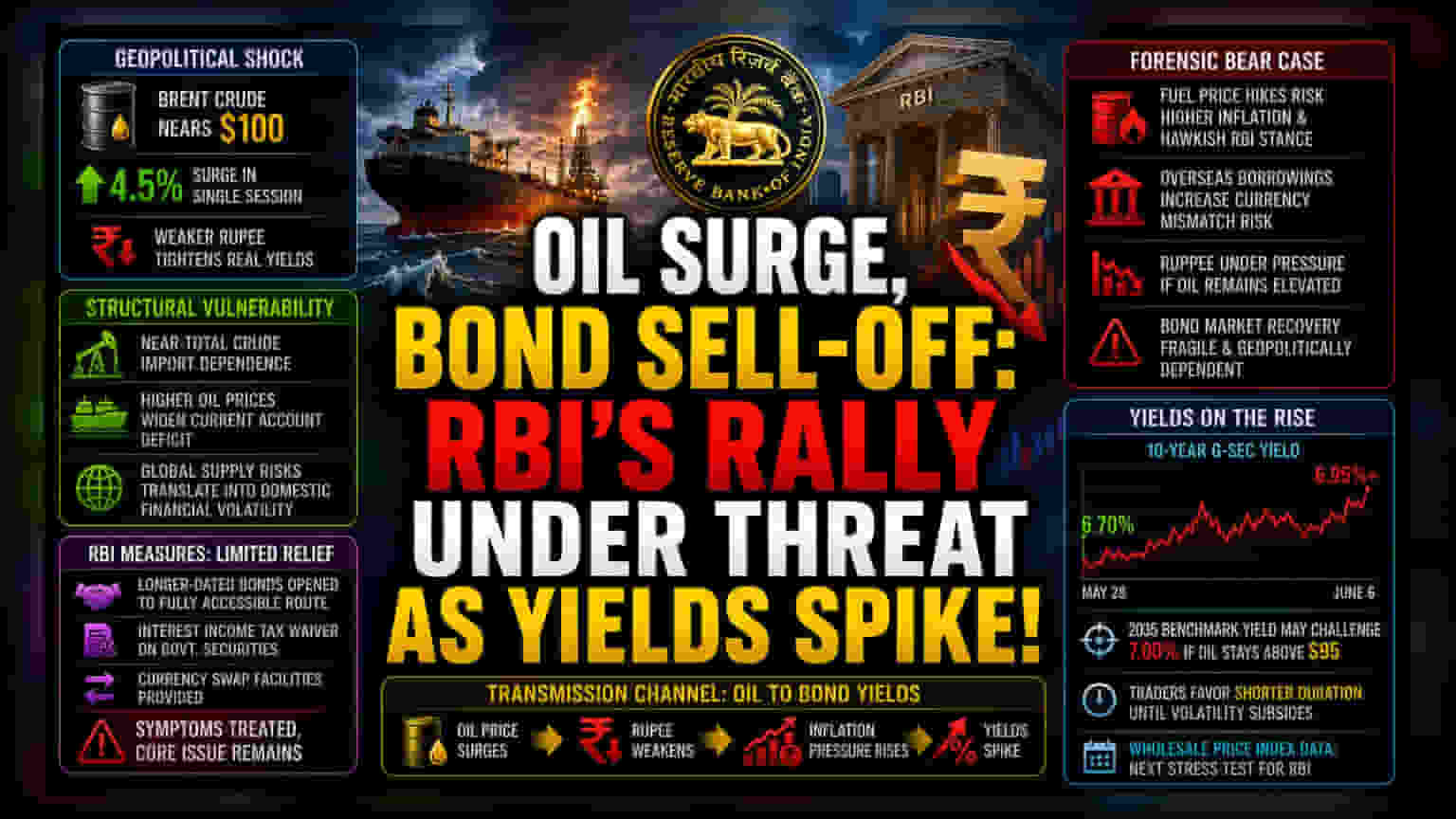


The Geopolitical Tax on Monetary Policy
The abrupt reversal in bond yields signals a fundamental loss of confidence in the market’s ability to sustain the RBI-led rally seen at the end of last week. While the central bank’s recent move to open longer-dated securities to the fully accessible route was designed to encourage stable, long-term capital inflows, the mechanics of the Indian economy remain hostage to imported energy costs. As Brent crude surges toward the $100 threshold, the immediate consequence is a tightening of real yields, forcing fixed-income investors to demand higher premiums for the inflationary risks associated with a weakened rupee.
Structural Vulnerabilities in the Current Account
Unlike economies with diversified energy production, India’s near-total reliance on imported crude creates an immediate transmission mechanism between Mideast conflict and domestic financial volatility. The current account deficit is particularly sensitive to these shifts, as each dollar increase in the price of a barrel complicates the trade balance. While the RBI has provided currency swap facilities to mitigate liquidity strain, these measures fail to address the core issue: the pricing power of oil exporters. When crude prices jump 4.5% in a single session, the fiscal benefits of removing interest income taxes on government bonds are effectively nullified by the rising cost of energy-induced inflation.
The Forensic Bear Case
The market’s aggressive sell-off reveals a deeper anxiety regarding the efficacy of administrative policy when faced with systemic energy shocks. A significant risk factor is the potential for domestic fuel price increases, which would not only act as a drag on consumer spending but also force the RBI to adopt a more hawkish stance, potentially invalidating the accommodative outlook shared just days prior. Furthermore, the reliance on overseas borrowings by public sector entities—now incentivized by cheaper swap windows—exposes the banking sector to increased currency mismatch risks should the rupee face sustained downward pressure. Unlike emerging market peers with net-exporter status, India remains uniquely vulnerable to supply-side energy shocks, leaving the current bond market recovery fragile and heavily dependent on a de-escalation in the Strait of Hormuz.
Forward Trajectory
Institutional attention is shifting toward upcoming wholesale price index data, which will likely serve as the next stress test for the RBI’s policy framework. If oil prices hold above the $95 level, traders anticipate further upward pressure on the 2035 benchmark yield, likely challenging the 7.00% psychological barrier. Market participants are now recalibrating their duration exposure, favoring shorter-term instruments until the volatility surrounding regional energy shipping lanes subsides.