

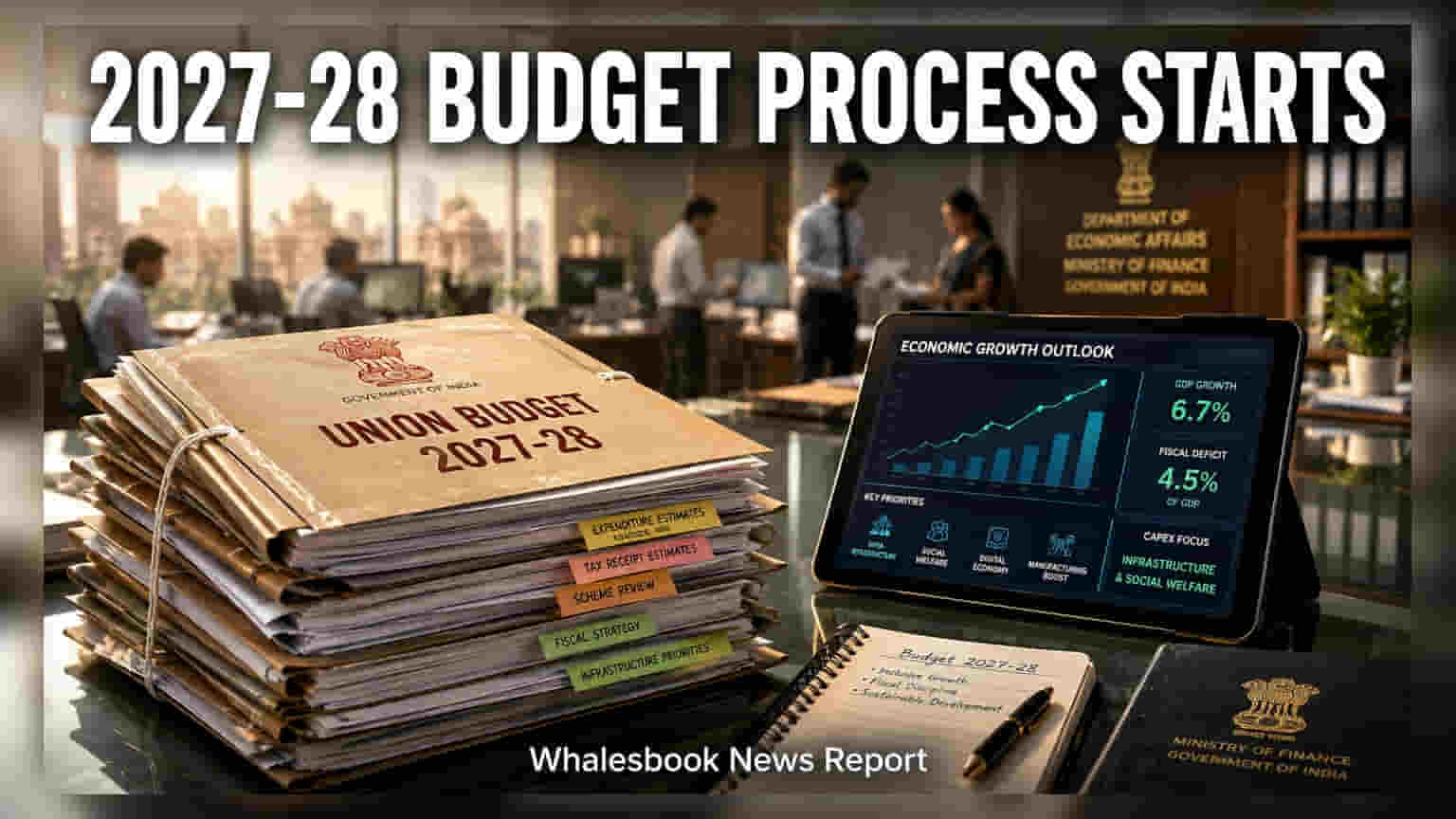
The Finance Ministry has officially kicked off the budget planning cycle for the 2027-28 fiscal year. Ministries are required to submit financial estimates by early October 2026. This process is significant for investors as it defines government spending priorities and the overall roadmap for the next fiscal year.
The Union Finance Ministry has initiated the formal budget-making process for the 2027-28 fiscal year. Through a recent circular, the Department of Economic Affairs has directed all government ministries to begin preparing their financial estimates. This administrative exercise is the first step in creating the Union Budget, which serves as a blueprint for the country’s economic policy and spending plans.
The government has set a tight schedule to ensure the process remains on track. Ministries must submit their expenditure projections for the next fiscal year and updated spending estimates for the current 2026-27 year by October 6, 2026. Following this data collection, pre-budget meetings, chaired by the Secretary of Expenditure, are set to begin on October 12, 2026. A separate deadline of October 15, 2026, has been fixed for ministries to submit their tax receipt estimates.
For investors and the economy, this cycle provides early signals about the government’s fiscal direction. The process involves a thorough review of existing government schemes. Ministries have been instructed to identify and discontinue programs that are no longer necessary or productive beyond the 2026-27 fiscal year. This rationalization of government spending is intended to ensure that resources are directed toward high-priority areas like infrastructure and social welfare, rather than maintaining outdated projects.
Alongside this budget planning, the government is also focused on meeting its revenue targets. Official data shows that the government has already achieved approximately 78% of its disinvestment target for the 2026-27 fiscal year, realizing about ₹55,757 crore out of the ₹80,000 crore goal. Successfully hitting these non-tax revenue targets is crucial for maintaining fiscal discipline, as it reduces the need for the government to borrow heavily from the market.
Investors typically watch this phase to understand potential shifts in policy focus or changes in spending patterns. A disciplined fiscal approach can influence broader economic factors such as inflation, interest rates, and the cost of government borrowing. As the budget meetings progress through October, market participants will monitor any official commentary that hints at the government’s approach to managing the fiscal deficit and its commitment to infrastructure-led growth.