

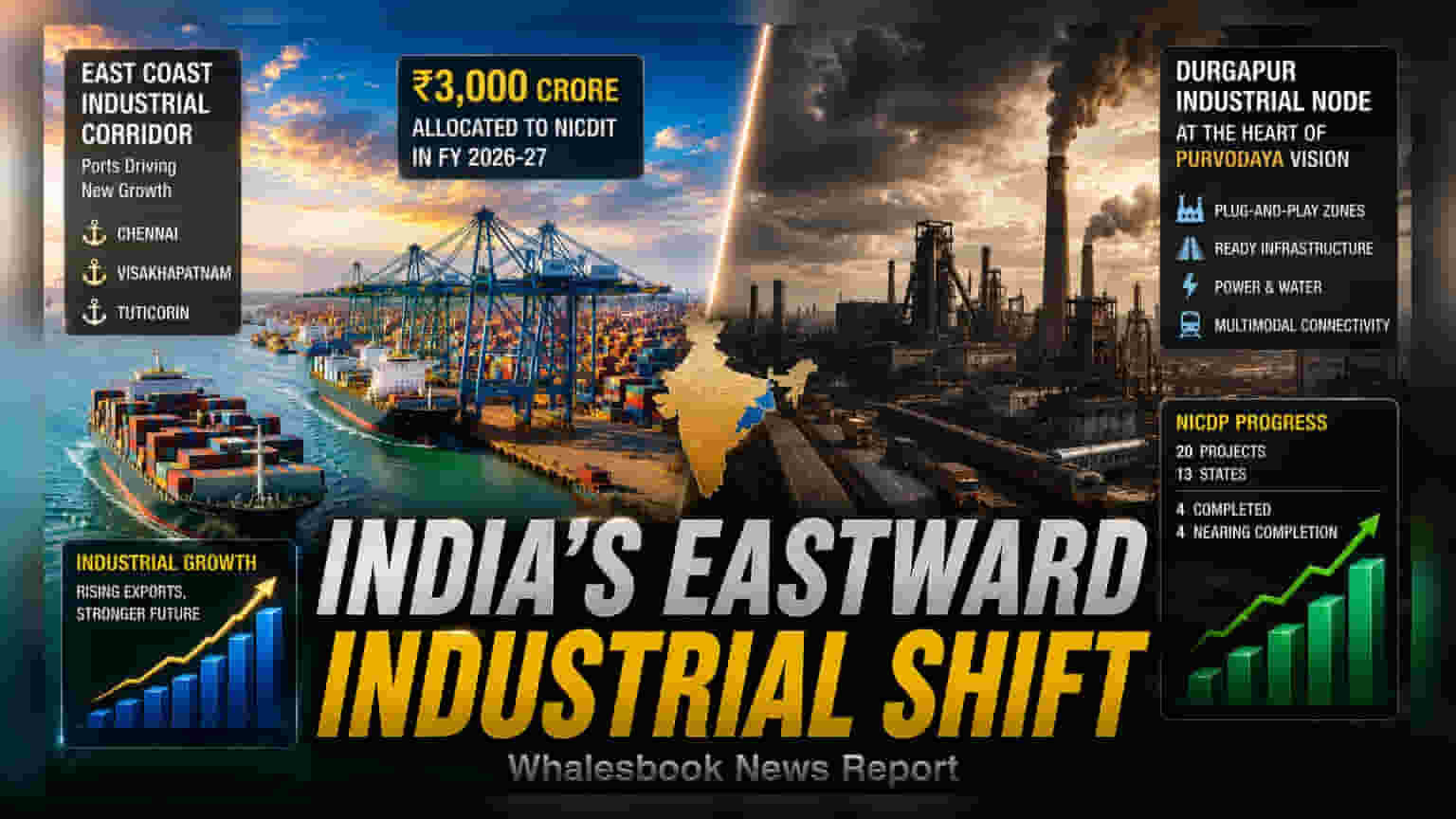
The government is expanding the National Industrial Corridor Development Programme with a new focus on the East Coast, anchored by a major node in Durgapur. With a ₹3,000 crore budget allocation, this initiative aims to rebalance industrial growth by creating 'plug-and-play' manufacturing zones. This push is designed to reduce logistics costs and attract investment to eastern states by leveraging existing port infrastructure.
India is reorienting its industrial strategy by focusing on the eastern coast, with the 2026-27 Union Budget allocating ₹3,000 crore to the National Industrial Corridor Development and Implementation Trust (NICDIT). The initiative centers on creating an integrated East Coast Industrial Corridor, featuring a primary node in Durgapur, West Bengal. This move aligns with the broader 'Purvodaya' (Eastern Rise) vision, aiming to shift industrial development from the traditional western concentration toward eastern regions.
The project is part of the National Industrial Corridor Development Programme (NICDP), which currently oversees 20 approved industrial projects spread across 13 states. While the government has previously focused on planning and initial approvals, the current phase prioritizes physical execution. This includes land allotment, the completion of essential infrastructure, and the operational launch of manufacturing units. As of August 2026, four of these corridor projects have been completed, with another four nearing finalization.
Scaling Up with 'Plug-and-Play' Zones
A central feature of this development is the 'plug-and-play' model. The government aims to prepare industrial land with pre-approved clearances, road connectivity, power, and water supply before companies begin operations. The objective is to reduce the time companies spend waiting for regulatory and infrastructure approvals, thereby lowering the initial capital spending required to start factories. By integrating industrial hubs with existing ports such as Chennai, Visakhapatnam, and Tuticorin, the policy intends to make manufacturing for export more cost-effective.
Historically, the western coast has dominated India's industrial output. For example, export volumes from major western ports significantly exceed those from eastern counterparts. The East Coast Corridor intends to bridge this scale gap by providing the necessary logistics backbone to support large-scale manufacturing and global supply chain integration.
Operational Risks and Implementation Challenges
While the funding is in place, the success of these industrial zones faces significant execution risks. The primary challenge remains the process of land acquisition, which often involves complex legal and administrative procedures. Furthermore, the development of these corridors requires tight coordination between the central government and various state-level Special Purpose Vehicles (SPVs). If the development of utilities and multimodal transport connectivity—such as rail and road links—does not match the pace of industrial demand, project timelines could face delays.
Investors should track the progress of land allotment and the actual commissioning of industrial units in the Durgapur node and other newly developed zones. The effectiveness of this policy will ultimately depend on how quickly these zones can transition from state-backed infrastructure projects into active, revenue-generating manufacturing hubs, and whether the promised 'plug-and-play' environment successfully attracts private sector investment.