

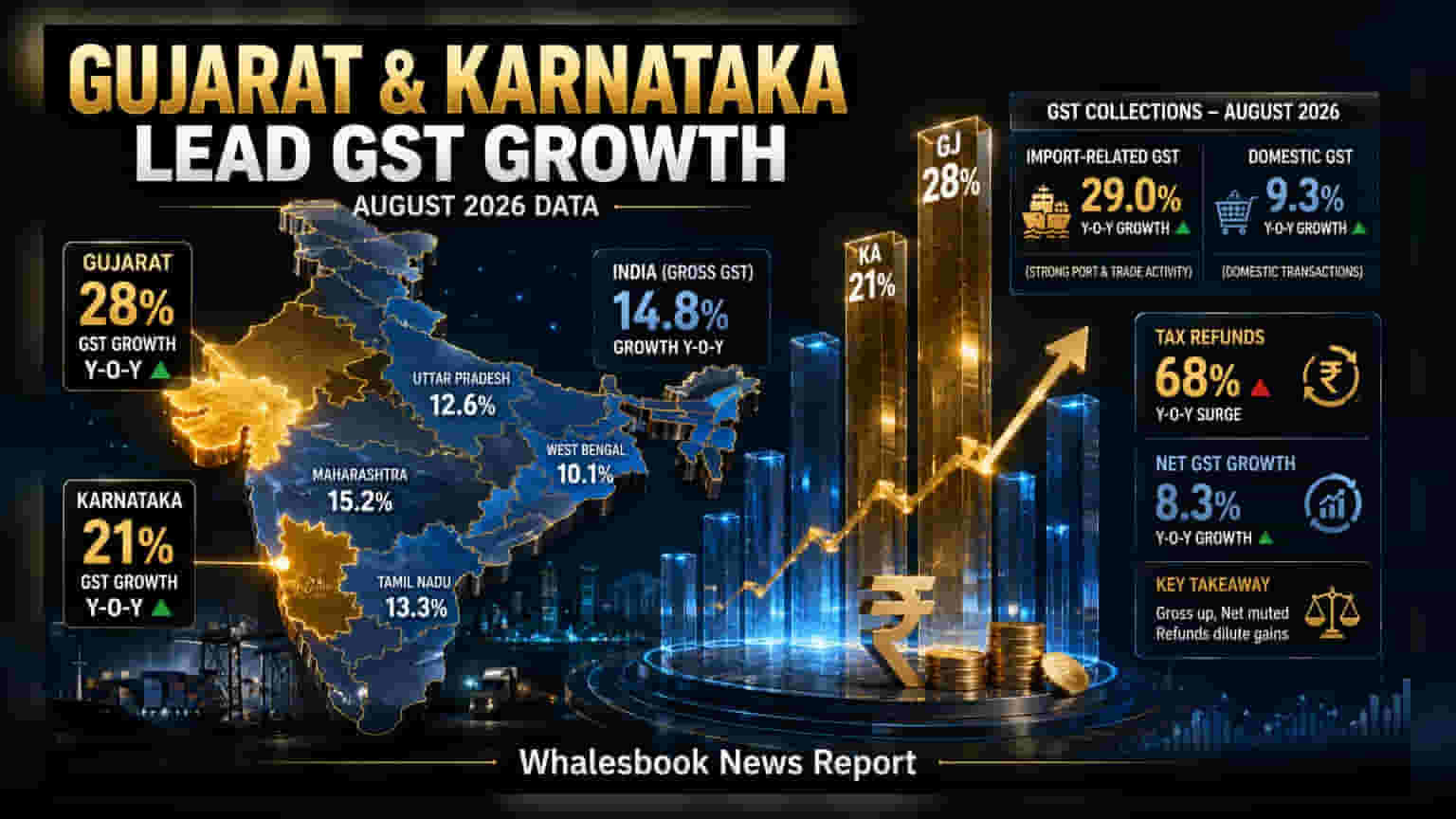
Gujarat and Karnataka have emerged as leaders in GST revenue growth, significantly outpacing the national average. While robust import-related tax collections are boosting headline figures, a sharp surge in tax refunds is limiting net revenue growth across the country. Investors are monitoring how these state-specific economic profiles influence fiscal stability as the new tax regime matures.
In the latest data for August 2026, Gujarat and Karnataka have recorded significantly higher GST revenue growth compared to other major states. Gujarat reported a 28% year-on-year increase in GST collections, significantly outperforming the national average of 14.8% for gross collections. This divergence highlights how the GST 2.0 tax regime, which simplified tax slabs into 5% and 18% tiers, is impacting states differently based on their specific economic and industrial compositions.
Import Dependence and Revenue Drivers
A critical trend in the current tax data is the heavy reliance on import-related GST for headline growth. National data shows that import-related GST collections grew by 29% in August 2026, which significantly outpaced the growth in domestic transactions, which stood at 9.3%. This suggests that for states like Gujarat, which often serve as gateways for international trade, the robust revenue numbers are heavily supported by port activity and global commodity movement rather than purely domestic consumption patterns alone.
Impact of Rising Tax Refunds
While gross GST collection figures may appear strong, the fiscal reality for many states is more complex due to a substantial increase in tax refunds. Official data indicates a 68% surge in GST tax refunds during this period, which has diluted the net revenue growth for the government. Consequently, while gross collections grew at a double-digit pace, the net GST collection growth rate was limited to 8.3%. For investors and policymakers, this gap between gross and net collections is a primary monitorable, as it directly affects the actual cash available for state-level capital spending and welfare programs.
Structural Economic Divergence
The performance gap between states also reflects their underlying economic strengths. Karnataka continues to show resilience, with analysts attributing its stable tax performance to a robust B2B IT services sector. This sector is less sensitive to the recent rate rationalization on consumer goods compared to states with a higher concentration in traditional manufacturing, such as textiles or auto components. Manufacturing-heavy states are currently more vulnerable to fluctuations in demand, especially if consumption recovery remains uneven following the September 2025 rate overhaul.
Future Risks to Track
Looking ahead, the sustainability of this tax growth faces two main challenges. First, the heavy dependence on import-related GST makes state revenues sensitive to global trade volatility, currency fluctuations, and changes in commodity prices. If global trade slows down, these high-growth states could see a sharper deceleration in revenue compared to states with a more balanced domestic consumption mix. Second, the trend in tax refunds will be critical; if the 68% surge in payouts continues, it will exert pressure on net fiscal inflows. Market participants will likely watch the monthly trend in net GST growth and the recovery in domestic consumption sectors to gauge the true health of state finances in the coming quarters.