

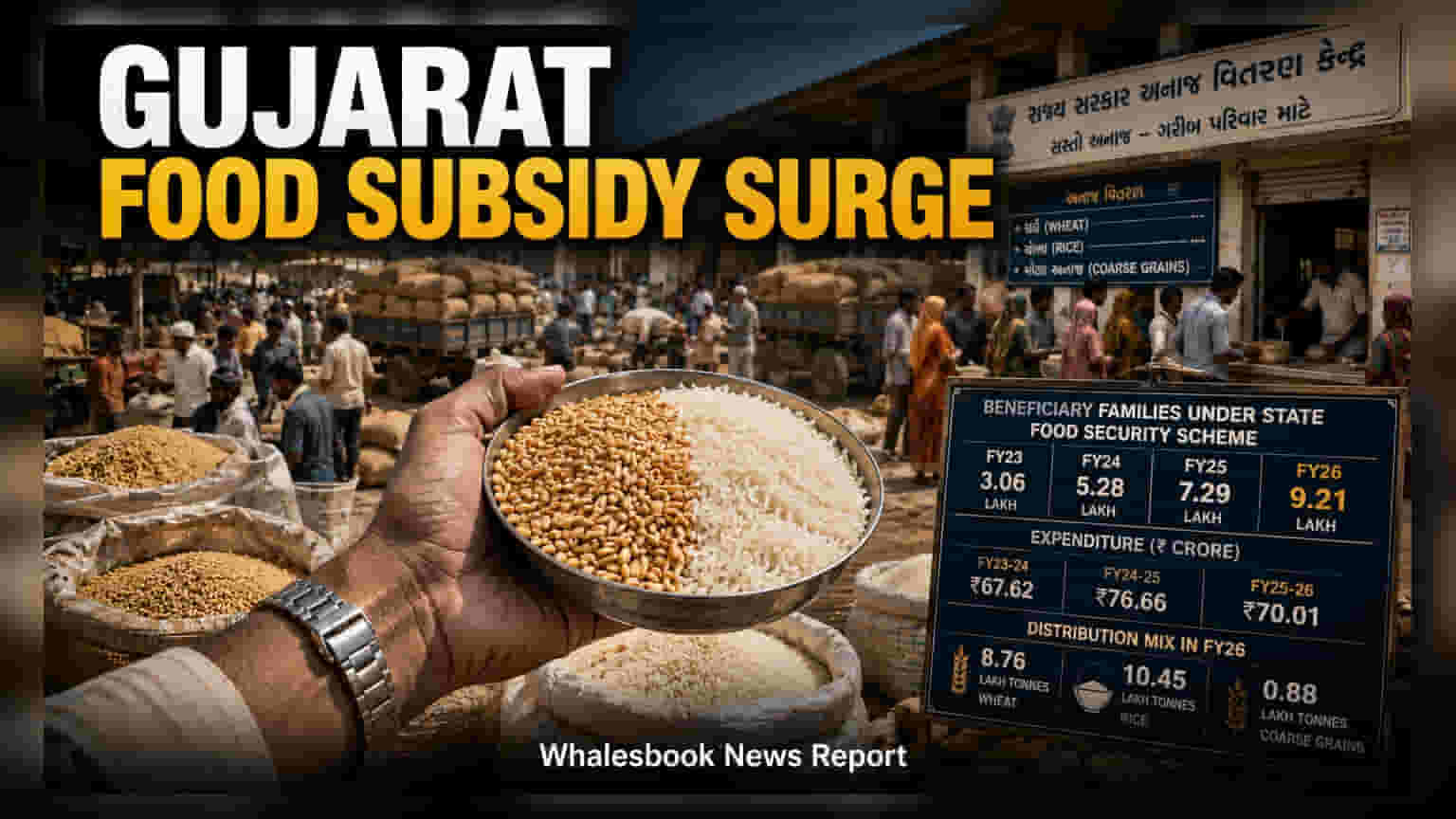
The number of families enrolled in Gujarat's food security scheme has tripled to 9.21 lakh by FY26, even as the state reports a per capita income exceeding ₹3 lakh. This trend highlights a paradox between rising regional prosperity and increased reliance on government food support, prompting discussions on the sustainability of state welfare policies.
Gujarat, a state frequently recognized for high industrial output and a per capita income now surpassing ₹3 lakh, is currently observing a counterintuitive trend in its social welfare sector. Despite the state’s status as one of India's more affluent regions, the number of families depending on the state-run food security program has increased sharply over the last three fiscal years.
Surge in Welfare Dependency
Official data from the state’s food and civil supplies department shows that the number of beneficiary families under the state's food security scheme has tripled, rising from 3.06 lakh in FY23 to 9.21 lakh by the end of FY26. This expansion now covers approximately 39.65 lakh individuals. For policymakers and economists, this rapid increase in enrolment raises questions about the nature of the state's economic growth and whether the benefits of increased wealth are reaching all income segments equally.
Fiscal Spending and Grain Patterns
While the beneficiary count has surged, the fiscal management of these subsidies has remained complex. Expenditure on wheat and rice distribution was reported at ₹67.62 crore in FY23-24, rising to ₹76.66 crore in FY24-25, before stabilizing at ₹70.01 crore in FY25-26.
Behind these expenditure numbers, there has been a notable shift in the composition of the food basket being distributed. Over the last four years, the reliance on wheat has dropped significantly. In FY26, the state distribution mix featured 8.76 lakh tonnes of wheat, 10.45 lakh tonnes of rice, and the introduction of 0.88 lakh tonnes of coarse grains. This structural change in consumption patterns—moving away from wheat toward rice and coarse grains—suggests shifting dietary habits, which the state is actively accommodating.
Economic Implications for the State
The contrast between high per capita income and rising food dependency is often described by analysts as a welfare paradox. While the rising number of beneficiaries could reflect better administrative outreach and identification of eligible families, it also serves as an economic monitorable. If the reliance on subsidized food continues to climb despite economic growth, it may indicate that employment or income security is not keeping pace with the state's broader economic metrics.
Investors and economic observers will likely watch how the state balances this rising social spending with its overall fiscal discipline. The key monitorable for the coming quarters will be the government's approach to procurement costs and whether it can sustain the current level of subsidy support without impacting the budget for capital expenditure and infrastructure development.