

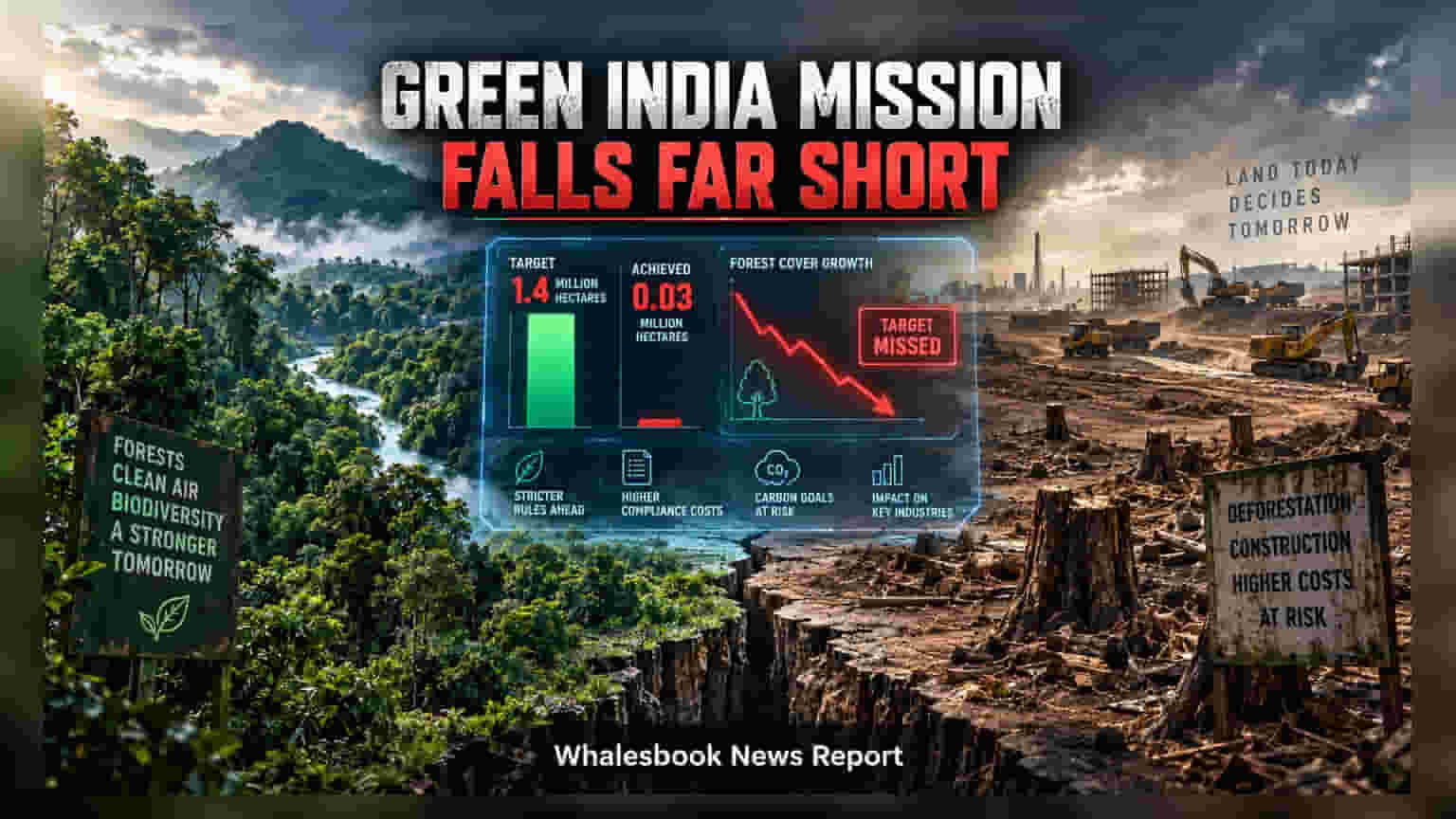
The Comptroller and Auditor General (CAG) reported that the Green India Mission achieved only 0.03 million hectares against a 1.4 million hectare target. This audit highlights risks for infrastructure, mining, and cement companies that rely on compensatory afforestation for environmental clearances. Stricter future norms may increase compliance costs for projects that previously relied on simple tree planting as a substitute for ecological restoration.
A recent performance audit by the Comptroller and Auditor General (CAG) of India has brought the Green India Mission under regulatory scrutiny. The report revealed a significant shortfall, with the mission achieving only 0.03 million hectares of forest cover growth against its original target of 1.4 million hectares. For investors, this update highlights potential changes in how environmental compliance and carbon credits are viewed in India.
Impact on Industrial Clearances
Many infrastructure, mining, and cement projects require compensatory afforestation to obtain environmental clearances. This process involves companies funding tree plantations to offset the forest land they use for industrial projects. The CAG report specifically criticizes the current practice of treating mass tree planting as a direct replacement for complex ecological restoration. The audit noted that these projects often move the site of the new plantation far away from the original site of deforestation, sometimes ignoring local soil, climate, and biodiversity needs. If regulators move toward stricter requirements that demand genuine ecological restoration instead of simple plantation, the cost of compliance for land-heavy industries could rise significantly.
ESG and Carbon Sink Risks
India has committed to creating a carbon sink of 3.5 to 4 billion tonnes of carbon dioxide equivalent by 2035. The audit warns that the current strategy, which fails to ensure the survival of native species and canopy structures, threatens this national goal. For companies, this creates a reputational and regulatory risk. Firms are increasingly required to report their environmental footprint through frameworks like the Business Responsibility and Sustainability Report (BRSR). If the government tightens definitions of what constitutes a valid carbon offset, companies may need to adjust their sustainability strategies and carbon credit accounting. Investors should monitor whether the government introduces new mandates that require higher quality, localized environmental compensation, which could pressure profit margins for companies undertaking large-scale land development.
Governance and Policy Monitoring
The report suggests that until forest governance integrates satellite-based geospatial intelligence and better climate-vulnerability mapping into project approvals, there will remain a gap between on-paper metrics and actual environmental health. The key monitorable for the coming months will be any legislative or executive response from the Ministry of Environment, Forest and Climate Change. Any update on the strengthening of the compensatory afforestation monitoring framework will be important for assessing future operational risks for the infrastructure and manufacturing sectors.