

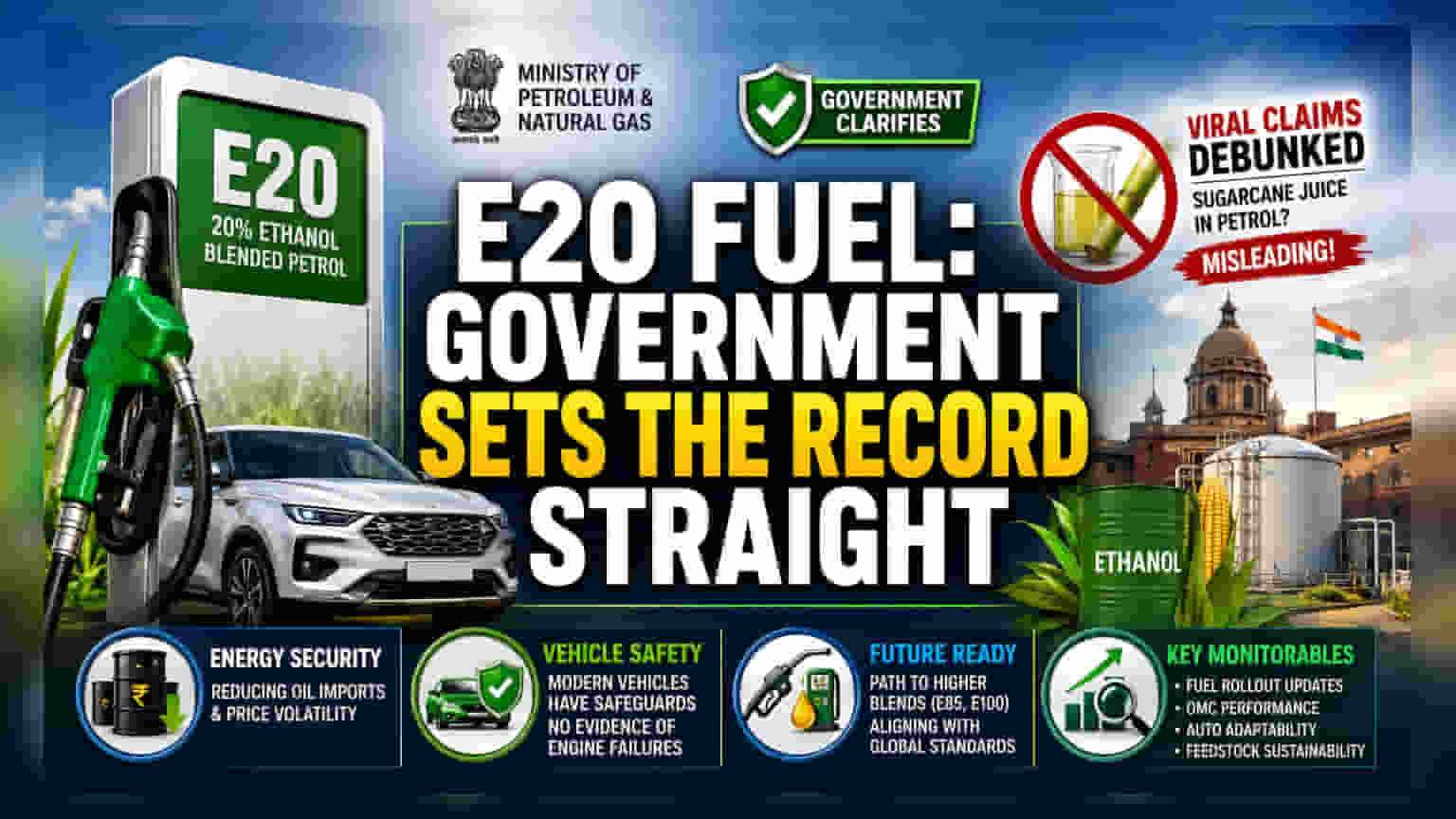
The Ministry of Petroleum and Natural Gas has formally dismissed social media claims regarding engine failures caused by 20% ethanol-blended petrol (E20). The government reaffirmed that E20 is scientifically validated and continuously monitored, emphasizing its role in energy security. Investors should track the phased rollout of higher ethanol blends (E22-E100) and its impact on the automotive and oil marketing sectors.
What Happened
The Ministry of Petroleum and Natural Gas has issued a clarification refuting widespread social media claims that suggest E20 (20% ethanol-blended petrol) causes engine failures or breakdowns. The government labeled viral videos—including those falsely depicting sugarcane juice being mixed directly into petrol—as misleading and unsubstantiated.
Officials reiterated that the Ethanol Blending Programme (EBP) is a scientifically validated initiative launched in 2003 to reduce crude oil import dependency and enhance national energy security. The ministry confirmed that since the implementation of E20 fuel, no widespread instances of engine failure directly linked to ethanol blending have been reported. The government also clarified that modern vehicles are equipped with safeguards designed to prevent issues like water ingress, which had been a point of concern in online discussions.
Why This Matters For Investors
The government's clarification is crucial for maintaining consumer confidence, which directly impacts the automotive and energy sectors. For Oil Marketing Companies (OMCs) like Indian Oil, Bharat Petroleum, and Hindustan Petroleum, the EBP is a central strategy for reducing the national oil import bill and managing crude price volatility.
For auto manufacturers, the transition to higher ethanol blends represents both an opportunity and a technical challenge. While E20 is now the standard, the government’s recent regulatory framework for higher blends (such as E85 and E100) signals a move toward flex-fuel vehicles. Investors may monitor whether this transition impacts vehicle demand, as consumers weigh the costs of fuel efficiency changes and potential long-term maintenance requirements for older versus newer vehicle models.
The Shift Toward Higher Ethanol Blends
While the current focus is on E20, the government is preparing the fuel ecosystem for higher blends. Recent policy updates have exempted blends like E22, E25, and E30 from certain excise duties, and amendments have been proposed to recognize E85 and E100 fuels under the Central Motor Vehicles Rules. This policy push reflects India's goal to align its fuel strategy with global standards seen in markets like Brazil and the United States.
However, this rapid transition presents challenges. Automakers face the need to recalibrate engines and secure new certifications, while OMCs must manage the logistics of supplying multiple fuel blends. Analysts often view this shift as a 'double-edged sword'—offering long-term energy savings while requiring careful management of vehicle compatibility and fuel efficiency, which can drop slightly with higher ethanol content.
What Investors Should Track Next
Investors should focus on the following monitorables to understand the long-term impact of the ethanol policy:
- Fuel Rollout Updates: Watch for the commercial availability and testing results of higher blends (E22-E100) at fuel stations.
- OMC Performance: Track how ethanol procurement and blending ratios influence the operating margins and under-recoveries of public sector oil companies.
- Automotive Adaptability: Monitor management commentary from auto companies regarding the pace of flex-fuel vehicle adoption and the associated research and development spending.
- Feedstock Sustainability: Keep an eye on policy updates regarding ethanol sources, as the government balances production between sugarcane, maize, and rice to manage food inflation and water usage.