

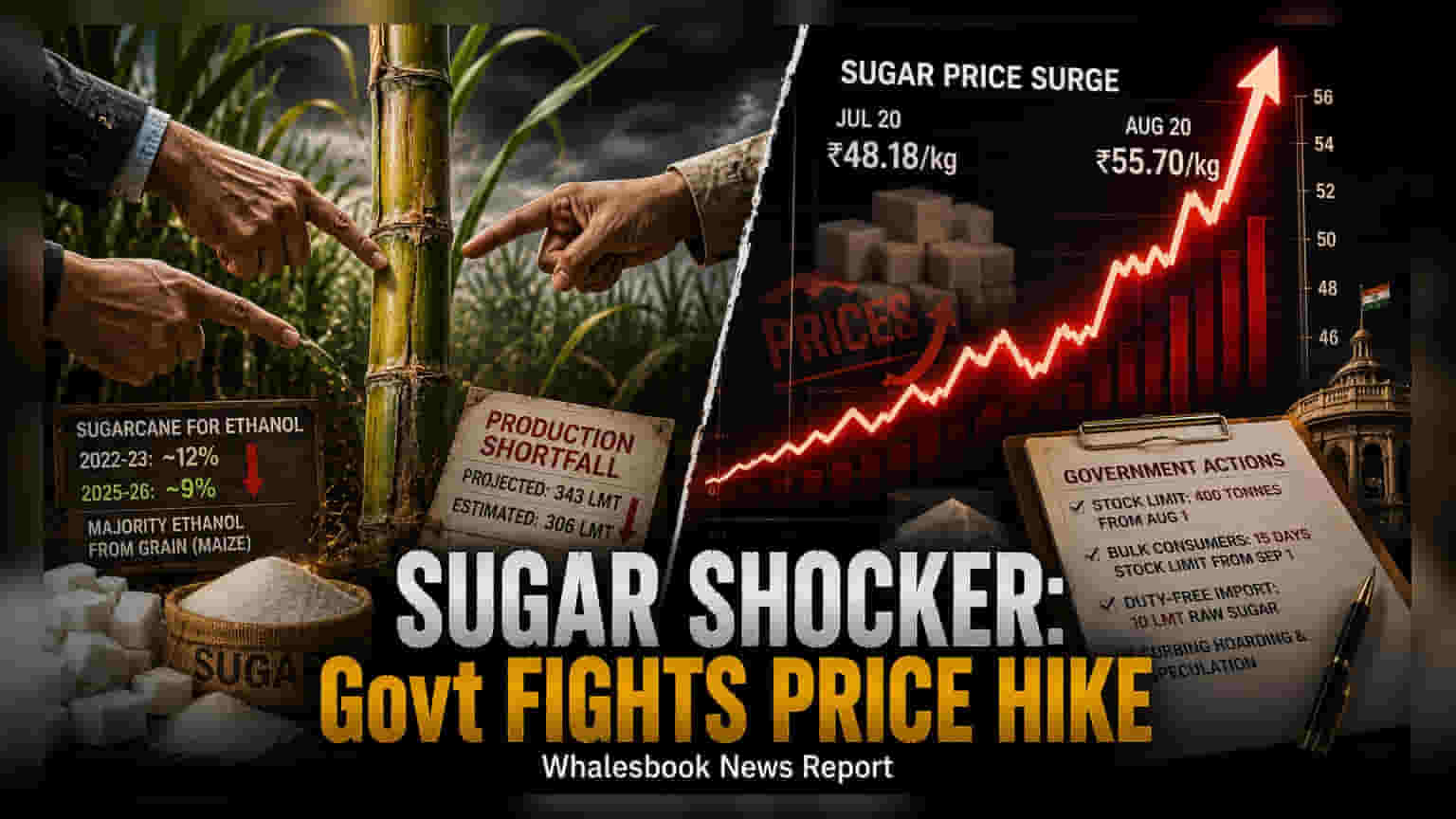
The government has rejected claims that ethanol production is driving up sugar prices, citing instead a drop in domestic output due to crop disease and weather. With retail prices climbing to ₹55.70 per kg, officials have implemented dealer stock limits and approved 10 LMT of duty-free raw sugar imports to stabilize supply. These regulatory measures may create margin pressure for sugar manufacturers by capping potential price growth.
The Ministry of Consumer Affairs, Food and Public Distribution has formally dismissed allegations that the diversion of sugarcane for ethanol production is the primary cause of the recent rise in domestic sugar prices. In a clarification issued on Friday, the government emphasized that the allocation of sugarcane for ethanol has actually decreased, dropping from approximately 12% in the 2022-23 season to roughly 9% in 2025-26. Instead, the administration stated that the majority of the nation's ethanol requirement is now being met through grain-based production, particularly from maize.
Domestic sugar prices have seen a sharp climb over the past month, rising from ₹48.18 per kg on July 20 to ₹55.70 per kg by August 20. The ministry attributed this escalation to a combination of factors, primarily a shortfall in domestic production. While states had initially projected a production level of 343 lakh metric tonnes (LMT), the actual output for the season is estimated at 306 LMT. This gap has been exacerbated by weather-related issues, including excessive waterlogging, and the spread of crop diseases such as Red Rot and Top Borer, which have negatively impacted sugarcane yields.
To address the supply-demand imbalance and curb speculative hoarding, the government has introduced several regulatory measures. Effective August 1, a stock limit of 400 tonnes has been imposed on sugar dealers, while bulk consumers—those using more than 10 tonnes per month—will be restricted to holding no more than 15 days of inventory starting September 1. Furthermore, the government has permitted the duty-free import of 10 LMT of raw sugar to bolster availability. These interventions are designed to keep retail prices in check, particularly with the festive season approaching.
For investors, these policy actions introduce a period of regulatory uncertainty for sugar manufacturers. While the government's stance protects against immediate further price spikes, it also limits the ability of sugar mills to benefit from higher market prices. The combination of lower domestic production and official price caps can squeeze EBITDA margins, as companies face increased operational costs without the relief of higher sales realizations. Following these announcements, sugar stocks have faced downward pressure on the bourses, reflecting market concerns over potentially constrained profit growth for the upcoming quarters.
The next major trigger for the sector will be the start of the new crushing season. The government has advised sugar mills to commence operations by October 15, 2026, to boost inventory levels before the peak festive demand. Investors will likely monitor the actual production figures from these early crushing operations and the impact of the raw sugar imports on domestic price trends, as these will determine whether the current supply tightness persists or begins to ease in the final quarter of the year.