 Whalesbook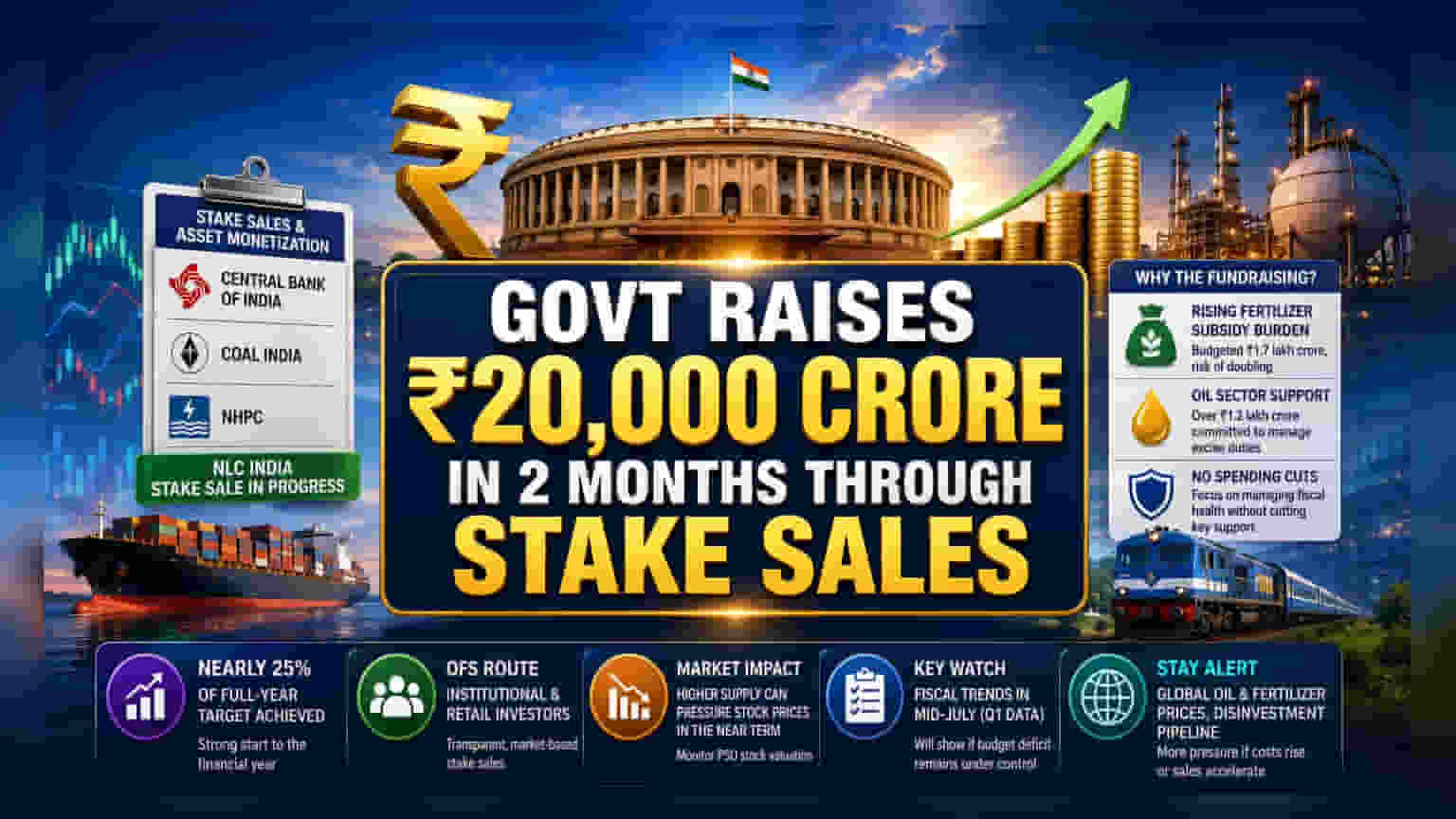


The government has raised ₹20,000 crore through stake sales in state-owned firms within two months, meeting 25% of its annual target. This move helps cover rising costs for fertilizer and oil subsidies caused by global market volatility. Investors should track how this effort balances the fiscal gap and how frequent share sales impact the stock prices of public sector companies.
What Happened
The Indian government has successfully raised approximately ₹20,000 crore in the first two months of the current financial year through stake sales and asset monetization. This proactive fundraising, managed by the Department of Investment and Public Asset Management (DIPAM), represents nearly 25% of the government's full-year target. Funds were generated through Offer-for-Sale (OFS) routes, where the government sells a portion of its holdings in listed public sector entities to institutional and retail investors. Recent activity has involved companies such as Central Bank of India, Coal India, and NHPC, with an ongoing stake sale in NLC India currently in progress.
Why This Matters For Investors
The primary driver behind this rapid fundraising is the need to offset mounting subsidy burdens. The government is managing significantly higher costs for essential items like fertilizers and petroleum products, largely due to ongoing geopolitical tensions that have pushed global commodity prices higher. For the market, this fundraising highlights the government's strategy to balance its budget gap without immediately resorting to major spending cuts. While this provides liquidity to the exchequer, investors in public sector stocks often watch these developments closely because government stake sales increase the supply of shares in the market, which can exert temporary pressure on stock prices.
The Subsidy Pressure Point
Rising input costs have put the national budget under strain. Fertilizer subsidies, initially budgeted at ₹1.7 lakh crore, are facing the risk of doubling due to supply chain issues and expensive imports. Similarly, the government has already committed over ₹1.2 lakh crore to the oil sector to manage excise duties and keep fuel prices stable despite volatile global crude oil rates. This creates a challenging fiscal environment where the government must maintain its support for essential sectors while attempting to meet its long-term financial goals. Officials have indicated that there are no plans to cut spending at this stage, but the true health of the budget will likely be assessed after the first-quarter financial results are analyzed in mid-July.
How Investors May Read This
When the government uses the OFS route to sell stakes in companies like Coal India or NHPC, it essentially increases the available supply of those shares. Historically, this can cause a short-term dip in the stock price as the market absorbs the new supply. Advanced investors often look at these moves to understand the government’s timeline for stake sales and how they might affect the valuation of public sector undertakings (PSUs). If the government continues to sell stakes to fund rising subsidies, it could keep a lid on the price appreciation of some of these stocks in the near term, even if the underlying business performance of the company remains solid.
What Investors Should Track
The most important monitorable for the coming months is the government's fiscal position. By mid-July, the release of first-quarter financial trends will provide a clearer picture of whether the budget deficit remains under control. Investors should also monitor global commodity prices, particularly for oil and fertilizers, as any further rise could force the government to look for even more ways to raise money. Finally, keep an eye on the schedule for further disinvestment and asset monetization plans, as the frequency and size of these share sales will determine the supply pressure on PSU stocks.