

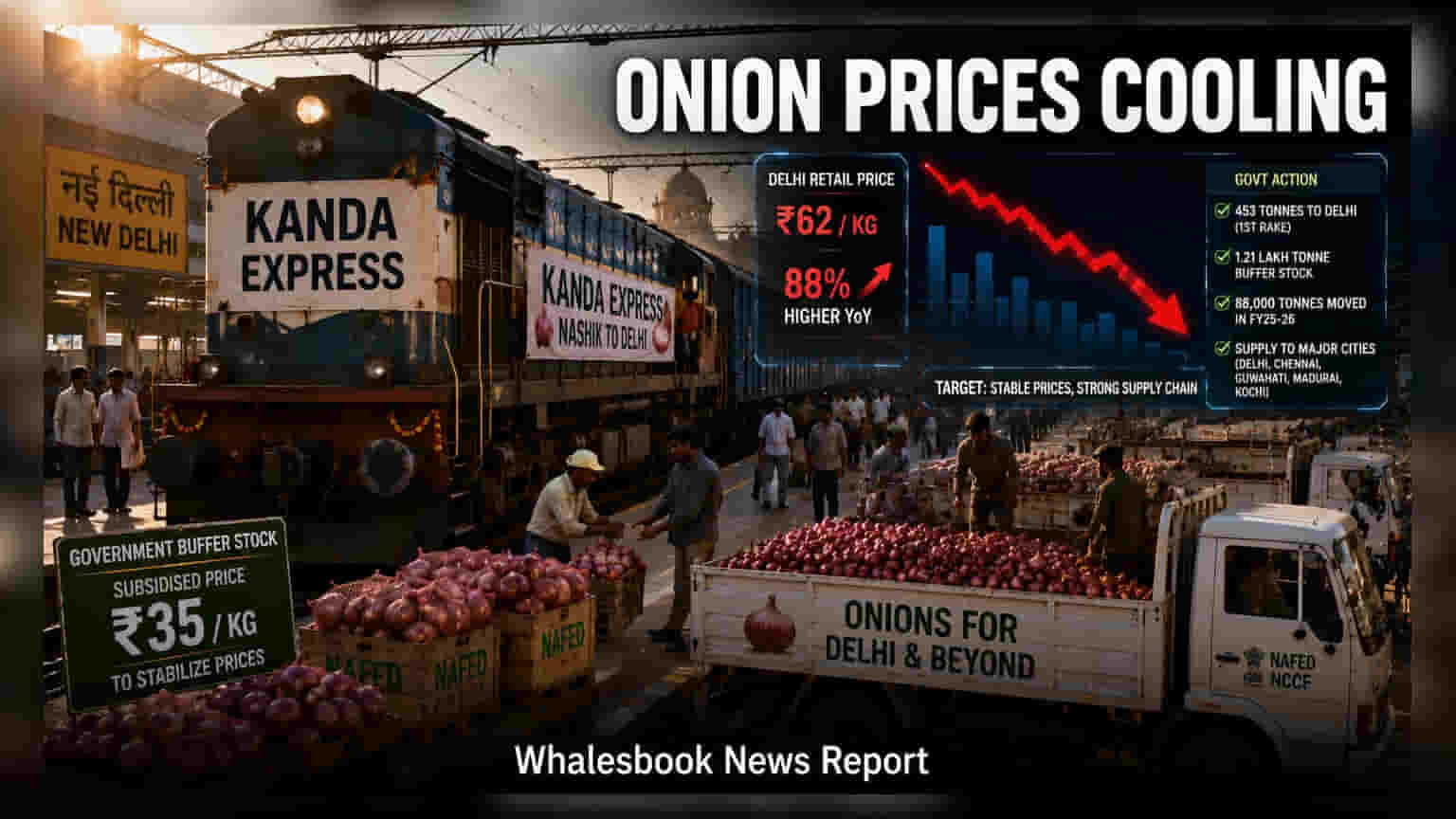
To combat an 88% year-on-year surge in onion prices, the Indian government has deployed the 'Kanda Express' rail rakes to transport 453 tonnes of buffer stock to Delhi. This intervention aims to cool retail markets by offering produce at a subsidized rate of ₹35 per kg. Investors should track the effectiveness of these logistics-heavy measures, as seasonal price volatility and supply chain challenges remain key monitorables for inflation impact.
The central government has launched a specialized logistical operation, dubbed 'Kanda Express', to transport large quantities of onions from Nashik to key consumption centers, starting with an initial 453-tonne shipment to Delhi. This move comes in response to a sharp rise in retail prices, which recently touched ₹62 per kg in the capital—a significant 88% increase compared to the previous year. To stabilize the market, government agencies including the National Agricultural Cooperative Marketing Federation of India (NAFED) and the National Cooperative Consumers' Federation of India (NCCF) are retailing these buffer stocks at a fixed, subsidized price of ₹35 per kg.
Scaling the Logistics Intervention
This rail-based supply chain initiative is an extension of the government's efforts to utilize its 1.21 lakh tonne onion buffer stock, funded by the Price Stabilisation Fund. The program has scaled rapidly; after moving 12,000 tonnes via 14 rakes in the 2024-25 fiscal year, the current 2025-26 cycle has already facilitated the transit of 88,000 tonnes. Beyond Delhi, additional rakes are being routed to major cities like Chennai, Guwahati, Madurai, and Kochi. The objective is to force a correction in wholesale and retail prices by injecting supply directly into urban markets where volatility is most pronounced.
Operational Challenges and Risks
While the government maintains that national domestic supply remains steady with projected 2025-26 production levels of over 307 lakh tonnes, the Kanda Express initiative faces notable operational hurdles. Reports indicate that earlier consignments have encountered logistical bottlenecks, including train delays and concerns regarding the quality of the onions during long-distance transit. For the broader economy, these issues highlight the difficulty of managing perishable goods on a large scale. If the produce suffers from spoilage or quality issues, it could reduce consumer demand, limiting the overall impact of the price control measures. Furthermore, while these interventions aim to protect consumers, they impose a recurring fiscal cost on the government through procurement price hikes and ongoing logistical expenses.
What Investors Should Monitor
For those watching the broader economic landscape, the primary monitorable is the speed and efficacy of these price corrections. If the influx of subsidized onions successfully curbs retail inflation in major urban centers within the coming week, it may provide temporary relief for headline inflation data. However, market participants should remain cautious about the dependency on these short-term fixes. The persistence of weather-related supply shocks and the potential for cartelization in local wholesale markets mean that the government may need to sustain high spending from the Price Stabilisation Fund to keep prices in check. The success of this initiative will ultimately depend on the seamless coordination between rail logistics and local distribution networks, ensuring that quality produce reaches the consumer before seasonal demand spikes exacerbate supply constraints.