

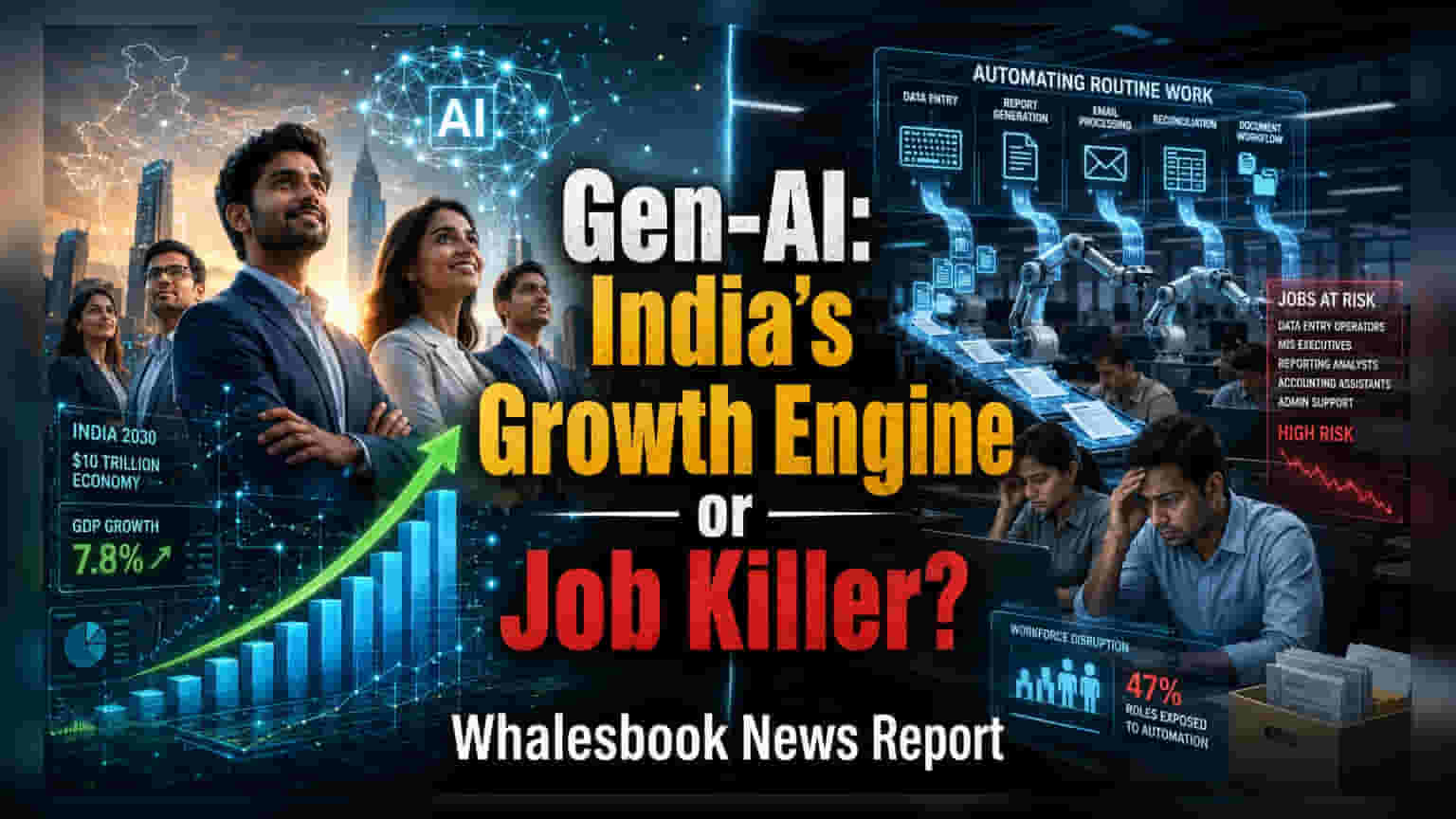
Goldman Sachs projects generative AI could boost India's annual labor productivity by 0.4 percentage points over the next decade. While the technology promises significant gains in services like finance and healthcare, routine clerical and BPS roles face automation risks. Success depends on massive infrastructure upgrades, including data centers and power networks.
Generative Artificial Intelligence is expected to act as a significant driver for India's economic growth, according to a recent report by Goldman Sachs Research. Analysts estimate that the technology could automate 9% to 17% of non-agricultural tasks in India, depending on how quickly the technology evolves. However, the report suggests that for most workers, AI will serve as a productivity tool rather than a replacement for their roles.
Productivity Boost vs Automation Risk
The research indicates that 42% to 48% of the non-agricultural workforce may see improved efficiency through AI assistance. In contrast, 8% to 12% of jobs face a higher risk of being replaced. Roles centered on repetitive, routine, and clerical tasks are the most vulnerable to automation. Meanwhile, sectors requiring physical labor or complex interpersonal skills—such as manual machine operation and construction—are expected to face less disruption, as AI remains limited in these areas.
Impact on Key Service Sectors
The services industry is positioned to experience the most notable transformation. Goldman Sachs highlights that fields like healthcare, education, and financial services could benefit significantly from advanced analytics and diagnostic tools. Conversely, sectors such as Business Process Services (BPS), telecom, and postal services are identified as having a higher substitution risk due to their reliance on standardized workflows. Investors tracking the Indian IT and services sector may note that companies with a higher share of knowledge-based, high-value work may be better insulated than those focused on high-volume, repetitive data entry.
Infrastructure and Export Hurdles
For these growth projections to materialize, India must overcome significant infrastructure barriers. The country currently possesses approximately 1 gigawatt (GW) of data center capacity, accounting for only about 1% of the global total. Scaling AI adoption requires massive capital spending on computing power, reliable electricity, and high-speed digital networks. Without these foundational investments, the pace of AI integration could remain slow.
Additionally, investors should monitor geopolitical risks regarding services exports. Rising protectionism in major markets like the United States and Europe could lead to restrictions on cross-border data flows. Such policies could potentially hinder Indian service providers that rely on global model integration, creating a headwind for the export-oriented segments of the economy. The long-term economic impact will depend on the government and private sector’s ability to build out the necessary infrastructure while navigating these evolving trade and regulatory environments.