

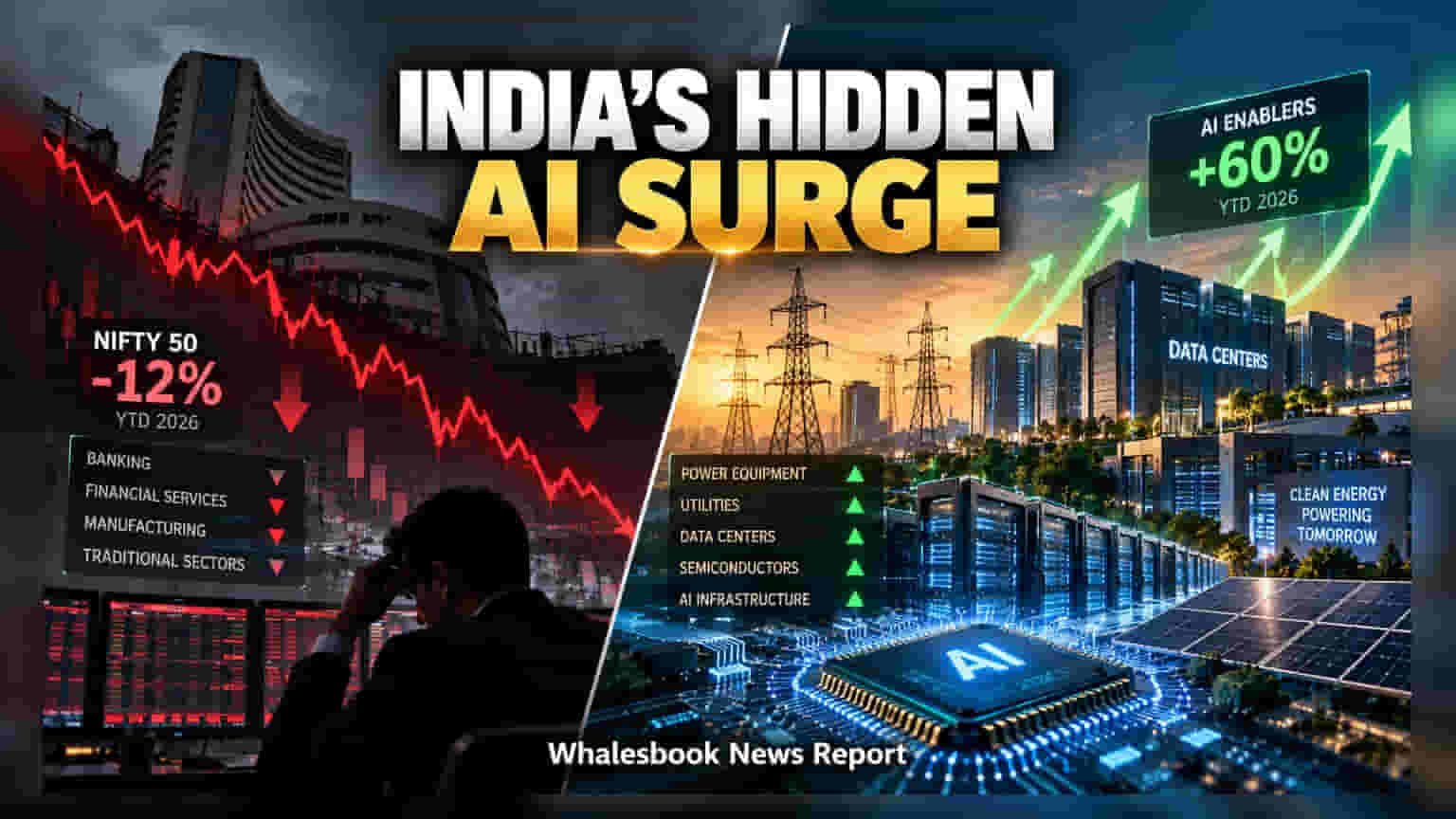
While the Nifty index declined 12% in 2026, a select group of 42 Indian companies identified by Goldman Sachs as AI Enablers surged 60%. These firms, focused on power and data infrastructure, highlight that the real AI play in India is tied to physical utilities rather than traditional software.
The performance of the Indian equity market in 2026 has shown a notable divide between benchmark indices and the emerging artificial intelligence sector. While global markets have seen tech-driven rallies, the Nifty index has struggled, posting a 12% decline during the year. This disconnect stems from the structural composition of Indian indices, which remain heavily weighted toward banking, financial services, and traditional manufacturing, with limited exposure to modern technology firms.
The AI Infrastructure Pivot
Data from the MSCI India index indicates that AI-exposed equities currently represent only 16% of the total index weight. This is significantly lower than the tech-heavy concentrations seen in regional peers like Taiwan, Korea, and Japan, which have benefited more directly from the global software and hardware surge. To identify where the growth is actually happening, Goldman Sachs analysts narrowed their focus to 42 specific companies categorized as AI Enablers. This group has defied the broader market slump, recording a 60% gain in 2026.
Unlike the global AI rally, which has been driven by software and cloud service providers, the Indian AI story is centered on the foundational architecture required to run these systems. The list of enablers focuses heavily on power equipment, utilities, and the hardware necessary for building data centers. This trend suggests that investors are treating energy security and data infrastructure as the primary proxies for the AI boom in India.
Challenges for Investors
For investors, the rapid rise of these utility and hardware firms creates a complex situation. While the demand for data centers is growing as computing requirements increase, electricity generation and grid stability remain significant bottlenecks. Companies that can bridge this gap between power supply and data demand are finding strong business opportunities, but the 60% surge in these stocks in a single year raises questions about valuation.
Stocks that have outperformed the broader market by such a wide margin often trade at significantly higher valuations than their historical averages. Investors may want to track whether the actual growth in data center capacity and power utilization matches the high expectations priced into these stocks. The primary risk is that if execution on large infrastructure projects faces delays or if the power demand does not materialize as quickly as anticipated, these high-flying stocks could see a sharp correction. Monitoring the order books of these utility companies and the progress of data center construction will be essential to understanding whether this growth is sustainable.