

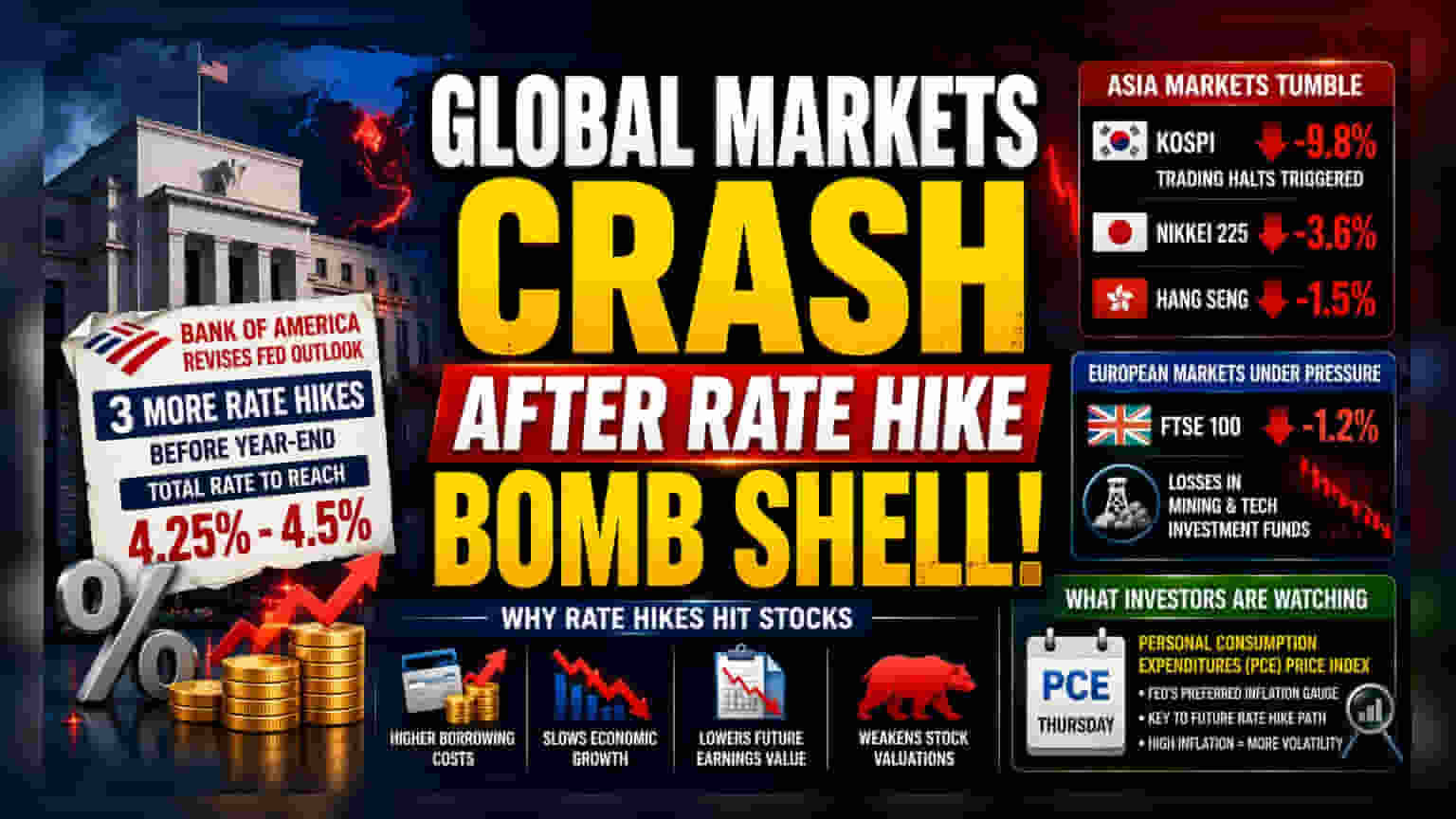
Stock markets worldwide are falling as Bank of America predicts three more interest rate hikes by the US Federal Reserve this year. The forecast has triggered investor anxiety over tighter liquidity, leading to significant declines in Asian and European indices. Investors are now awaiting crucial inflation data on Thursday to gauge the future path of monetary policy.
What Happened
Global markets are facing a sharp downturn today following a revised forecast from Bank of America regarding the US Federal Reserve. The bank now expects the Federal Reserve to implement three additional quarter-point interest rate hikes before the end of the year. If these increases occur, the benchmark interest rate in the US would climb to a range of 4.25% to 4.5%. This shift in expectations regarding monetary policy has caused concern among investors and led to a wave of selling across major global indices.
Why Interest Rate Hikes Impact Stocks
When central banks raise interest rates, the cost of borrowing money for businesses and consumers increases. For the stock market, this environment is typically challenging. Higher rates can slow down economic activity and reduce the present value of future corporate earnings. This adjustment is often more painful for growth-oriented sectors, such as technology, which rely on easy access to capital to fund expansion. As borrowing costs rise, investors often reassess the valuations of these companies, leading to lower stock prices.
The Impact on Asian and European Markets
The reaction has been particularly intense in Asian markets. South Korea’s KOSPI index suffered a decline of nearly 10%, which triggered multiple automatic trading halts meant to curb panic selling. Other major indices also faced pressure, with Japan’s Nikkei 225 losing over 3.5% and the Hang Seng in Hong Kong dropping by 1.5%.
In Europe, the FTSE 100 saw a decline, driven by losses in sectors like mining and technology investment funds. The broad-based sell-off reflects growing uncertainty about how higher US interest rates will affect international capital flows and the strength of local currencies against the US dollar.
What Investors Are Watching
Market focus is now shifting toward the release of the Personal Consumption Expenditures (PCE) price index, scheduled for this coming Thursday. This report is the US Federal Reserve's preferred measure of inflation. Investors will closely analyze this data to see if price pressures are cooling or if they remain high. If the PCE data shows that inflation is not declining as hoped, it could reinforce the expectation that the Federal Reserve will continue to raise rates to bring inflation under control, potentially leading to further volatility in the coming weeks.