

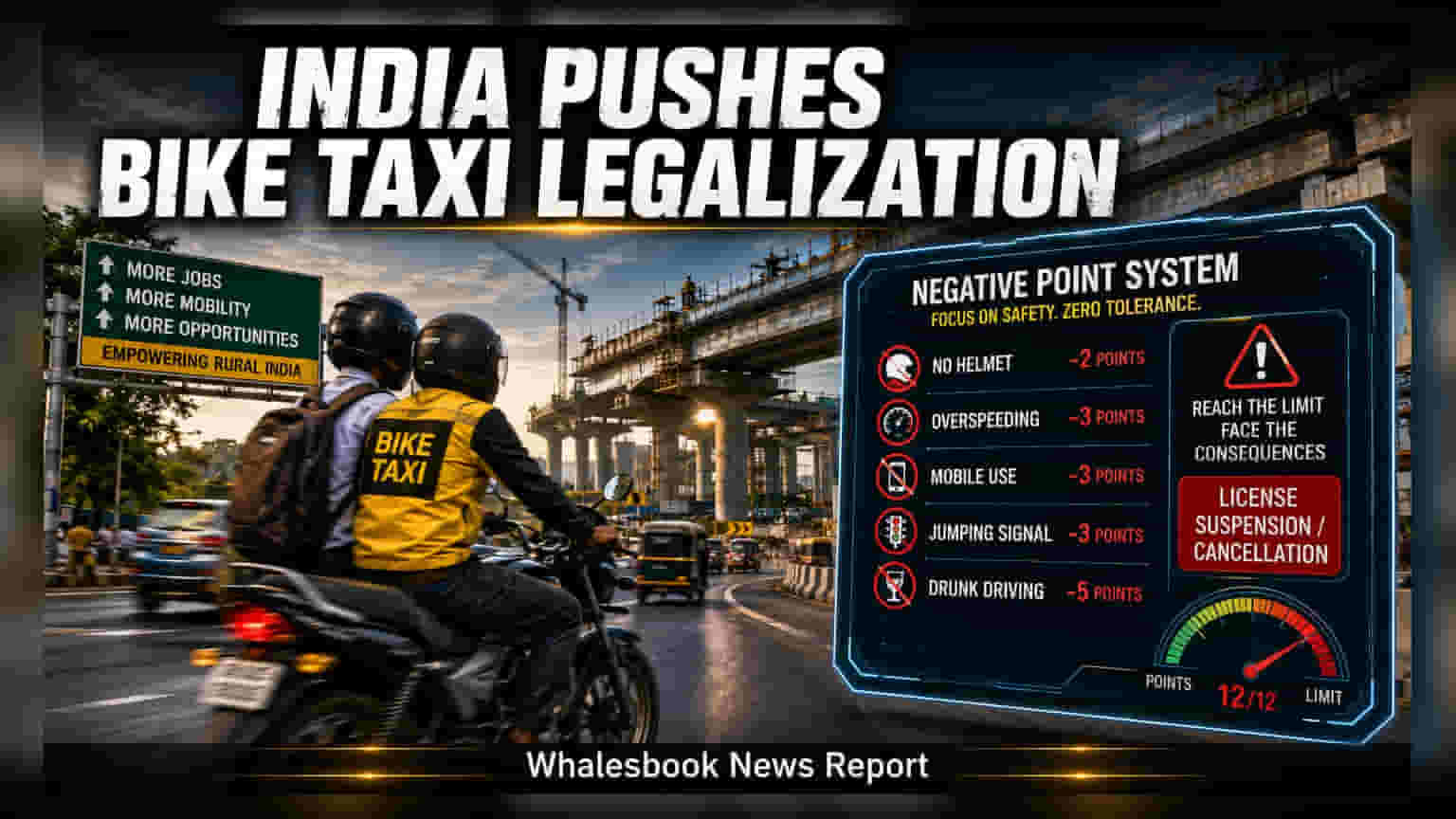
Union Minister Nitin Gadkari is calling on state governments to legalize bike taxis, aiming to create rural livelihood opportunities using the 2025 Aggregator Guidelines. Separately, the Ministry plans a new negative point system under the Motor Vehicles Act to discipline repeat traffic offenders, which could impact the gig driver workforce.
Union Road Transport Minister Nitin Gadkari has stepped up efforts to expand the gig economy by urging state governments to formally legalize bike taxi services. The minister emphasized that enabling private two-wheeler owners to operate as bike taxis could create immediate and accessible livelihood opportunities for millions of people across rural India.
Despite the central government’s active push, progress remains inconsistent across the country. Because transport is legally defined as a state subject in India, individual state governments retain the final authority to permit or restrict these services within their borders. While the central Motor Vehicle Aggregator Guidelines of 2025 provide a framework for implementation, actual adoption remains patchy. This creates an environment of regulatory uncertainty for ride-hailing aggregators and drivers, who face different rules depending on the state where they operate.
Alongside this expansion effort, the Ministry of Road Transport and Highways is moving to implement stricter road safety measures. The government plans to amend the Motor Vehicles Act to introduce a negative point system for traffic offenders. Under this proposed framework, drivers will accumulate penalty points for each violation. Once a driver reaches a specific threshold, they could face severe consequences, including the suspension or outright cancellation of their driving license. The government intends for this system to shift enforcement from reactive to proactive, aiming to curb habitual traffic offenses.
The ministry also recently launched the 'Suraksha' pilot program, initially deployed in parts of Maharashtra including the Chandrapur mining belt and stretches of NH-44. This initiative provides free medical diagnostics and counseling to a target group of 10,000 individuals, covering commercial drivers, construction workers, and mining personnel. The ministry maintains that improving the physical wellbeing and vision of drivers is a prerequisite for broader road safety improvements in high-stress work environments.
For investors and market participants, the key monitorable will be how individual state governments respond to this renewed push for bike taxi legalization. Continued regulatory fragmentation remains a primary operational risk for the gig economy, as divergent policies make it difficult for platforms to scale operations uniformly. Additionally, the upcoming negative point system will be important to track, as stricter enforcement against traffic violations could influence the availability of the gig workforce and operational costs for logistics and transport aggregators in the future.