

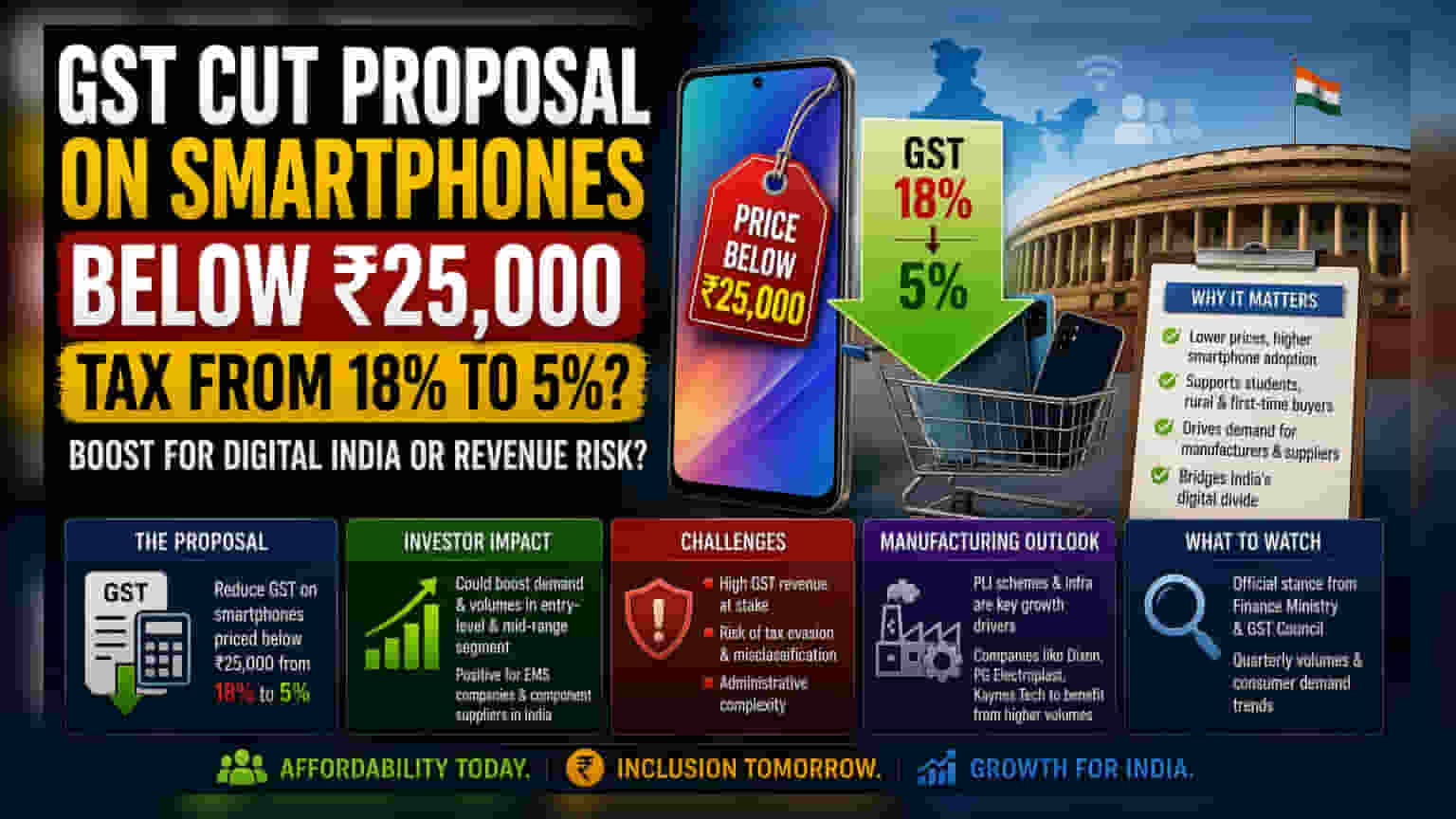
A whitepaper by Grant Thornton Bharat and Policy Watch India Foundation suggests lowering the GST on smartphones under ₹25,000 to 5% from the current 18%. While intended to boost digital inclusion, the proposal is only a recommendation and not government policy. Investors should consider the potential impact on electronics manufacturing demand and the fiscal challenges facing the government.
What Happened
A whitepaper released by Grant Thornton Bharat and the Policy Watch India Foundation (PWIF) has proposed a reduction in the Goods and Services Tax (GST) for smartphones priced below ₹25,000. The report recommends lowering the tax rate from the current 18% to 5%. This suggestion is framed as a move to support India’s digital inclusion, citing that the current uniform tax rate on all smartphones acts as an affordability barrier for students, rural consumers, and first-time buyers. The report notes that this specific price segment accounts for a significant majority of handset shipments in India.
Why Investors Should Care
For investors, the relevance of this report lies in the potential impact on consumer electronics demand. If such a tax reduction were implemented, it could theoretically lower the retail price of entry-level and mid-range devices. Increased affordability often leads to higher sales volume, which would benefit the broader electronics ecosystem. This includes listed electronics manufacturing services (EMS) companies and component suppliers that operate in India, as they would likely see an uptick in demand for contract manufacturing. However, it is crucial to understand that this is currently only a recommendation from research entities and does not represent an official change in government tax policy.
The Policy And Fiscal Reality
While the proposal aims to bridge the digital divide, it faces significant practical hurdles. The government relies heavily on GST as a primary source of revenue, and cutting tax rates on a high-volume product category like smartphones could lead to a substantial loss in tax collections. Furthermore, a two-tier tax system—with 5% for budget phones and 18% for premium models—would create administrative challenges. Regulators often worry about the risk of tax evasion, where expensive devices might be misclassified as budget-friendly to benefit from the lower tax rate. The government has not indicated any plans to adopt this specific change, and any shift would require lengthy deliberations by the GST Council.
Manufacturing And Sector Impact
India has been actively promoting electronics manufacturing through various Production Linked Incentive (PLI) schemes, which have successfully attracted large global and domestic players to set up assembly lines in the country. Companies such as Dixon Technologies, PG Electroplast, and Kaynes Technology are key players in this sector. While these companies would stand to benefit if lower taxes led to higher production volumes, their performance is currently tied to broader consumer spending trends and global supply chain dynamics. Investors should note that the electronics manufacturing sector's growth is driven more by PLI incentives and infrastructure development than by tax structure alone.
What To Watch Next
Investors should monitor any official statements or discussion papers released by the Finance Ministry or the GST Council regarding electronics taxation. Rather than reacting to independent reports, the focus should remain on quarterly volume growth for smartphone manufacturers and their EMS partners, as well as broader trends in domestic consumer demand. The key monitorable remains whether the government prioritizes tax revenue stability or considers further incentives to accelerate digital adoption.