

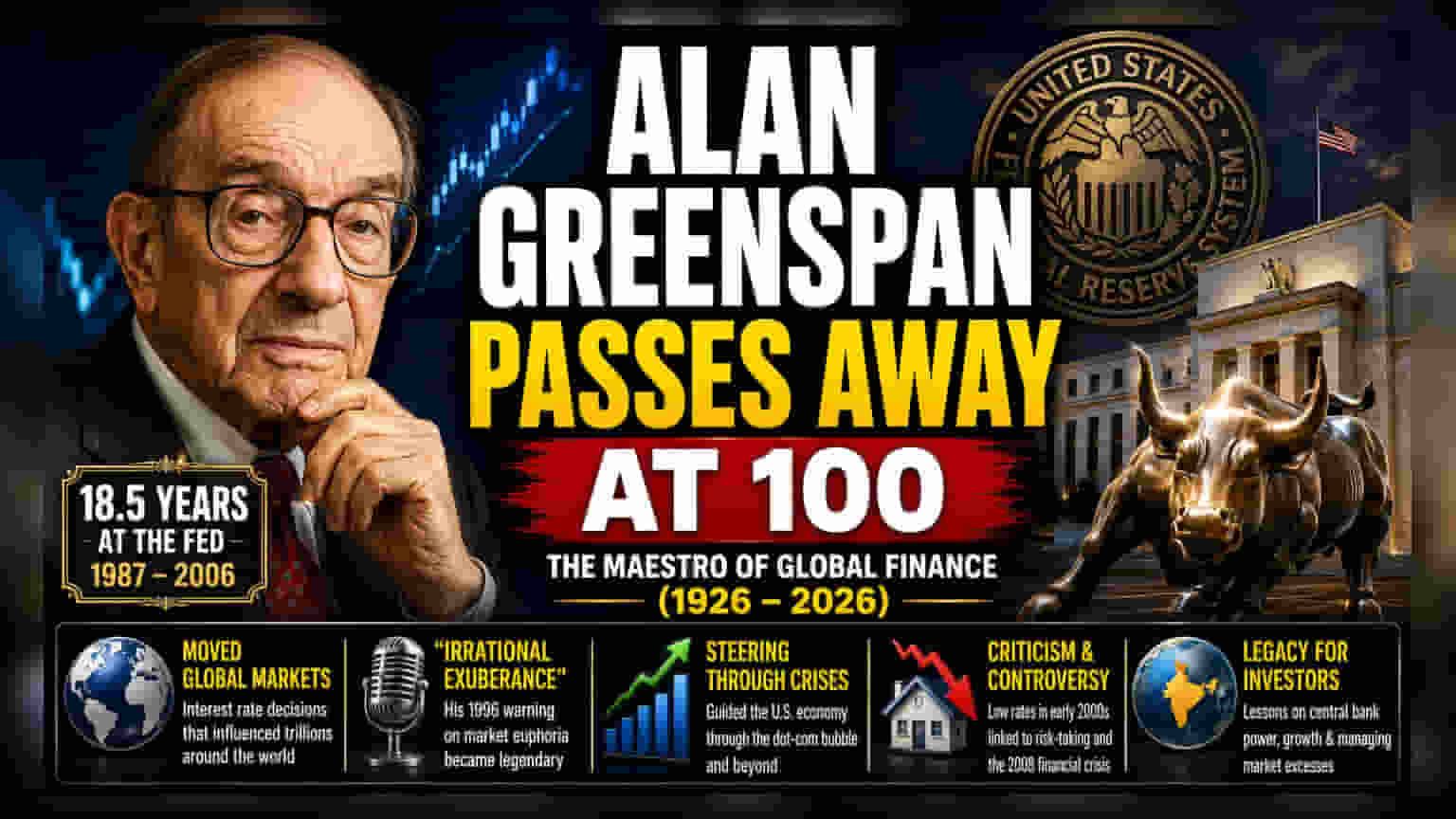
Alan Greenspan, the influential former U.S. Federal Reserve Chair, has passed away at age 100. He led the Fed for over 18 years, becoming a central figure in shaping global interest rates and financial markets. His tenure was marked by significant economic growth, famous market warnings, and debates over policies linked to the 2008 financial crisis.
What Happened
Alan Greenspan, who served as the Chair of the U.S. Federal Reserve for 18 and a half years, has passed away at the age of 100. His death was confirmed by his family on Monday. Greenspan, often referred to as the "Maestro" or the "Oracle" of Wall Street, held this powerful position from 1987 to 2006. His long tenure made him one of the most significant figures in modern economic history, as his policies and public statements consistently moved global financial markets.
The 'Maestro' of Global Finance
Greenspan’s influence was immense. During his time at the Federal Reserve, investors across the globe, including those in India, watched his every word. His announcements regarding interest rates could shift billions of dollars in capital, change currency values, and influence stock market trends worldwide. He was widely respected for his technical approach to monetary policy and for steering the U.S. economy through a lengthy period of expansion that began in the early 1990s.
Investors often tried to read his intentions based on subtle clues, such as the thickness of his briefcase during meetings, illustrating how closely the market tracked his every move. He played a central role in managing the U.S. economy during major events, including the dot-com bubble and the recovery that followed.
Famous Market Warnings
One of his most enduring legacies is his 1996 warning regarding "irrational exuberance." With this phrase, he publicly suggested that investors were becoming too optimistic, pushing asset prices to levels that could not be sustained by economic fundamentals. This warning has since become a standard term in finance to describe market bubbles. It demonstrated his role not just as a policy maker, but as an observer who attempted to warn investors when markets detached from reality.
Economic Growth and Controversy
Greenspan’s career was not without significant criticism. While he was praised for maintaining price stability and preventing runaway inflation for much of his tenure, his decisions in the early 2000s remain a subject of intense debate. Many economists argue that keeping interest rates too low for too long during that period encouraged excessive risk-taking, which helped build the conditions for the global financial crisis of 2008. These critics believe his policy approach during those years contributed to the housing bubble that eventually burst with severe global consequences.
Why This Matters for Investors
For today’s market participants, Greenspan’s era provides a clear lesson on the power of central banks. The U.S. Federal Reserve remains the single most important institution for global financial conditions. When the Fed changes its interest rate policy, it impacts the cost of capital in India and other emerging markets. His long tenure established the modern framework for how the Federal Reserve communicates with the market. Understanding his legacy—the balance between fostering growth and managing speculative risks—remains relevant for anyone analyzing how interest rates impact global asset prices and economic health.