

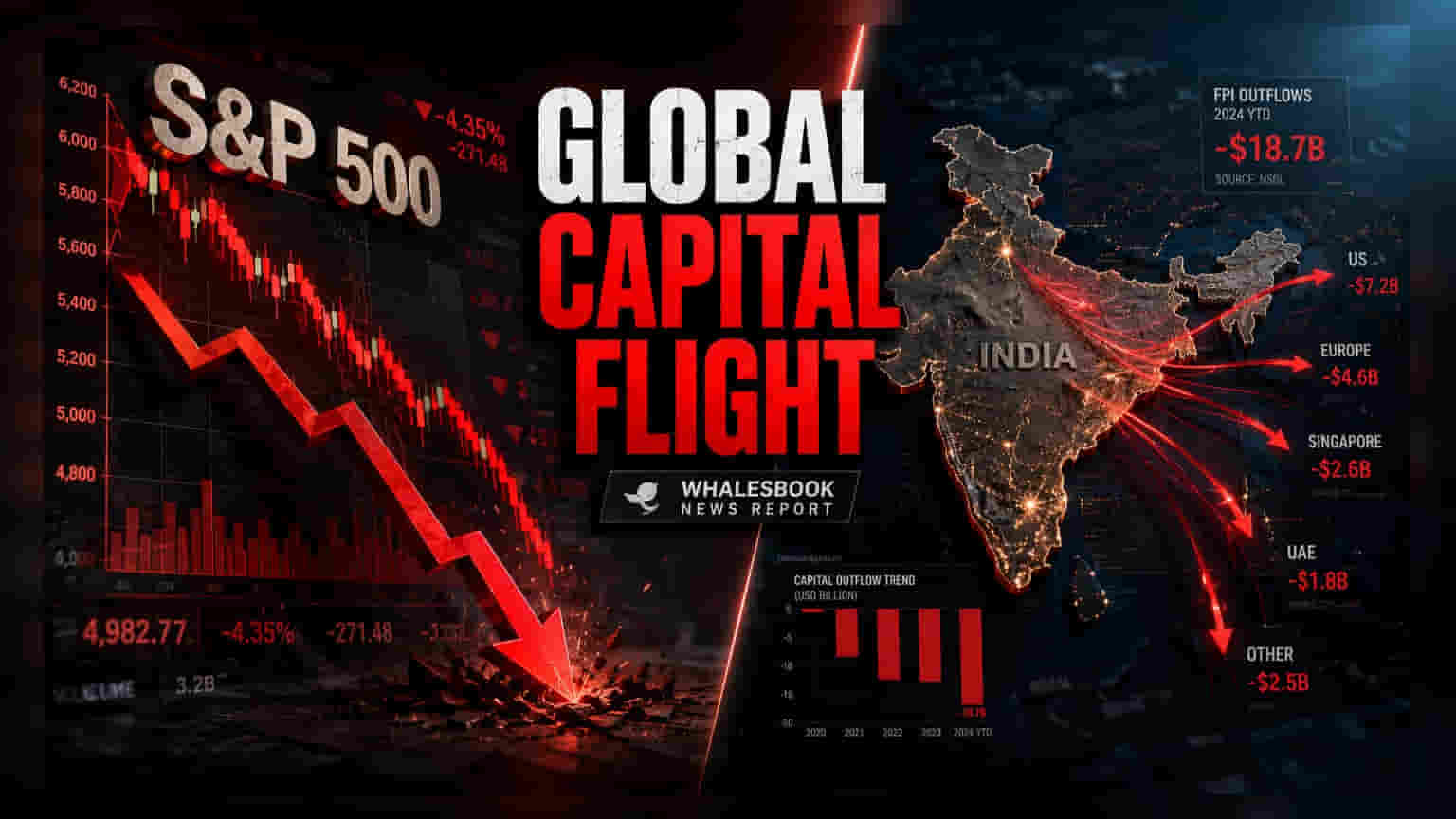
Foreign investors withdrew $580 million from Indian stocks last week amid a global trend of tightening liquidity. Emerging market funds have recorded nine consecutive weeks of outflows, indicating a shift in investor sentiment away from high-risk regions.
Global financial markets are witnessing a notable change in investor behavior as liquidity becomes more restricted. Investors have turned cautious, leading to a synchronized retreat from both U.S. equities and emerging markets. Data shows that U.S. equity funds saw a sharp increase in withdrawals, with redemptions reaching $17 billion in the latest week, up from $8 billion the week prior.
Impact on Emerging Markets and India
This cautious sentiment has directly affected emerging economies, which have now faced nine straight weeks of fund outflows. This is the longest period of continuous withdrawals since the 2022-23 cycle. India has not been spared from this trend, recording $250 million in outflows from India-focused equity funds. When combined with other movements, the total foreign withdrawal from Indian equities reached $580 million.
While this level of selling is currently less severe than the intense pressure observed during March and April, it signals a cooling in the momentum that previously favored these markets. Other Asian economies have faced similar or larger pressures, with investors pulling $766 million from Taiwan and $283 million from South Korea. The earlier speculative interest in artificial intelligence-related stocks, which was a major driver of market sentiment in early 2025, appears to be losing its influence on global capital allocation.
Commodity and Sectoral Trends
The retreat is not limited to equities. Global commodity funds have experienced eight weeks of consistent outflows, totaling $1.5 billion. Energy and gold-focused funds have been significantly affected, with investors redeeming $3.2 billion and $3.1 billion respectively. This synchronized exit across various asset classes suggests that the rally fueled by easy global liquidity is under pressure.
For Indian investors, the key monitorable remains the continuity of these flows. If foreign institutions continue to reduce their exposure, it could create volatility in large-cap stocks that are frequently held by foreign portfolios. Investors may track whether this is a short-term adjustment in global portfolios or the start of a more sustained trend of risk aversion. Future updates on global interest rate expectations and central bank policies will be essential to understanding whether this liquidity contraction continues or stabilizes.