

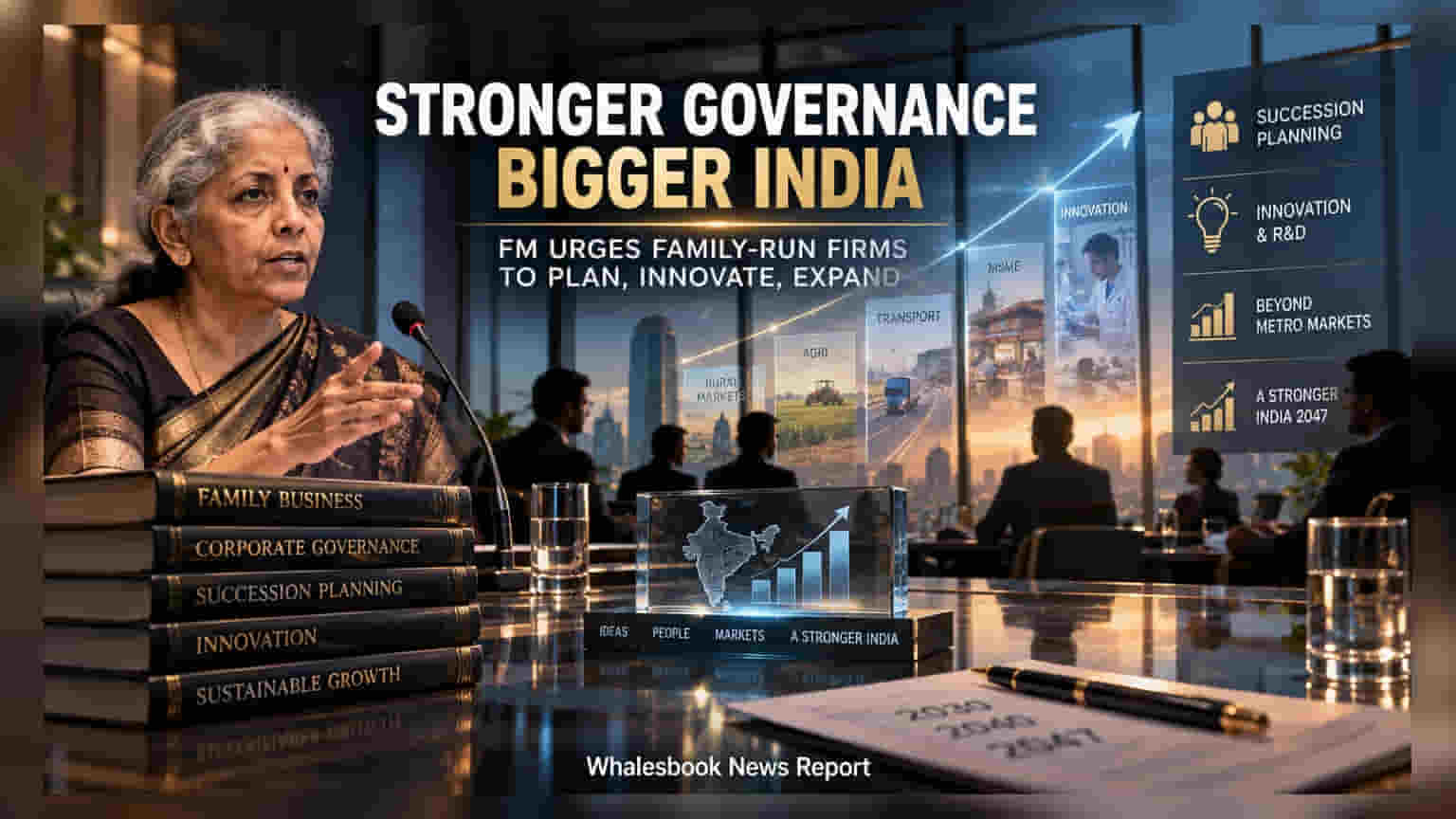
Finance Minister Nirmala Sitharaman has advised Indian family-run businesses to prioritize formal succession planning and professional governance. She also highlighted the need to boost India's R&D spending, currently at 0.83% of GDP, and shift from simple manufacturing to homegrown innovation to ensure long-term structural growth.
Finance Minister Nirmala Sitharaman has delivered a direct message to India’s family-run conglomerates, calling for a fundamental shift in how these companies manage succession and internal governance. Speaking at a recent event hosted by the All India Management Association, she highlighted that the longevity of India's largest business houses depends on professional leadership structures rather than just the scale of their operations.
For investors, governance remains a critical factor in risk assessment. Family-led disputes and unclear leadership transitions have historically created corporate uncertainty, sometimes leading to stock price volatility or operational delays. The Finance Minister’s focus on formal succession planning suggests that companies failing to institutionalize these processes may face increased scrutiny. Transparent leadership transitions are widely viewed by the market as essential for maintaining business continuity and protecting shareholder value.
Beyond internal management, the Finance Minister challenged firms to look beyond urban consumption centers. She pointed out that relying solely on premium products for metropolitan markets creates natural growth limits. By expanding reach into agricultural, transport, and informal sectors, companies can tap into a wider and more stable consumer base, which is crucial for achieving the nation's 2047 economic targets.
A significant portion of her address focused on India’s innovation deficit. She noted that India’s gross research and development spending stands at only 0.83% of GDP, significantly lower than the 2.7% to 3.5% seen in major global economies like China and the United States. With the private sector contributing only 36% of this total, the Minister urged a strategic shift from 'Made in India' to 'Imagined in India.' This entails moving from simple manufacturing assembly to homegrown product design and intellectual property creation.
For shareholders, these focus areas provide a useful checklist for evaluating long-term company health. Investors may increasingly track how companies structure their leadership teams, where they allocate capital for research and development, and how they penetrate non-urban markets. As family-led firms look to navigate these structural requirements, observing how they detail their succession planning and innovation budgets in future annual filings will be key to understanding their readiness for future growth.