

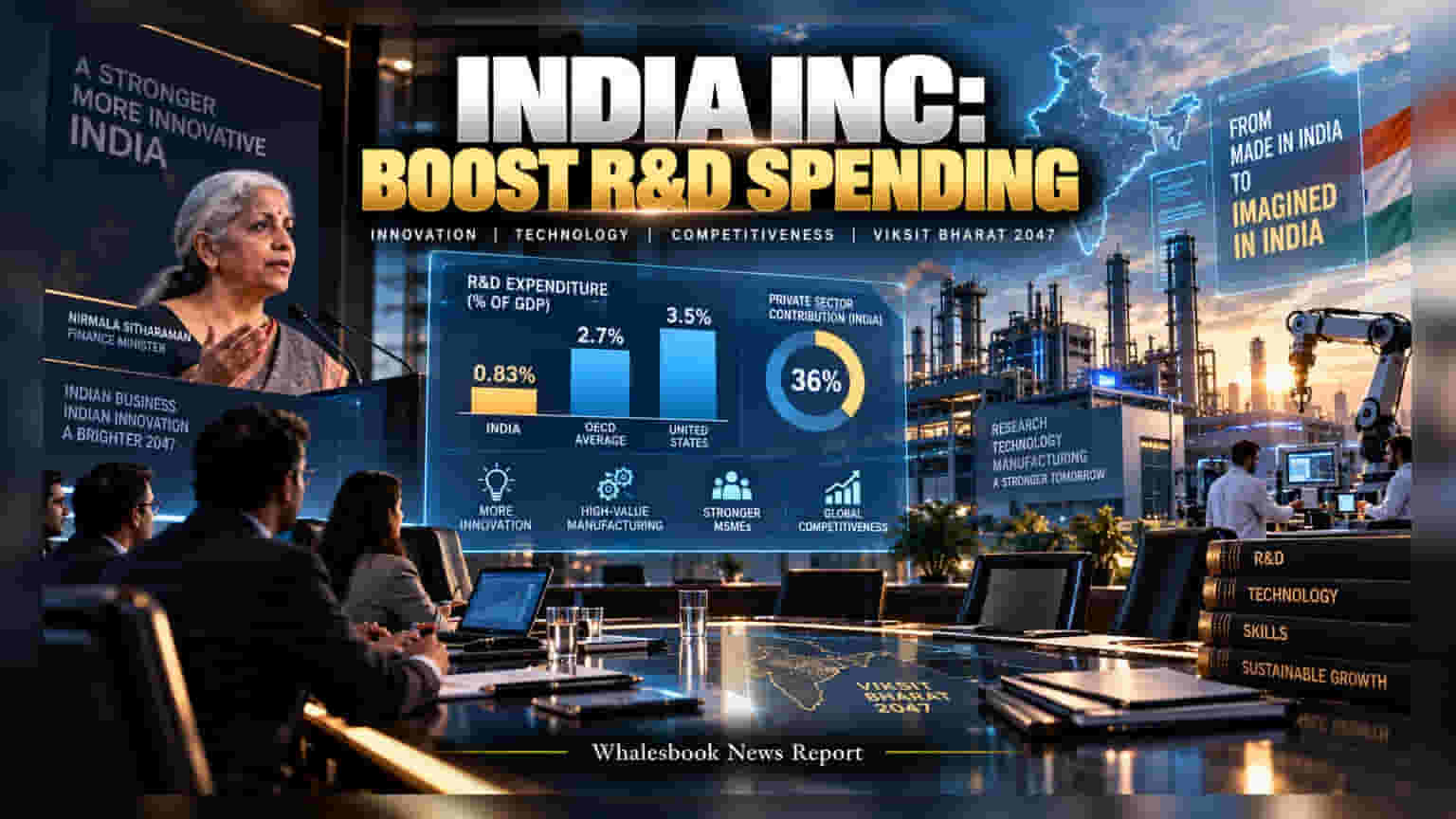
Finance Minister Nirmala Sitharaman has urged Indian companies to increase R&D spending, noting that India's 0.83% GDP investment lags behind global peers. She emphasized the need for institutional governance and proprietary innovation to move from 'Made in India' to 'Imagined in India'. For investors, this highlights the importance of tracking R&D ratios and professional management structures in corporate filings.
Finance Minister Nirmala Sitharaman has set a new roadmap for Indian businesses, urging a transition from basic manufacturing to innovation-led growth. Speaking at the All India Management Association’s Platinum Jubilee Convention on September 22, 2026, the Minister highlighted that the 'Made in India' narrative needs to evolve into 'Imagined in India' to meet national economic goals by 2047.
A key focus of her message was the need to close the research and development (R&D) gap. The Minister pointed out that India’s gross expenditure on R&D stands at 0.83% of GDP, which is significantly lower than the OECD average of 2.7% and the 3.5% allocation seen in the United States. She noted that the private sector contributes only 36% to this figure, signaling that companies need to invest more in in-house research to stay competitive globally.
For stock market investors, this call for innovation has direct implications. Companies that prioritize R&D often trade at different valuations compared to those reliant solely on cost-cutting or commodity-linked manufacturing. Investors looking at long-term holdings may track the R&D-to-revenue ratio in corporate annual reports. High-tech sectors like pharmaceuticals, automotive, and software services are often assessed on their ability to build intellectual property and proprietary designs, which can protect profit margins against low-cost global competition.
Beyond technology, the Finance Minister addressed the need for institutional maturity, especially within the MSME and mid-sized sectors. Many of these companies face risks related to succession planning and informal decision-making, which can impact operational continuity. The government’s emphasis on professionalizing management—separating ownership from the daily business—is aimed at creating sustainable, long-term corporate entities.
Looking ahead, the market may see a greater focus on quality standards. As global supply chains shift, the government is pushing for Indian firms to become trusted, high-standard suppliers rather than just low-cost alternatives. Investors may monitor whether companies can successfully transition to high-value product segments without compromising on operational efficiency or stretching their balance sheets through excessive capital spending. Future financial reports, particularly disclosures on governance practices and investment in new technologies, will be key data points for shareholders to assess how well companies are aligning with this national goal.