

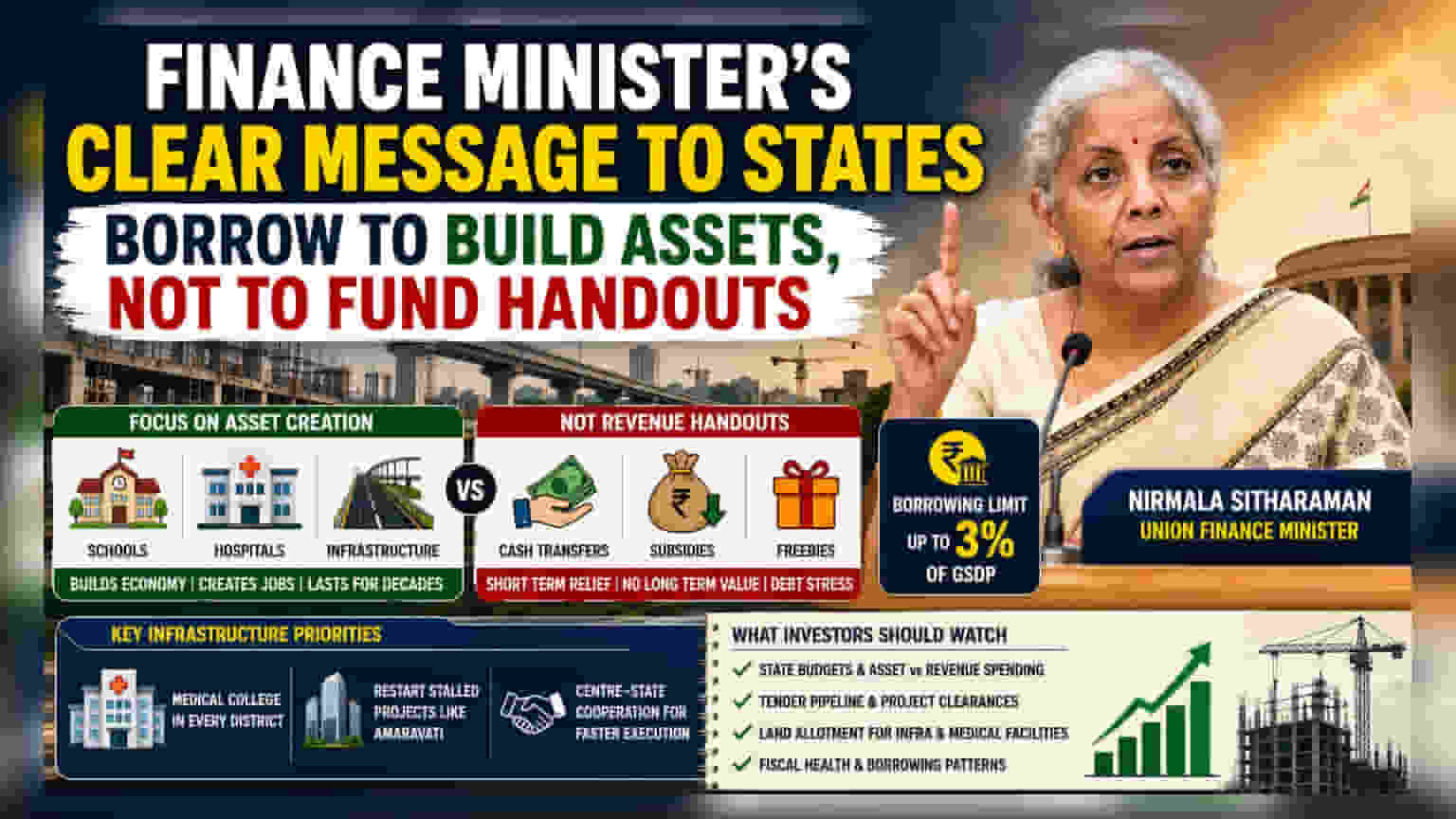
Finance Minister Nirmala Sitharaman has urged states to prioritize using borrowed funds for long-term infrastructure assets like schools and hospitals rather than short-term cash handouts. For investors, a shift toward capital spending by states is a key monitorable, as it can drive demand for construction, cement, and steel sectors while improving the fiscal health of state governments.
What Happened
Union Finance Minister Nirmala Sitharaman has issued a clear directive to state governments regarding the use of public funds. During her recent visit to Tamil Nadu and Puducherry, the Minister emphasized that states should prioritize utilizing borrowed money for creating long-term assets, such as schools, hospitals, and public infrastructure, instead of focusing on revenue expenditure like cash handouts or subsidies. She reminded states that they have a defined borrowing limit of up to three percent of their Gross State Domestic Product (GSDP) and urged them to ensure this capital is deployed into projects that generate economic value for decades.
Why The Shift To Asset Spending Matters
For investors, the distinction between spending money on infrastructure and spending it on recurring handouts is significant. When states spend on infrastructure—what is often called capital expenditure—it creates a direct pipeline of work for construction, engineering, cement, and steel companies. These projects generate employment and long-term economic activity. In contrast, revenue expenditure, such as subsidies or cash transfers, provides immediate consumption but does not build durable economic capacity. If state governments align with this directive, it could lead to higher order inflows for infrastructure-related companies, potentially boosting their revenue and operational performance.
The Fiscal Logic For States
The Minister highlighted that the core issue is not the act of borrowing, but the purpose for which the debt is utilized. A state that borrows to build a hospital or a road creates an asset that serves the public for 50 to 60 years. This asset can then contribute to the local economy. However, borrowing to fund non-productive expenses can lead to long-term debt stress without a corresponding increase in the state's income-generating ability. By adhering to the three percent borrowing limit while focusing on assets, states aim to maintain fiscal discipline, which is essential for ensuring that contractors and vendors, including listed infrastructure firms, receive payments on time.
Infrastructure Projects To Track
During her address, the Finance Minister also touched upon specific areas where state and central cooperation is necessary for project execution. She reiterated the government's policy to support the establishment of a medical college and hospital in every district, encouraging states to submit proactive proposals. Additionally, the Minister addressed the stalled development of Amaravati, the capital of Andhra Pradesh, noting that project delays often stem from political changes. Investors usually track such projects closely, as delays in government-backed capital expenditure can impact the order book execution timelines for construction companies and suppliers involved in these developments.
What Investors Should Monitor
Investors may want to watch for how state budgets evolve in response to this emphasis on asset creation. The key monitorable will be whether states prioritize tenders for public infrastructure projects or continue to lean heavily on revenue-heavy schemes. The pace of project clearances, land allotment for new medical facilities, and the restart of stalled infrastructure projects like Amaravati will provide clues about the actual shift in spending. Furthermore, keeping an eye on the fiscal health and borrowing patterns of major industrial states will help gauge if they have the financial flexibility to fund new infrastructure projects.