

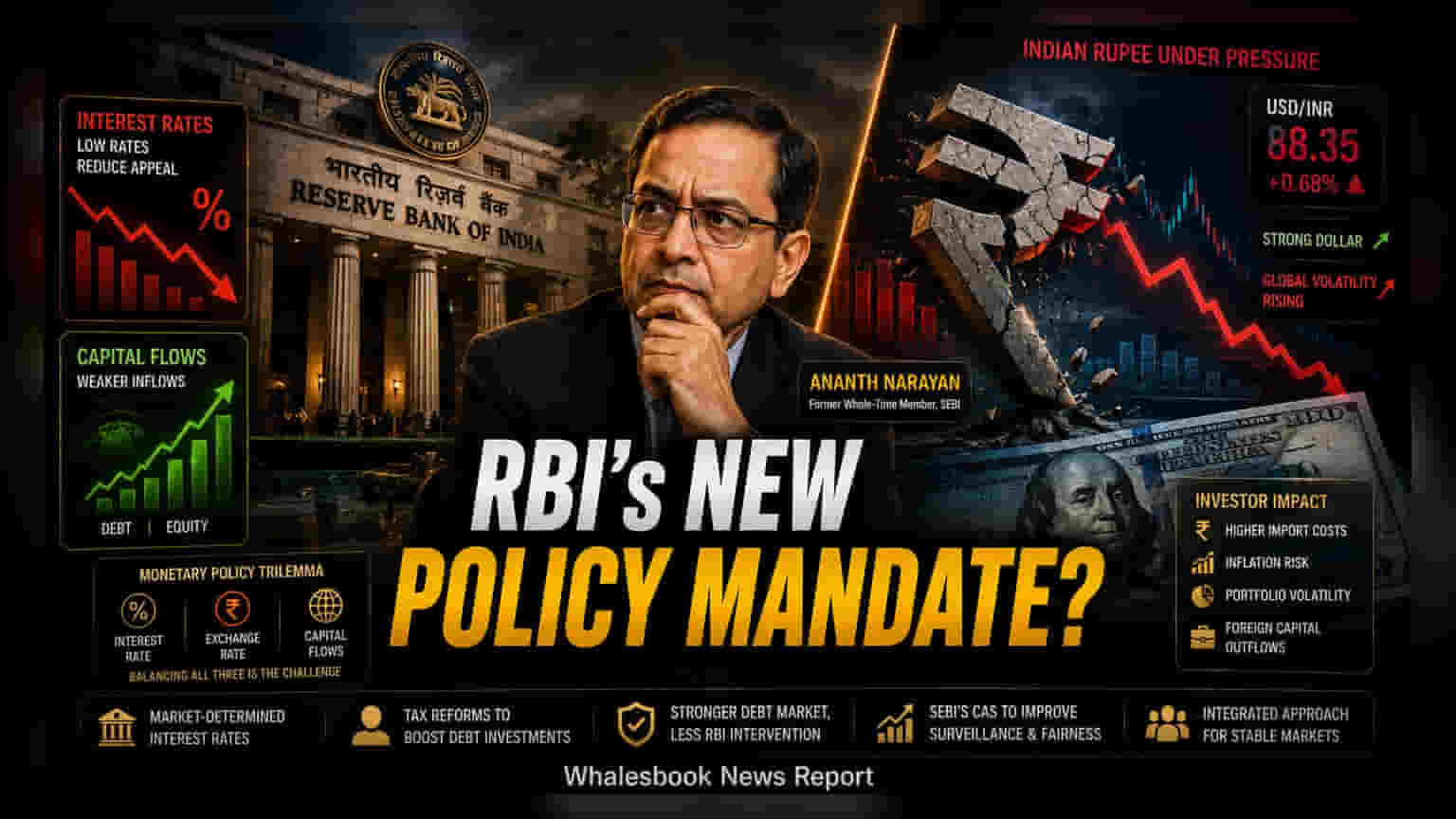
Former SEBI member Ananth Narayan has advised the Reserve Bank of India to align its interest rate and currency management strategies. He argues that isolated interventions create market distortions, potentially impacting foreign investments and the stability of equity and debt markets in India.
Ananth Narayan, a former Whole-Time Member of the Securities and Exchange Board of India (SEBI), has highlighted the need for the Reserve Bank of India (RBI) to adopt a more integrated approach to managing interest rates, the rupee, and capital flows. He argues that the central bank’s current interventions in these areas are often disconnected, creating ripple effects that could distort the broader financial market.
Balancing Interest Rates and Capital Flows
Narayan describes the current situation as a "monetary policy trilemma," where the RBI faces the challenge of managing local interest rates while keeping the currency stable and encouraging steady investment inflows. He points out that when local interest rates are kept artificially low, it reduces the appeal of investing in India for foreign players. This can lead to reduced capital inflows into both the debt and equity markets.
For investors, this suggests that the central bank’s decisions are not just about inflation or growth but have a direct impact on how money enters or exits the country. He advocates for a shift toward market-determined interest rates, where domestic savings and demand, rather than constant RBI intervention, play a bigger role in setting bond yields. This, he believes, would create a more self-sustaining market environment.
Debt Market and Tax Reforms
Beyond central bank policy, Narayan emphasized the need to make the Indian debt market more attractive for domestic savers. He suggested that tax reforms—specifically reducing the tax burden on interest income and debt-oriented mutual funds—could help channel more household savings into bonds. Currently, lower interest rates often discourage savers from choosing fixed-income options, pushing them instead toward equities, gold, or even overseas assets. By aligning debt taxation with other capital market instruments, the policy could stabilize the market and reduce the need for the RBI to step in as frequently to manage liquidity.
SEBI’s Market Surveillance Efforts
In his comments, Narayan also addressed recent regulatory steps taken by SEBI. He praised the regulator’s implementation of the Closing Auction Session (CAS), which was introduced to address concerns regarding potential price manipulation during the weekly options expiry on the Sensex. He expressed confidence that this framework will strengthen market surveillance and increase investor trust. He noted that increased participation by arbitrage funds and better securities lending and borrowing mechanisms would further enhance the liquidity and fairness of this closing auction process.
What Investors Should Monitor
For market participants, the key monitorable remains the RBI’s monetary policy commentary and any potential government-led tax changes regarding fixed-income investments. While the RBI continues its balancing act to manage currency volatility and liquidity, any shift toward more market-driven interest rates could change the return profiles for debt and equity instruments. Investors may also track how regulatory changes, such as the new closing auction mechanisms, affect daily trading stability and market participation levels.