

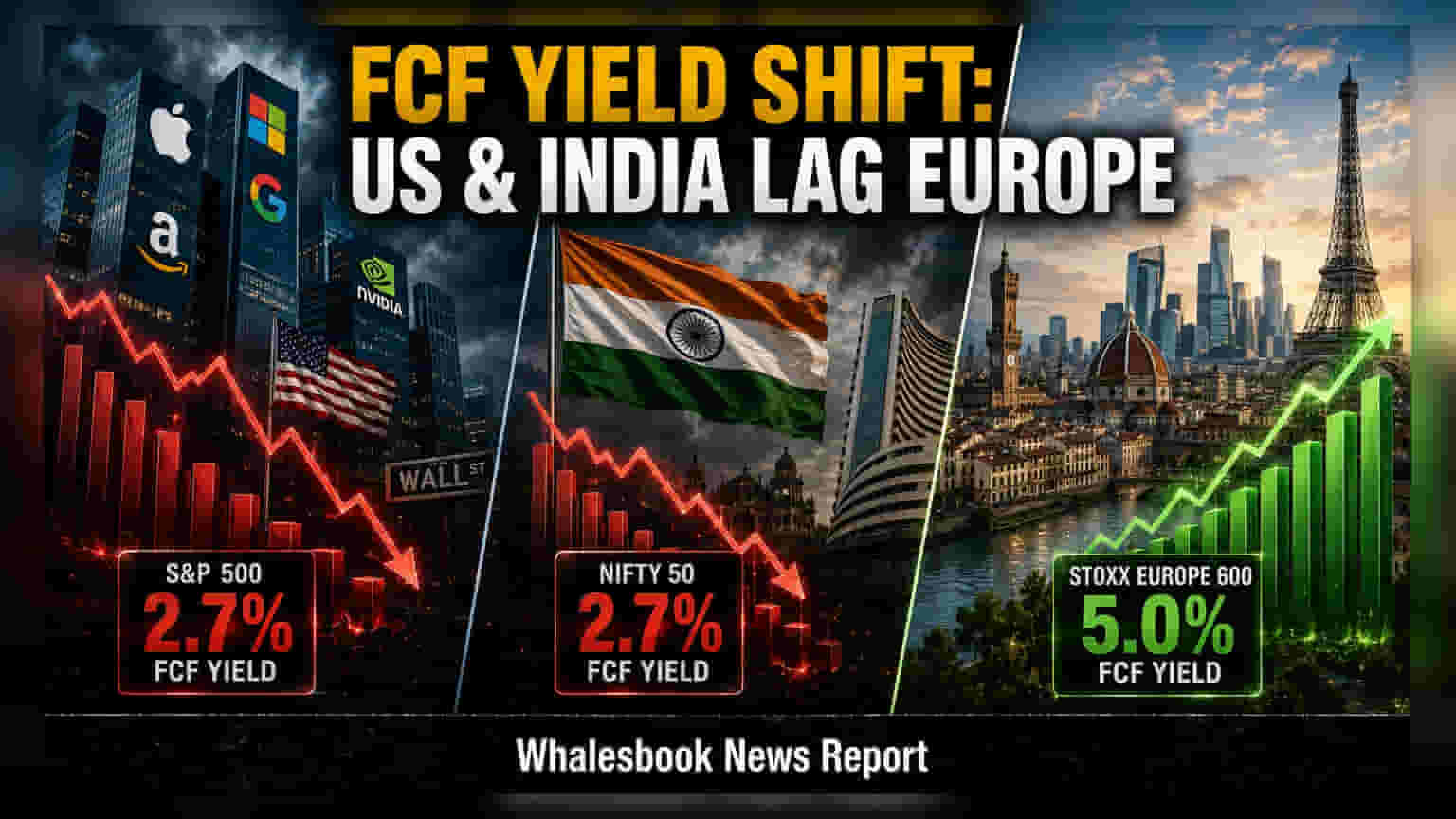
European markets are currently offering a 5% free cash flow (FCF) yield, significantly higher than the 2.7% seen in both the US S&P 500 and India’s Nifty 50. This gap is largely driven by aggressive spending on artificial intelligence infrastructure by major US technology firms, which is putting pressure on their ability to generate surplus cash.
Global investors are increasingly focusing on a metric known as 'free cash flow yield' to determine where they get the best value for their money. Recent analysis shows that European equities, represented by the Stoxx Europe 600 index, are currently offering a free cash flow yield of approximately 5%. This stands in contrast to the US S&P 500 and India’s Nifty 50, both of which are trailing at around 2.7%.
To understand why this gap matters, one must first look at what free cash flow yield represents. It measures how much cash a company generates after paying for its day-to-day operations and necessary investments in equipment or infrastructure. A higher yield generally tells investors that a company or market is highly efficient at turning revenue into usable cash. When the yield is low, it often means the company is spending a large portion of its earnings on expansion, or that its current stock price is high relative to the cash it creates.
The primary driver behind the lower yield in the US is the massive capital spending cycle currently underway among major technology companies. These firms, often called hyperscalers, have committed hundreds of billions of dollars to build out the infrastructure needed for artificial intelligence. While this spending is aimed at securing future growth, it has significantly reduced the amount of free cash these companies have on hand today. This aggressive investment strategy is a major shift from previous years when many tech giants maintained capital-light business models.
This trend has created a valuation dilemma for investors. Because these large US technology stocks form a significant portion of the S&P 500, their heavy spending is dragging down the index's overall cash flow efficiency. Investors are now questioning the potential return on this record-level spending. There is a risk that if the expected profits from artificial intelligence do not materialize as quickly as predicted, these companies may struggle to justify their high stock valuations.
India’s Nifty 50, with its FCF yield of 2.7%, finds itself in a similar position to the US tech-heavy index. While Indian markets are not driven by the same artificial intelligence spending boom, investors should monitor how domestic companies manage their own spending cycles. In an environment where global liquidity is shifting, markets with stronger, consistent cash generation are often seen as safer havens compared to those where valuations rely heavily on the promise of future earnings.
For investors, the key monitorable going forward is the return on investment from this current wave of infrastructure spending. If US technology firms can prove that their AI investments lead to sustained profit growth, the current pressure on cash flow may be temporary. However, if this spending continues without a corresponding rise in earnings, the market may continue to favor more cash-efficient regions like Europe.