

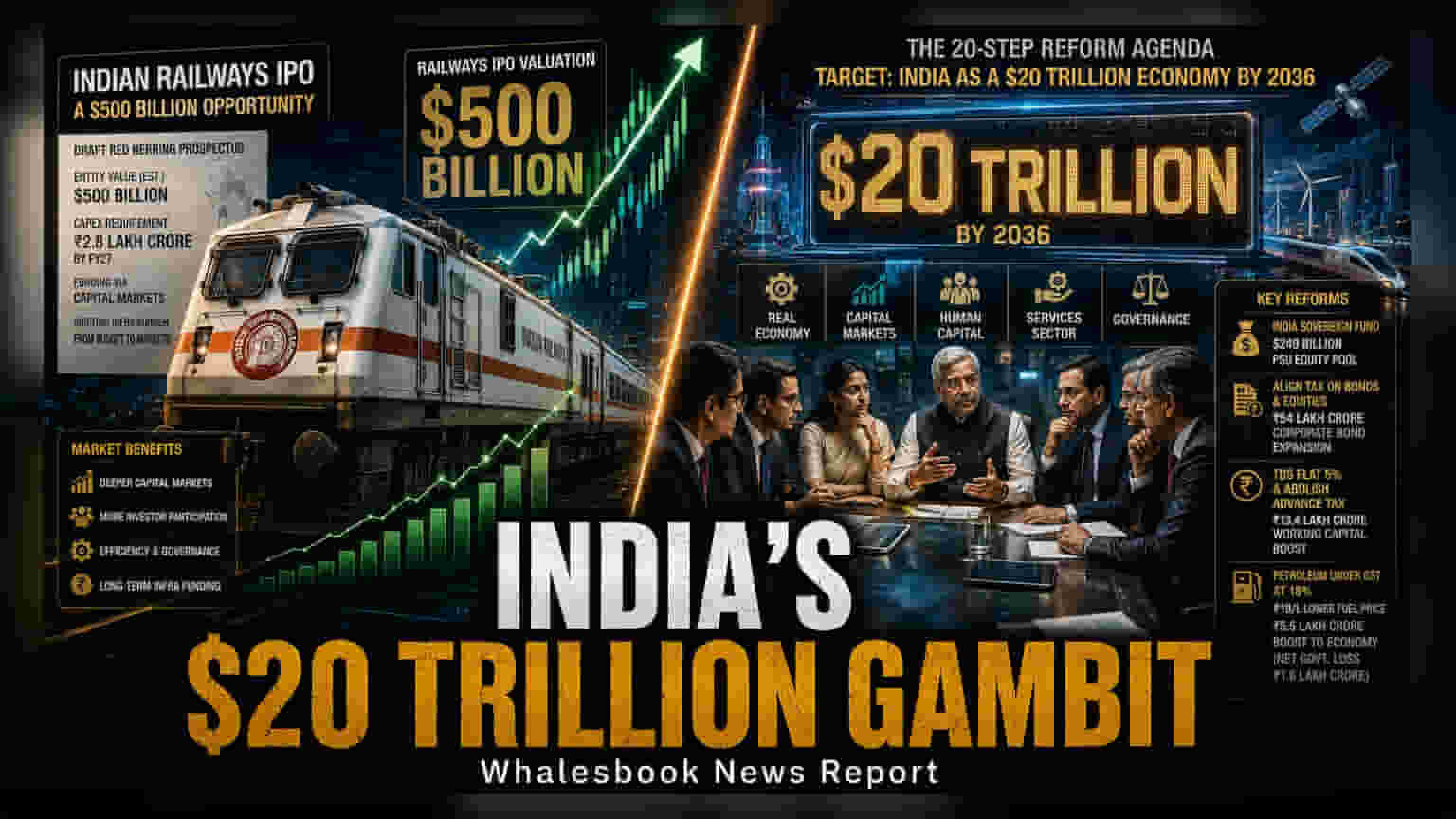
Research firm Equirus has proposed a roadmap to elevate India's economy to $20 trillion by 2036. Key recommendations include listing Indian Railways, introducing flat tax rates, and bringing fuel under the GST framework. While the plan aims to unlock massive liquidity and infrastructure funding, it relies on ambitious annual growth targets of 18%, significantly higher than historical trends.
Equirus Securities has released a strategic research report outlining a 20-step reform agenda designed to propel India’s economy to a $20 trillion valuation by 2036. The plan focuses on five pillars: the real economy, capital markets, human capital, the services sector, and governance. The roadmap suggests that to reach this milestone, India must maintain a nominal dollar growth rate of approximately 18% annually, supported by a steady 3–3.6% appreciation of the rupee.
Radical Infrastructure and Market Reforms
One of the most significant proposals in the report is the public listing of Indian Railways. Equirus projects that a potential IPO could value the entity at $500 billion, shifting the heavy burden of infrastructure funding from the government budget to the capital markets. The report estimates that Indian Railways requires about ₹2.8 lakh crore in capital expenditure by fiscal year 2027. By accessing public markets, the government could free up this capital for other national priorities.
Another key proposal is the creation of a new India Sovereign Fund. By pooling approximately $249 billion worth of equity from Public Sector Undertakings (PSUs), the government could generate consistent returns, reducing reliance on direct budgetary allocations. The firm also recommends aligning tax treatments for bonds and equities, a move that could potentially expand the corporate bond market by ₹54 lakh crore and lower borrowing costs for companies.
Tax and Fuel Reforms to Boost Liquidity
Equirus argues that the current tax system ties up significant working capital. It proposes a flat 5% Tax Deducted at Source (TDS) on investment income, with final tax liabilities settled during annual filing. It also suggests abolishing advance tax. The firm estimates these changes could inject ₹13.4 lakh crore of working capital back into the economy.
Additionally, the report advocates for bringing petroleum products under the Goods and Services Tax (GST) regime. Equirus projects that an 18% GST rate could lower fuel prices by approximately ₹19 per litre, potentially injecting ₹5.5 lakh crore into the economy. However, the report acknowledges this would come at a cost, with an estimated net revenue loss of ₹1.6 lakh crore for the central government.
Economic Assumptions and Risks
While the plan offers a structured path to growth, it relies on assumptions that are significantly higher than India’s historical performance. The target of 18% nominal dollar growth exceeds the country’s typical trajectory of 10–11%. Achieving this will require sustained, high-level execution across multiple sectors, including a major shift in the services sector, which the report projects should grow from 54% to over 65% of GDP.
There are also notable implementation risks. Structural reforms, such as setting mandatory state capital expenditure floors and centralizing state coordination, face complex political and federal challenges. Furthermore, the massive revenue impact from shifting fuel under GST and the volatility associated with public listings of major state entities remain significant variables. Investors and policy watchers will likely monitor whether these specific proposals gain traction in upcoming policy discussions or government budget planning.