

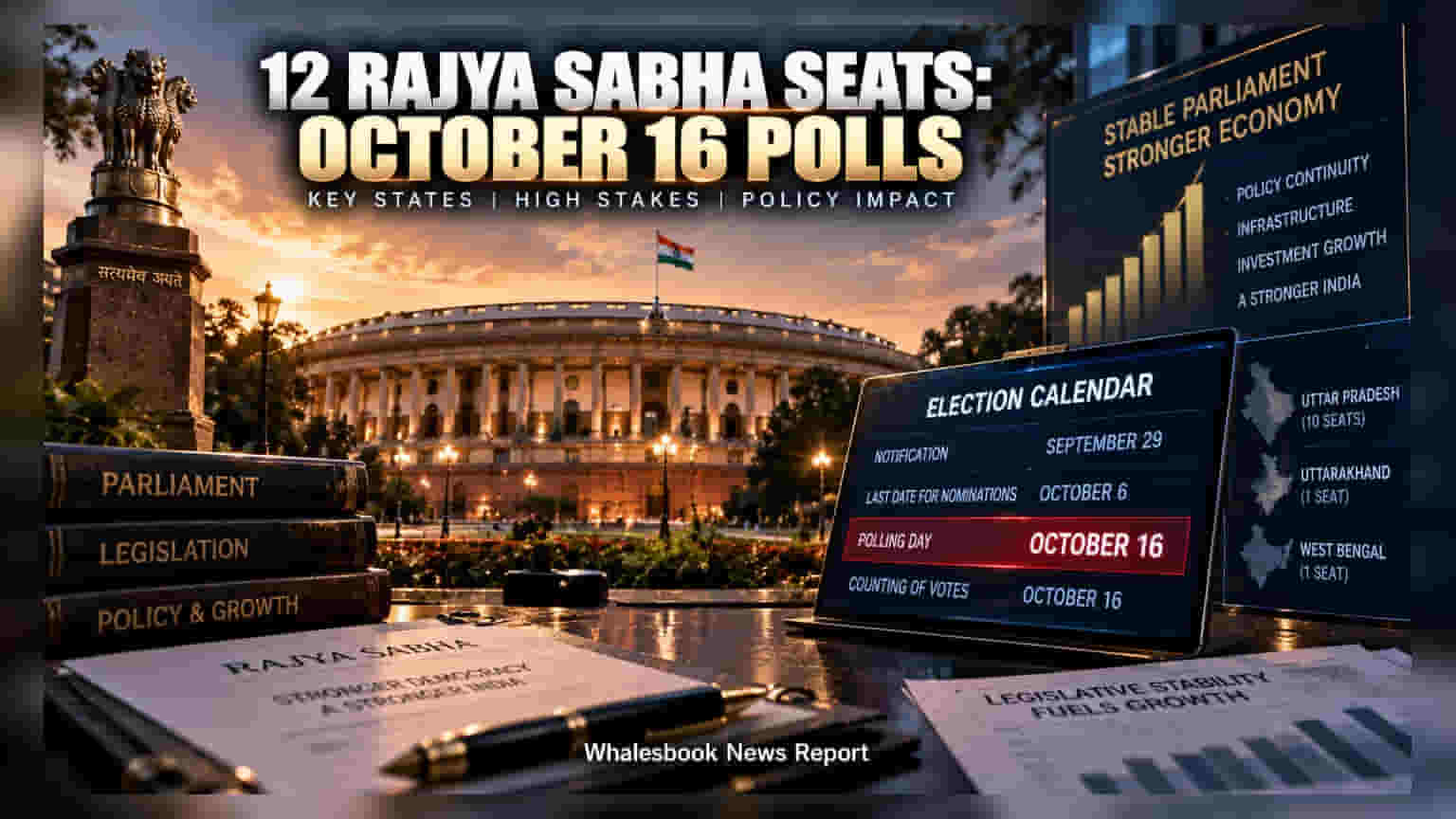
The Election Commission has announced elections for 12 Rajya Sabha seats on October 16 across Uttar Pradesh, Uttarakhand, and West Bengal. These polls fill vacancies caused by term completions and a resignation. Investors keep track of such political events to assess legislative stability, which can influence policy momentum and market sentiment in these key states.
The Election Commission of India has announced that elections for 12 Rajya Sabha seats will be held on October 16. This election cycle covers vacancies in Uttar Pradesh, Uttarakhand, and West Bengal, which were triggered by the completion of terms for several members and one resignation in West Bengal. The official notification for the polls is scheduled for September 29, with October 6 set as the final deadline for filing nominations. The voting process and the counting of votes are slated for October 16.
Uttar Pradesh remains the primary focus of this electoral cycle, as 10 of the 12 total vacancies are in the state. These vacancies arise as the terms of several senior members expire on November 25. Political arithmetic in the state suggests that the current assembly composition may lead to a consolidation of influence for the ruling BJP-led alliance, while the Samajwadi Party is expected to retain a smaller share of the seats. In Uttarakhand, the single seat becoming vacant is expected to remain with the ruling party based on current legislative strength.
For the financial and business community, these elections are monitored for their potential impact on legislative stability. The composition of the Rajya Sabha plays a significant role in the government's ability to pass both national and state-related legislation. A stable and predictable legislative environment is often viewed as a positive factor for policy continuity, which influences long-term investment decisions and the speed of industrial project approvals. As Uttar Pradesh and other involved states are major hubs for various economic activities, shifts in party representation in the Upper House can provide signals on the government's capacity to push through key reforms, infrastructure bills, or state-specific policies.
The next steps for observers will be the release of the final list of candidates and the eventual election results. These will clarify the legislative strength of various parties in the Upper House, which remains a factor in assessing the political environment for the coming months.