

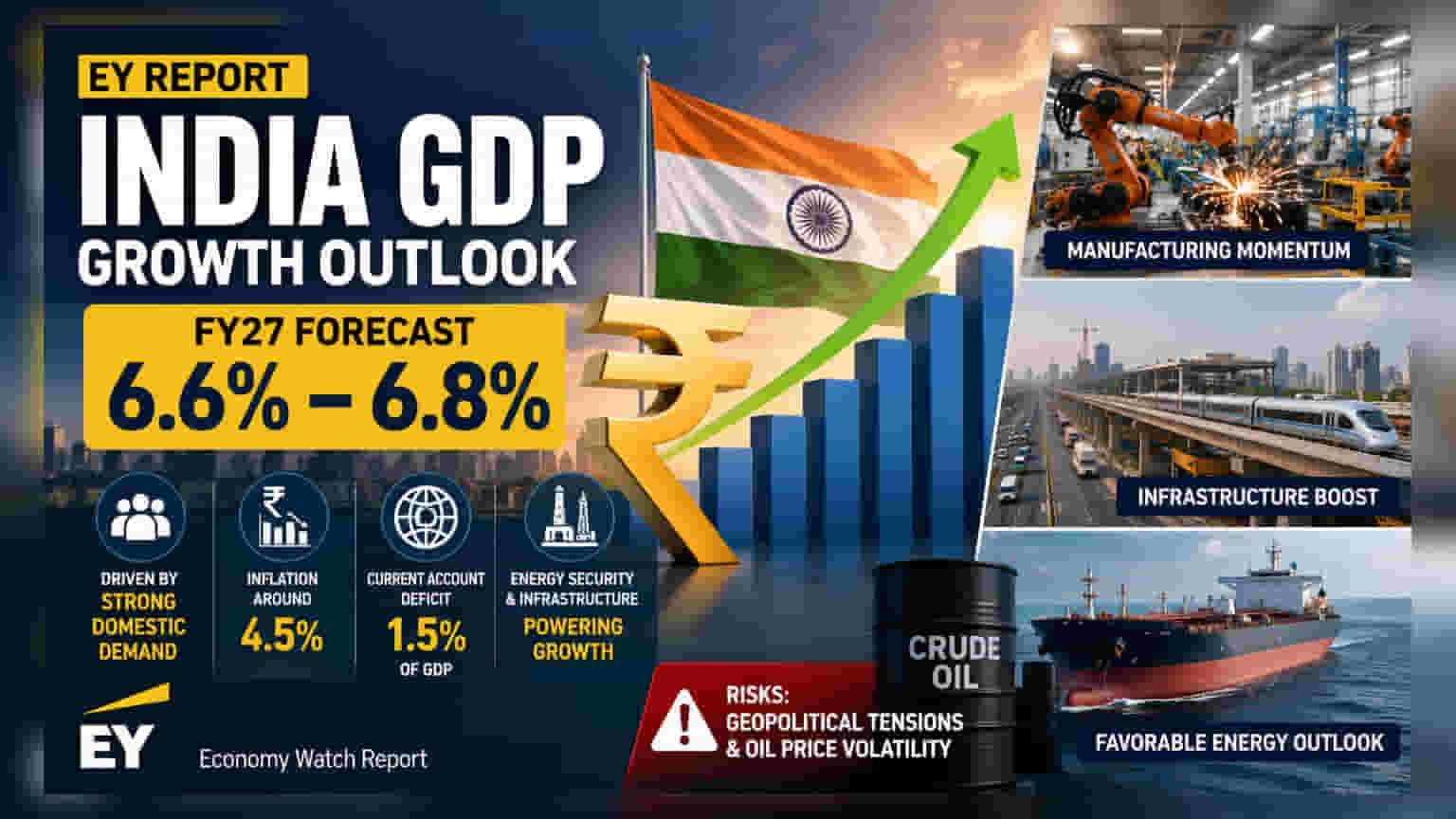
Ernst & Young estimates India’s economy will grow by 6.6% to 6.8% in the current financial year. This growth is supported by strong domestic demand and stable global energy prices. Investors may watch how this economic stability impacts corporate earnings and sector performance throughout the year.
What Happened
Ernst & Young (EY) has released its latest "Economy Watch" report, projecting India's Gross Domestic Product (GDP) to grow between 6.6% and 6.8% for the financial year 2027 (FY27). This forecast comes as the Indian economy continues to show resilience despite global market uncertainties. The report highlights that steady domestic consumption and a favorable outlook on global energy markets are the primary engines behind this expected expansion.
The Drivers Of Growth
The report points to strong domestic fundamentals as the main strength of the economy. In the Indian market context, this means that companies in sectors like manufacturing, services, and industrial goods are likely seeing sustained demand. The report notes that high-frequency indicators, which provide quick snapshots of economic activity, show steady credit growth and improved industrial output. For investors, this suggests that the broader business environment remains supportive of operations, potentially aiding top-line growth for companies catering to domestic needs.
Inflation And Stability Factors
Macro-economic stability is essential for businesses to plan and grow. EY expects inflation to hover around 4.5%, a level often considered manageable. This stability is credited to improving supply chains and moderating commodity costs.
Additionally, the report forecasts the current account deficit—the gap between what the country earns from exports and pays for imports—to remain modest at 1.5% of GDP. A stable external sector is positive for the economy as it reduces the risk of currency volatility, which can otherwise increase costs for companies that rely on imported raw materials.
Infrastructure And Energy Security
The report highlights India's petroleum refining sector as a core strength. By bolstering energy security, the refining sector not only supports domestic energy needs but also acts as a significant contributor to exports. Furthermore, the focus on infrastructure development is seen as a long-term buffer that helps the economy handle future challenges. Continued government spending on infrastructure is a key monitorable, as it often creates a ripple effect, benefiting construction, steel, cement, and logistics companies.
What Could Pressure The Outlook
While the outlook is positive, the report acknowledges that global factors play a significant role. The projection relies on the assumption that global energy prices will remain stable and that shipments through the Strait of Hormuz will normalize. Any unexpected geopolitical tensions in key shipping routes or a sudden spike in global crude oil prices could disrupt supply chains and put pressure on inflation. Investors may look for how these global variables shift over the coming quarters, as they directly affect the cost of production and profitability for many Indian firms.
What Investors Should Track
Investors may track how corporate management commentary shifts regarding input costs and consumer demand in upcoming quarterly results. While the macro-economic projection is optimistic, the actual performance of the economy will depend on sustained credit growth, the pace of infrastructure project execution, and how successfully companies manage any potential volatility in global commodity prices.