

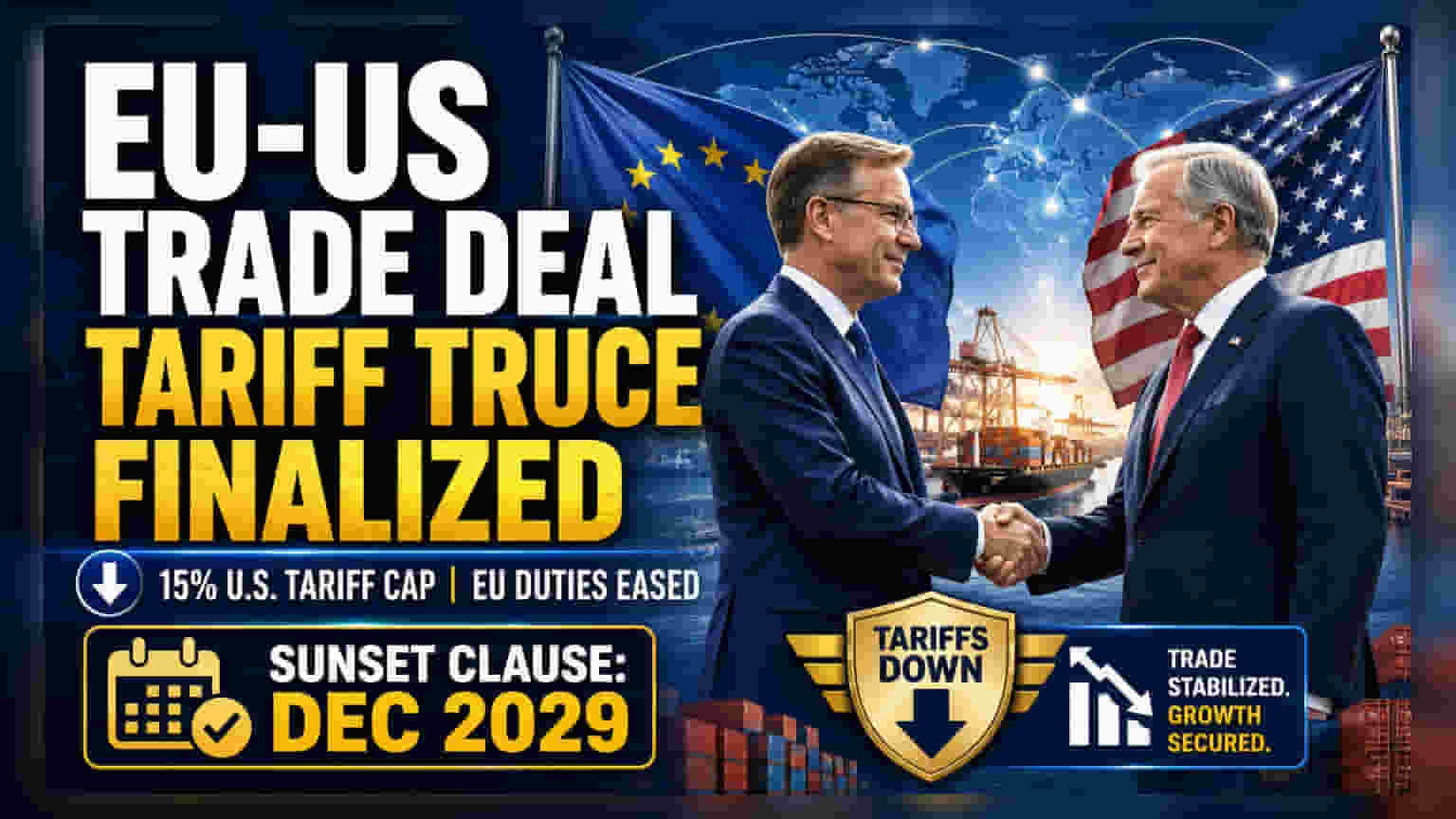
The European Union has formally ratified a trade agreement with the United States, capping tariffs on European goods at 15% and removing duties on many US industrial imports. This move aims to end recent trade friction and provides a more predictable environment for global business. Investors may watch how this stability influences international supply chains and trade policy.
What Happened
The European Union (EU) has officially finalized a long-discussed trade agreement with the United States. Following a legislative vote and formal adoption by the EU Council, this deal establishes a "tariff truce" between the two major economic blocs. The agreement includes the elimination of most EU customs duties on American industrial goods, while the United States has agreed to cap tariffs on a wide range of European exports at 15%. This ratification comes just ahead of a July 4 deadline, effectively preventing the threat of increased tariffs that had created uncertainty for businesses on both sides of the Atlantic.
Why It Matters For Global Trade
For global markets, this deal serves as a significant stabilization measure. Transatlantic trade accounts for nearly 43% of global GDP, and years of fluctuating tariff threats had previously pressured companies with exposure to both markets. By establishing clear rules and caps, the agreement allows businesses to plan long-term investments with more confidence. The removal of duties on industrial goods is expected to lower costs for manufacturers and consumers, potentially easing inflationary pressures in specific supply chains that rely on inputs from both regions.
Key Terms and Safeguards
The agreement is structured as a temporary framework, with a "sunset clause" that keeps the current terms in effect until December 31, 2029, unless they are renewed or extended. To protect their respective interests, both sides have included specific safeguard mechanisms. The European Commission is empowered to suspend tariff preferences if the United States does not uphold its commitments or if European industries face serious damage from sudden import surges. Similarly, the deal sets conditions for how tariffs on steel and aluminum derivatives will be managed, providing a structured way to handle future trade disputes without resorting to immediate, broad-based retaliatory taxes.
Context for Indian Investors
While this deal is primarily between the EU and the US, it is relevant to Indian investors for two reasons. First, as the global trade landscape shifts, the EU and the US remain India’s largest trade partners. Stability between these two blocs reduces the likelihood of broader, chaotic global trade wars that could disrupt Indian exports. Second, India is separately working on its own trade engagements with these regions, including a much-anticipated Free Trade Agreement (FTA) with the EU. Clear trade rules between the EU and US provide a benchmark for how modern trade agreements are being structured in a post-2025 global economy, characterized by both protectionist safeguards and a need for supply chain resilience.
What Investors Should Track
The immediate impact of this deal is the removal of short-term uncertainty. Investors may monitor how the European Commission manages the reporting requirements, with thorough impact assessments scheduled to be completed by mid-2029. Additionally, any commentary from trade officials regarding the extension of the deal beyond the 2029 sunset date will be a significant indicator of long-term trade relations. While this agreement addresses specific industrial and agricultural goods, the ongoing dialogue regarding other excluded sectors will be important to observe for potential future updates.