

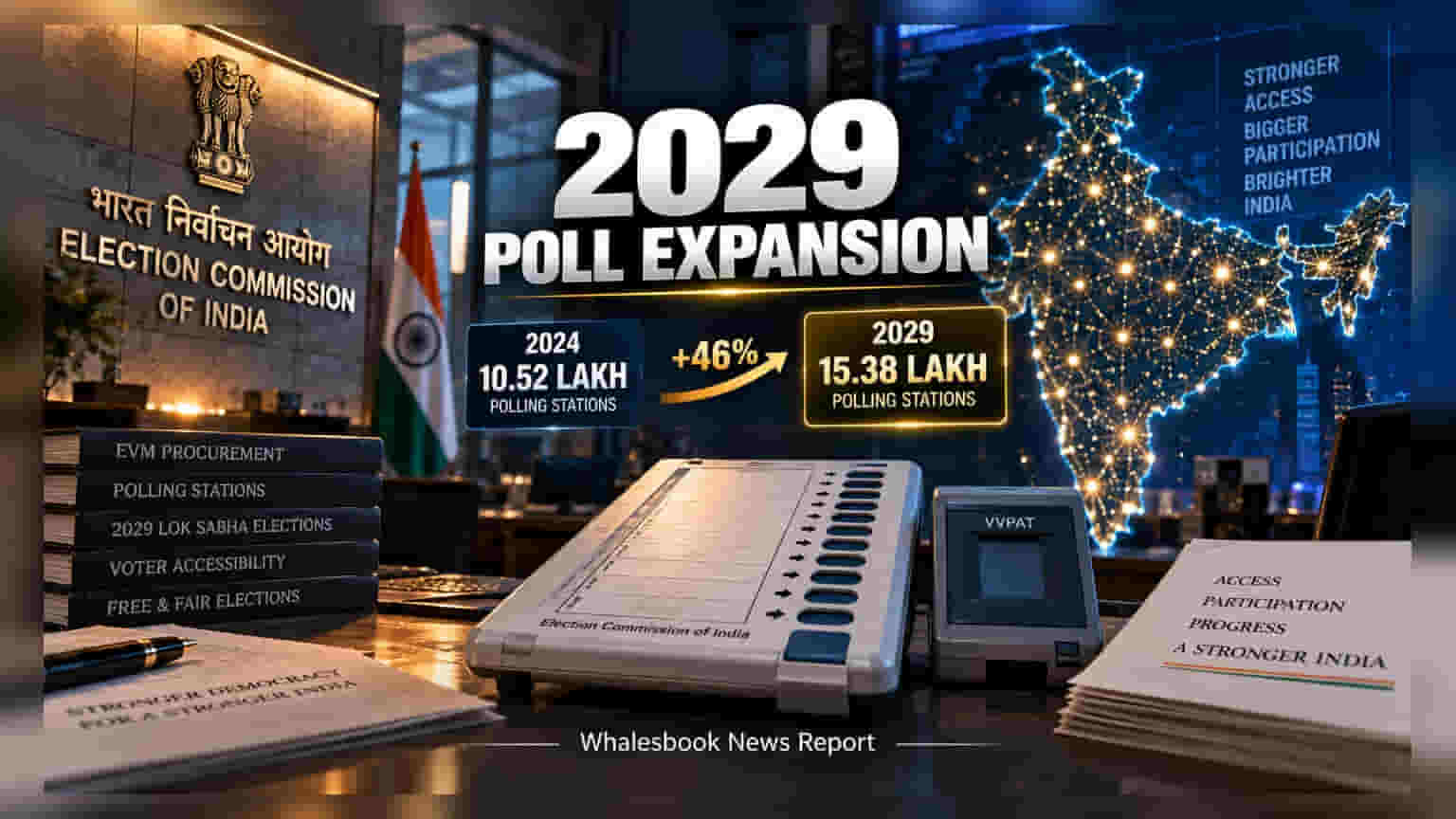
The Election Commission of India (ECI) intends to deploy 15.38 lakh polling stations for the 2029 Lok Sabha elections, marking a 46% increase from the 2024 cycle. To support this, the commission has allocated Rs 486 crore for the procurement of new EVMs and VVPATs. This significant capital spending will likely benefit public sector electronics manufacturers like Bharat Electronics Ltd (BEL) and Electronics Corporation of India Ltd (ECIL).
The Election Commission of India (ECI) has outlined a significant expansion plan for the 2029 Lok Sabha elections, targeting approximately 15.38 lakh polling stations across the country. This represents a 46% increase compared to the 10.52 lakh stations deployed during the 2024 general elections. This logistical growth is aimed at enhancing voter accessibility, though it requires a substantial upgrade to the nation’s voting infrastructure.
Procurement Budget and Strategy
To facilitate this expansion, the ECI has earmarked Rs 486 crore for the procurement of new Electronic Voting Machines (EVMs) and Voter Verifiable Paper Audit Trails (VVPATs). The commission’s current inventory includes 30.48 lakh ballot units and 21.92 lakh control units. Rather than expanding the total fleet size, the ECI has adopted a one-to-one replacement strategy. The plan involves purchasing 3.57 lakh new ballot units and 1.25 lakh new control units to replace an equivalent volume of aging hardware that has reached the end of its functional life.
Impact on Manufacturing Partners
While the Election Commission itself is a constitutional body and not a listed company, its procurement decisions have a direct impact on the revenue of its primary manufacturing partners. Bharat Electronics Ltd (BEL) and Electronics Corporation of India Ltd (ECIL) are the designated public sector enterprises responsible for manufacturing and supplying EVMs and VVPATs to the ECI. Consequently, the allocation of Rs 486 crore for hardware procurement serves as a key order pipeline for these companies. Investors in these public sector units often monitor such procurement announcements to gauge the volume of order inflow for their defense and electronics segments.
Operational Challenges and Risks
Managing an infrastructure network of 15.38 lakh polling stations introduces complex logistical and operational requirements. The ECI must ensure the seamless deployment, security, and maintenance of the voting equipment across diverse geographies. The success of this expansion will depend on the timely manufacturing and supply of new units by BEL and ECIL. Any delay in the production cycle or challenges in the fleet retirement process could impact the readiness of the election infrastructure. Furthermore, as the hardware is upgraded, the commission faces the ongoing task of managing the disposal of obsolete machines, ensuring that the lifecycle of the technology remains efficient and reliable for the upcoming general election cycle.