

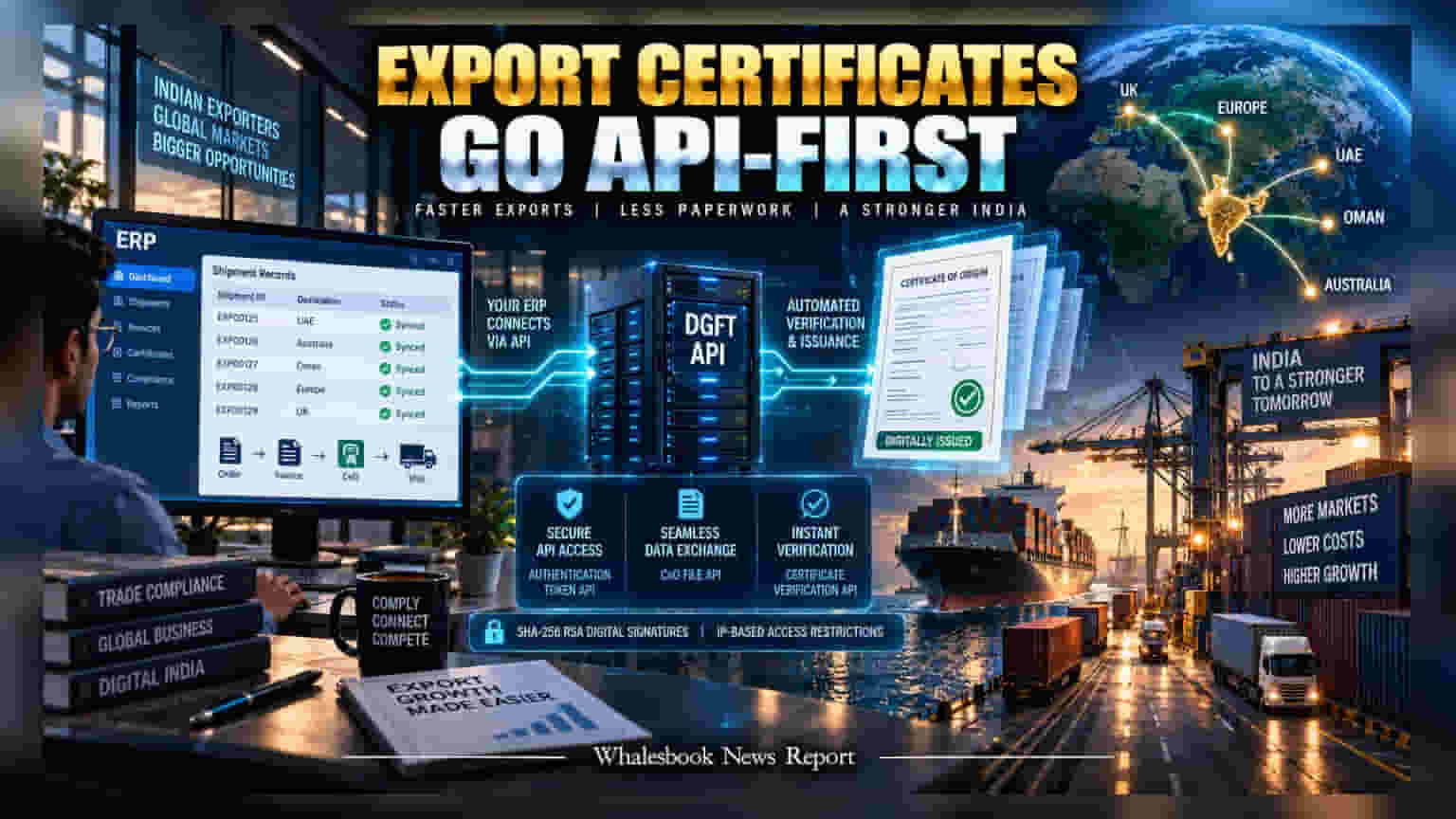
The Directorate General of Foreign Trade has introduced an Open API facility, allowing exporters to link internal ERP systems directly with the government’s CoO portal. Effective September 7, 2026, this integration aims to cut manual data entry and speed up processing for preferential and non-preferential trade certificates.
The Directorate General of Foreign Trade (DGFT) has launched an Open API facility to streamline the issuance and verification of Certificates of Origin (CoO). Introduced via Trade Notice No. 25/2026-27 on September 7, 2026, the new system allows exporters to integrate their internal Enterprise Resource Planning (ERP) and accounting software directly with the government's trade platform.
Moving Beyond Manual Workflows
Previously, exporters had to manually enter data into the DGFT portal to apply for certificates required for shipping goods under various trade agreements. The new API facility changes this by enabling machine-to-machine communication. This allows systems to exchange data directly, which significantly reduces the need for duplicate data entry and manual interventions.
For businesses handling large shipment volumes, this automation can lead to faster processing times and fewer clerical errors. The system supports both preferential certificates, which are necessary to claim tariff benefits under Free Trade Agreements, and non-preferential certificates used for general customs compliance.
Technical and Security Framework
The DGFT has rolled out three distinct API components to facilitate this transition: an Authentication Token API, a CoO File API, and a Certificate Verification API. To ensure data integrity, the system incorporates strict security standards, including SHA-256 RSA digital signatures and IP-based access restrictions.
Businesses looking to adopt this integration must ensure their IT systems meet the DGFT’s technical specifications. While the automation offers significant operational gains, companies must also focus on maintaining robust cybersecurity protocols. This includes careful management of access tokens, digital signatures, and IP whitelisting to prevent unauthorized access to their export documentation systems.
Part of a Larger Digital Push
This initiative is part of a broader government strategy to digitize trade documentation and reduce compliance friction for Indian exporters. The effort to move toward machine-to-machine processing has been gaining momentum; just recently, on September 1, 2026, the DGFT also automated the issuance of Free Sale and Commerce Certificates. These moves are intended to lower the cost of compliance and make it easier for Indian products to compete in international markets by simplifying the regulatory paperwork involved in cross-border trade.
For exporters, the next steps involve evaluating their internal software capabilities to see if they can support the new API integration. Companies will need to monitor how well their internal systems synchronize with the DGFT platform and ensure that their staff is trained on the security requirements to avoid any potential service disruptions during the transition.