

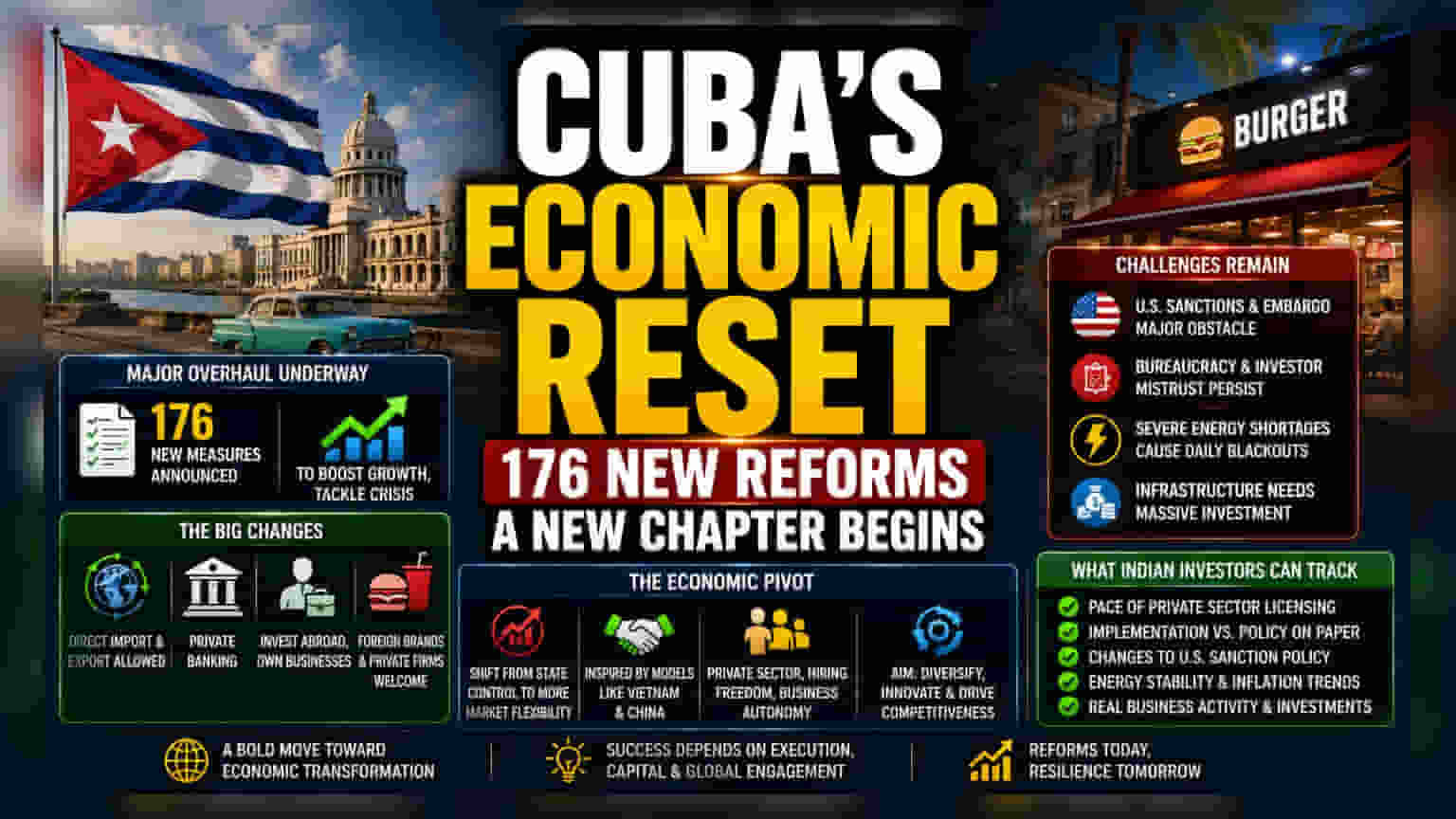
Cuba has introduced 176 economic reforms, marking its most significant shift toward a private economy since the revolution. These changes allow for private banking, direct foreign trade, and private business ownership to combat severe economic and energy crises. While these steps signal a potential pivot toward market-oriented policies, significant hurdles, including U.S. sanctions and local bureaucratic risks, remain for global investors.
What Happened
Cuba has initiated a major overhaul of its state-controlled economy, introducing 176 new measures aimed at decentralizing operations and allowing more private sector participation. This shift permits Cuban entities to engage in direct import and export activities without state intermediaries, introduces private banking, and allows individuals to invest in businesses abroad. Additionally, foreign fast-food chains and other private enterprises are now permitted to operate on the island. The government stated that these reforms are intended to address long-standing financial challenges and energy shortages that have crippled the nation's economic activity.
The Economic Pivot
For decades, Cuba’s economy has been characterized by heavy state centralization and monopolies on foreign trade. These new reforms represent a departure from that model, with officials comparing the strategy to the market-oriented approaches seen in countries like Vietnam and China. By allowing companies to hire personnel independently and enabling private business ownership, the government hopes to inject dynamism into an economy that has struggled with stagnation. For global observers, this indicates an attempt to foster a more competitive environment, though the transformation of such a deeply controlled system is a complex, long-term process.
The Sanctions and Execution Risk
While the reforms are significant on paper, their real-world impact is heavily clouded by geopolitical factors. The U.S. has maintained a "maximum pressure" policy through an intensified embargo, which continues to pose a major challenge for any entity looking to do business with Cuba. Analysts suggest that the effectiveness of these measures remains limited without a shift in international sanctions. Furthermore, internal issues such as bureaucratic inefficiencies and historical investor mistrust remain significant obstacles. Even with the legal framework for private enterprise now in place, the actual ability of businesses to operate smoothly, access capital, and navigate the embargo will dictate the success of these reforms.
Energy and Infrastructure Pressure
The reforms arrive amid severe energy shortages that have caused daily blackouts across the island, disrupting essential services and manufacturing. Economic diversification and new business approaches are cited as necessary steps to overcome these infrastructure deficits. However, physical infrastructure repairs and energy stability typically require substantial capital and time. For the reforms to truly boost economic output, the government must convince both domestic and international participants that the business climate has become stable enough to justify the risks associated with investing in the island.
What Indian Investors Can Track
For Indian investors, the direct exposure to Cuba is negligible, as there are few, if any, major Indian listed companies with material business operations there. However, this development is a useful case study in how isolated economies attempt to pivot toward growth. Investors may track whether the implementation of these measures leads to actual improvement in business activity or if bureaucratic hurdles limit the impact. The key monitorables for the broader global market include any changes to the U.S. sanction policy, the pace of private sector licensing, and whether these reforms lead to tangible improvements in energy stability and inflation control.