

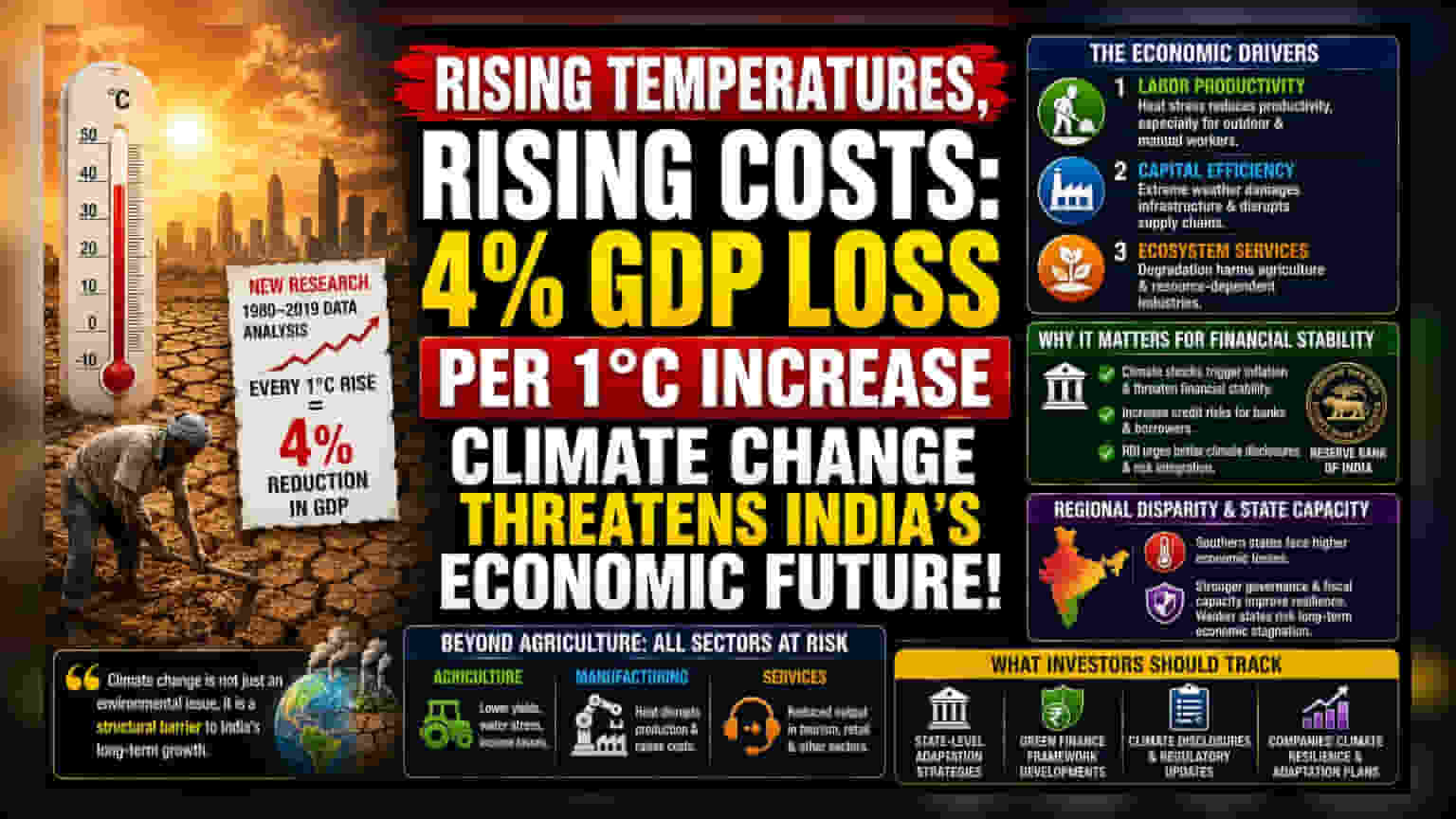
New research from the Delhi School of Economics reveals that a 1°C rise in annual temperature could slash India's GDP by nearly 4%. This decline is driven by reduced labor productivity and lower capital efficiency, posing a long-term risk to economic growth. The study highlights that the impact is systemic, affecting manufacturing and services alongside agriculture, necessitating proactive adaptation strategies.
What Happened
A new study by researchers Naveen Kumar and Dibyendu Maiti from the Delhi School of Economics has identified a direct, negative correlation between rising temperatures and India’s economic performance. The analysis of data spanning 1980 to 2019 indicates that every 1°C increase in annual average temperature could lead to a nearly 4% reduction in GDP. This research frames climate change not just as an environmental concern, but as a structural obstacle that can dampen long-term economic expansion and total factor productivity.
The Economic Drivers
The study points to three primary channels through which rising heat drags down economic output. First, labor productivity declines significantly due to heat stress, particularly affecting workers in outdoor or manual roles. Second, there is a measurable loss in capital efficiency, as extreme weather can damage infrastructure and disrupt supply chains. Third, ecosystem services—which support agriculture and other resource-dependent industries—face degradation. Unlike previous assumptions that localized climate impacts primarily to the farm sector, the findings show that manufacturing and services are also increasingly vulnerable to heat-related output losses.
Why It Matters for Financial Stability
This research aligns with observations from the Reserve Bank of India (RBI), which has increasingly flagged climate change as a systemic risk. The central bank has noted that climate-related shocks, such as erratic rainfall and heatwaves, can act as supply-side triggers for inflation and threaten financial stability. For banks and financial institutions, this creates credit risks, as extreme weather can affect a borrower's ability to repay loans. Consequently, the RBI has been encouraging banks to improve climate-related disclosures and integrate environmental risk assessments into their core lending and governance models.
Regional Disparity and State Capacity
The study emphasizes that the economic toll of climate change is not uniform. Southern states, which are already experiencing higher baseline temperatures, are projected to bear a larger share of the economic loss. Furthermore, the report indicates that a state’s ability to mitigate these risks depends heavily on its institutional strength and fiscal resources. Regions with stronger governance and better public infrastructure are better positioned to protect their local economies, while areas with limited financial capacity face a higher risk of persistent economic stagnation.
What Investors Should Track
Investors may monitor how government policy evolves to address these long-term climate risks. Key areas include the rollout of state-level adaptation strategies and the integration of green finance frameworks. As the RBI and other regulators push for better climate data and sustainability disclosures, companies will increasingly be expected to manage and report on their climate resilience. The ability of businesses to adapt their operations—such as investing in climate-resilient infrastructure or heat-efficient processes—will become an important factor in evaluating long-term operational stability.