 Whalesbook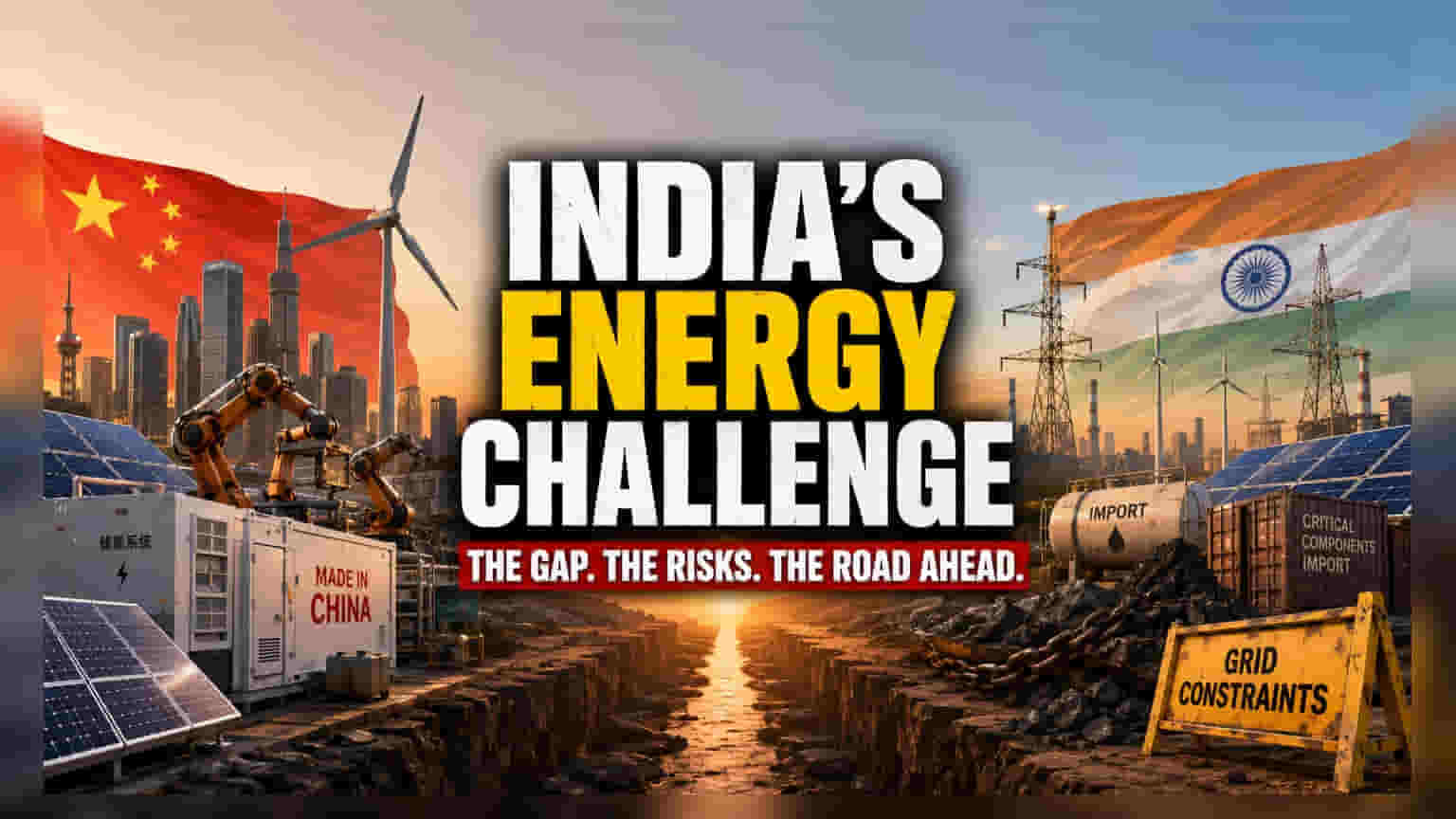


The Capital Disparity
The investment chasm between Beijing and New Delhi is not merely a matter of total dollars; it reflects a fundamental difference in economic architecture. While India has successfully increased its share of global clean energy transition capital to 5%, the raw arithmetic reveals a widening efficiency gap. With China’s energy investment projected to reach $945 billion this year, the sheer velocity of capital deployment in the Chinese market allows for vertical integration that India’s fragmented ecosystem currently struggles to replicate.
The Upstream Bottleneck
India’s clean energy strategy faces a significant friction point in the form of upstream dependency. Although the nation has made strides in module assembly, it remains tethered to foreign suppliers for critical components, including lithium-ion batteries and advanced wind turbine technology. This contrasts sharply with China’s control over more than 90% of global polysilicon, wafer, and PV cell production. For Indian project developers, this creates a volatile cost structure where grid-parity is frequently disrupted by shifting international trade policies and the logistical costs associated with securing essential materials.
The Structural Risk Factor
The persistence of India’s energy import dependency acts as a heavy anchor on its transition objectives. With more than half of its natural gas and crude oil requirements sourced from West Asia, the domestic energy transition is inextricably linked to geopolitical volatility. Market analysts observe that as India ramps up solar photovoltaic investment at an annual rate of 25%, the concurrent decline in domestic fossil fuel production creates a dangerous trade deficit pressure. Unlike China, which uses its massive manufacturing base to offset energy import costs through export dominance, India remains vulnerable to price shocks that threaten to degrade national fiscal health.
Financing and Grid Constraints
Beyond hardware, the institutional constraints surrounding India's energy sector present a formidable barrier to long-term sustainability. Higher costs of capital, coupled with persistent grid connectivity issues, continue to compress internal rates of return for major utility-scale solar projects. While the labor force offers a competitive edge in manufacturing, the absence of aggressive, state-backed industrial policy—similar to the mechanisms that allowed China to dominate the supply chain—leaves domestic players struggling to achieve the economies of scale necessary to challenge the current global hierarchy. The path toward a more resilient energy ecosystem in India will likely require more than just capacity growth; it demands a total overhaul of the upstream component supply chain to mitigate external shocks.