

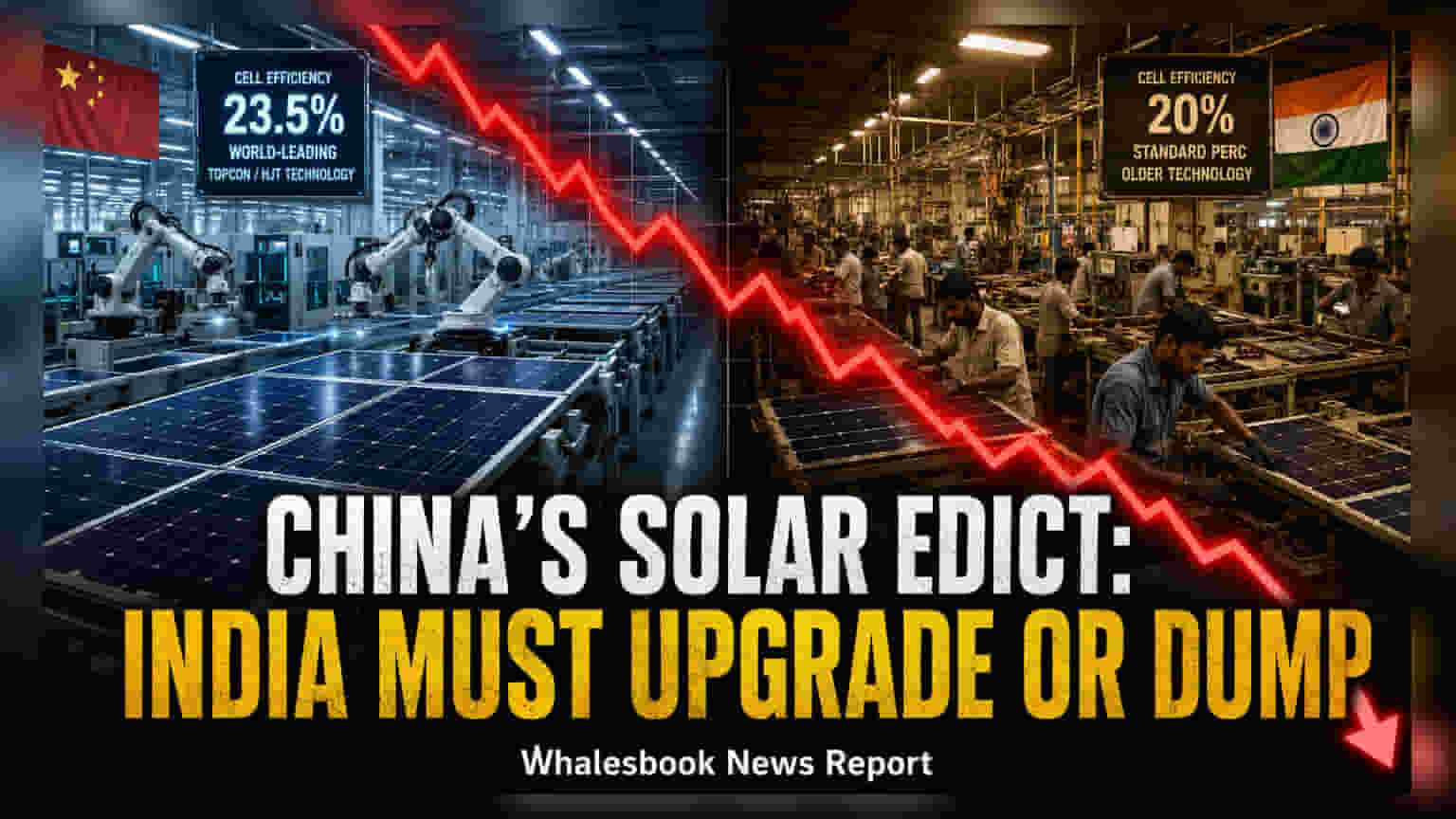
China will ban solar module production below 23.2% efficiency starting January 2027 to clear older stock. For India, this creates a risk of becoming a dumping ground for outdated technology, putting pressure on the government to accelerate its own quality standards under the ALMM framework.
China has announced a mandatory national standard that will prohibit the manufacture and sale of crystalline silicon solar modules that do not meet high-efficiency thresholds starting January 1, 2027. The new rule sets a floor of 23.2% efficiency for TOPCon and HJT modules, and 23.5% for back-contact modules. This move is designed to force the retirement of older manufacturing capacity within China, which could affect nearly 30% of the country's current production capability.
Impact on India’s Solar Strategy
For India, the primary risk is that modules failing to meet China's new, stricter standards could be diverted to other markets, including India. As India aims for its 2030 solar capacity targets, the Ministry of New and Renewable Energy (MNRE) currently manages quality through the Approved List of Models and Manufacturers (ALMM) framework. While the current proposal seeks to gradually lift efficiency floors to 21% by 2027 and 21.5% by 2028, this pace lags behind the upcoming Chinese standard. If India does not align its benchmarks, the domestic market may see an influx of older-generation technology that is no longer acceptable in China.
Why Efficiency Matters for Project Returns
Module efficiency directly influences the total cost of a solar project. In utility-scale plants, roughly half of the total capital cost is tied to land, civil structures, and labor, collectively known as balance-of-system components. Higher efficiency modules require less land to produce the same amount of power, effectively lowering the cost per megawatt. Given that land acquisition is a significant constraint for renewable projects in India, adopting higher efficiency standards is viewed not just as a technology choice, but as a crucial land policy tool.
Financial and Grid Benefits
Newer cell architectures that meet higher efficiency benchmarks also provide long-term financial stability for solar projects. These modules typically feature better temperature performance and lower degradation rates over their 25-year lifespan. Additionally, producing more power from the same connection point improves the return on investment for grid transmission infrastructure. By encouraging the adoption of advanced modules, India could improve the financial viability of solar power projects and reduce long-term operational risks.
Industry Recommendations for the ALMM Framework
Industry participants are advocating for a faster recalibration of the ALMM framework to match international trends. Proposed updates include setting a utility-scale efficiency floor of 22.4% by January 2027, scaling up to 23.2% by 2028. Many Indian manufacturers are already shifting toward TOPCon and other advanced technologies, making these targets technically achievable. A key monitorable for investors will be how the MNRE balances the need for stricter standards with the requirement for a phase-in period, which would allow existing projects to complete construction without being unfairly penalized by new requirements.