

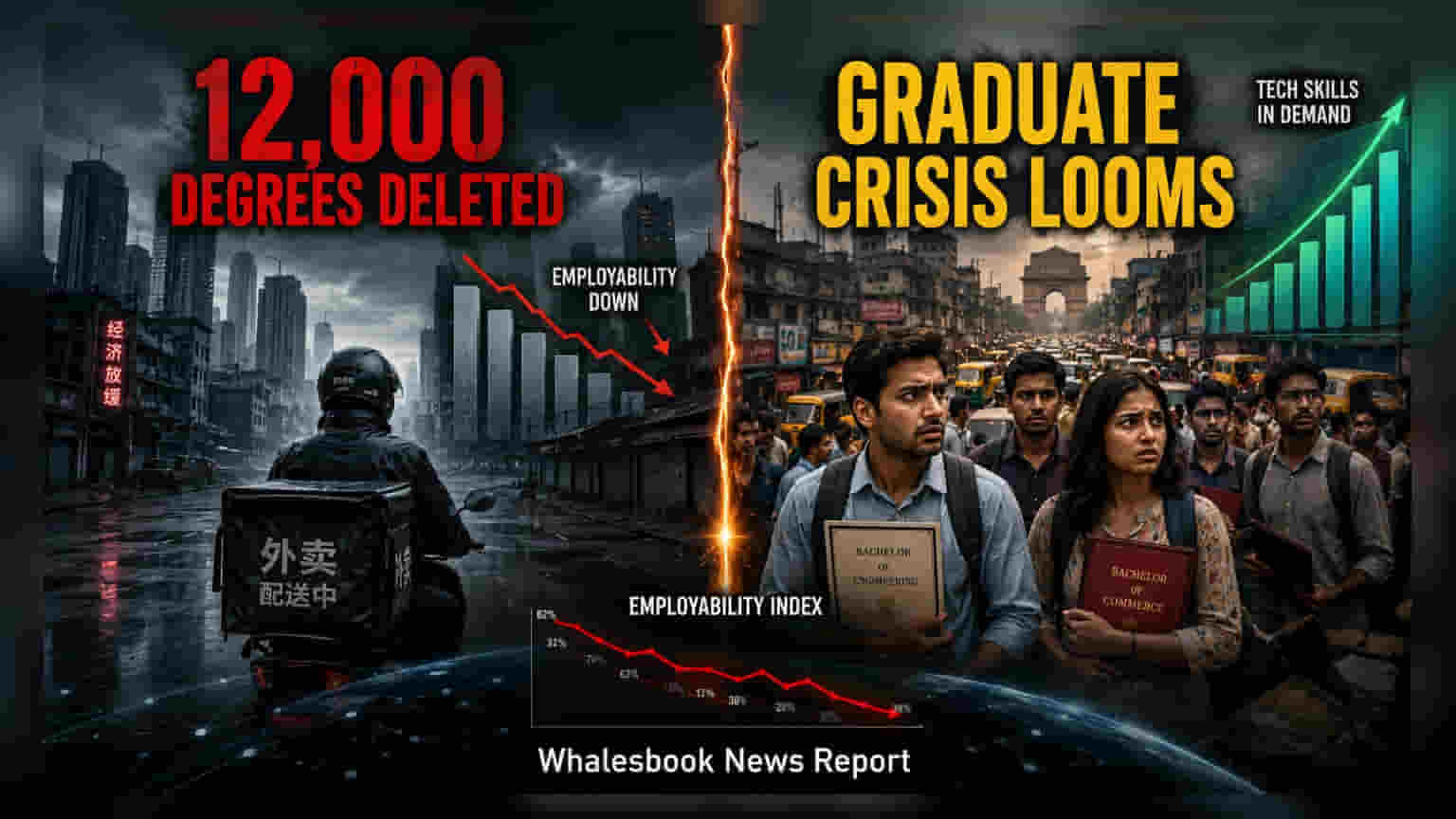
China has suspended 12,200 undergraduate programs to prioritize AI and tech-focused courses amid job market mismatches. This shift highlights the urgent need for India to address its own employability gap, where nearly half of graduates struggle to find relevant roles. Improving job outcomes and vocational training are now essential focus areas for the Indian education sector.
Detailed Coverage
In a major restructuring of its higher education system, China has revoked or suspended 12,200 undergraduate programs between 2021 and 2025. The government has simultaneously introduced 10,200 new courses, heavily weighted toward high-growth technical fields such as brain-computer interfaces, agricultural robotics, and carbon-neutrality engineering. This pivot away from traditional management, arts, and humanities degrees comes as Beijing attempts to solve the paradox of having a massive pool of university graduates who remain unable to secure roles that match their educational qualifications, with many settling for gig economy jobs.
The Skills Gap Challenge in India
For Indian investors and policymakers, this development mirrors a domestic concern. India produces over 10 million higher education graduates every year, yet the India Skills Report 2025 highlights that only 54.8% of these graduates are deemed employable by industry standards. This persistent gap creates a structural challenge: companies struggle to find talent with specific technical or applied skills, while millions of degree-holders remain unemployed or underemployed. The Indian economy faces mounting pressure to ensure that its large workforce can adapt to the rapid integration of artificial intelligence and automation across sectors.
Policy Shifts and Future Outlook
While China is adopting a hyper-specialized model, India is pursuing a different strategy through the National Education Policy 2020. This policy emphasizes multidisciplinary learning and a four-year undergraduate structure, aiming to move away from rigid, single-stream education. The goal is to produce graduates who possess both technical knowledge and soft skills such as critical thinking and communication, which are harder for AI to replace in the long run.
Critical Areas for Growth
To bridge the employability gap and improve return on investment in education, market experts and industry observers point to three key monitorables. First, there is a push for greater transparency, where the University Grants Commission may move toward mandating that institutions publish program-level data on graduate employment rates and salary outcomes, similar to systems used in Australia. Second, the development of hybrid graduates—who combine computational fluency with ethical and analytical reasoning—is becoming a competitive necessity for Indian companies. Finally, the creation of a stronger apprenticeship ecosystem is being discussed as a vital step. A national push for vocational training, modeled after successful frameworks in countries like Germany and Switzerland, could help change the perception of non-degree career paths and provide more practical pathways for youth entering the workforce. Investors may continue to monitor how these reforms impact workforce readiness in the private sector and the overall efficiency of India's labor market.