

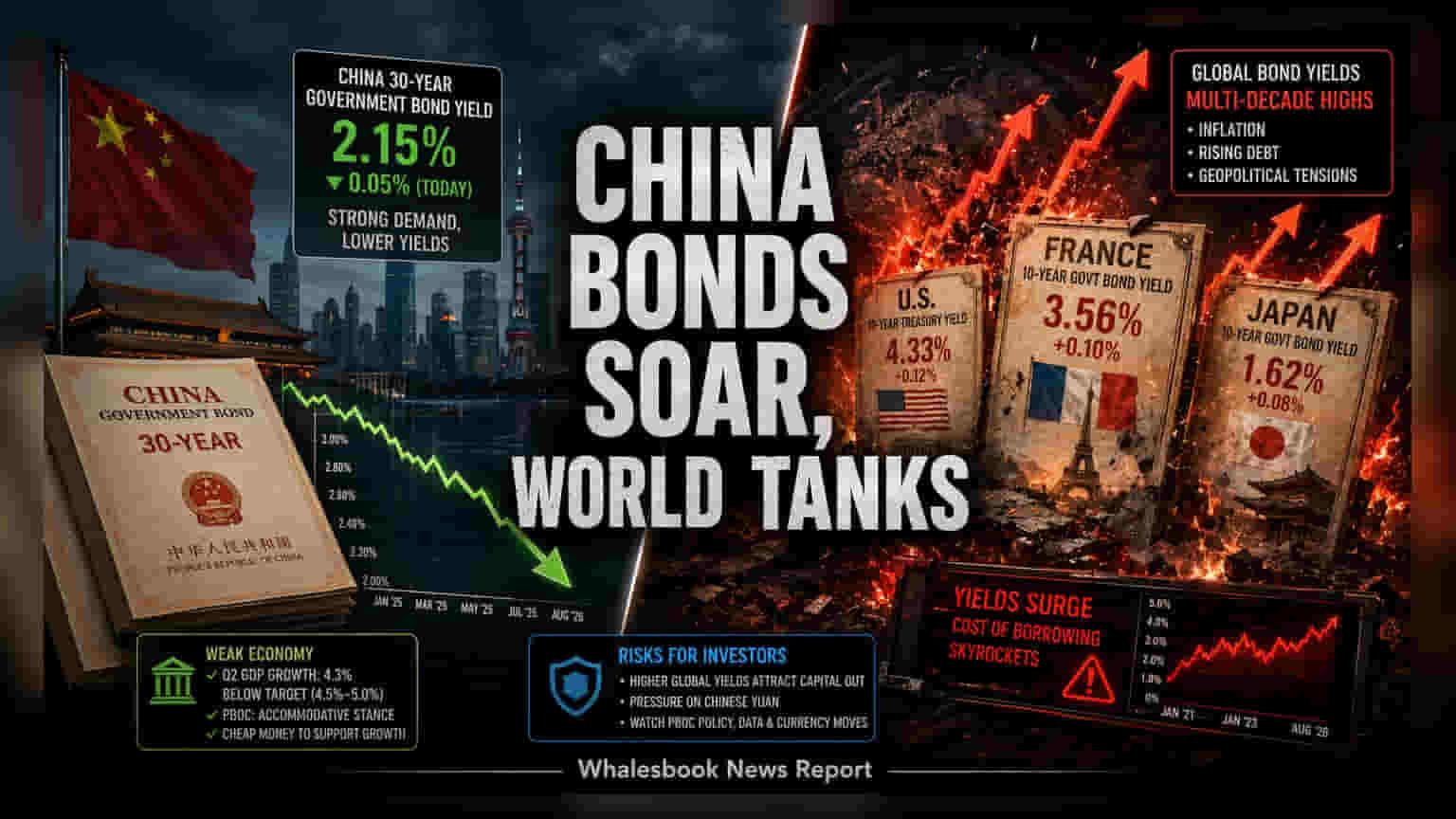
China's 30-year government bond yields have dropped to roughly 2.15%, creating a sharp contrast with the rising borrowing costs seen in other major economies. This trend points to Beijing's push to stimulate a slowing domestic economy, raising questions about potential capital outflows and the future of the yuan.
China's bond market is currently moving in the opposite direction of most major global economies. While the United States, Japan, and European nations are battling high inflation and rising borrowing costs, leading to multi-decade highs in government bond yields, China’s yields are falling.
On Tuesday, the yield on China’s 30-year government bond slipped to approximately 2.15%. In the world of finance, the yield is the return an investor gets for lending money to the government. When these yields drop, it generally indicates that there is strong demand for government bonds or that the market expects the central bank to keep interest rates low to support the economy.
This divergence is largely driven by China's weak domestic economic data. The country’s GDP grew by only 4.3% in the second quarter of 2026, which remains below the government's annual target of 4.5% to 5.0%. Retail sales, industrial output, and investment figures have also remained below expectations. To counter this sluggish growth, the People's Bank of China (PBOC) has signaled an intent to maintain an accommodative monetary stance, which essentially means keeping money cheap and accessible to boost business activity.
While China tries to lower its borrowing costs, the rest of the world is facing a different reality. In the US, Japan, and Germany, government bond yields have soared due to persistent inflation, rising debt levels, and geopolitical tensions. This creates a rare situation where the gap between Chinese yields and global yields is widening significantly.
For investors, this trend presents a potential risk. When interest rates in major economies like the US are much higher than those in China, global investors may choose to move their capital out of Chinese markets and into assets with higher returns. This shift can lead to capital outflows, putting downward pressure on the Chinese yuan.
To manage these risks, China has been looking at new tools to help investors. In August 2026, Hong Kong launched offshore Chinese government bond futures. These tools are designed to help international investors hedge their positions, effectively allowing them to manage the risk of fluctuating bond prices without having to exit the market completely.
Investors will now be watching how Beijing balances the need for economic stimulus with the risk of currency instability. Future updates on the PBOC’s policy decisions, monthly industrial data, and the movement of the yuan against major currencies will be the key indicators to track in the coming months.