

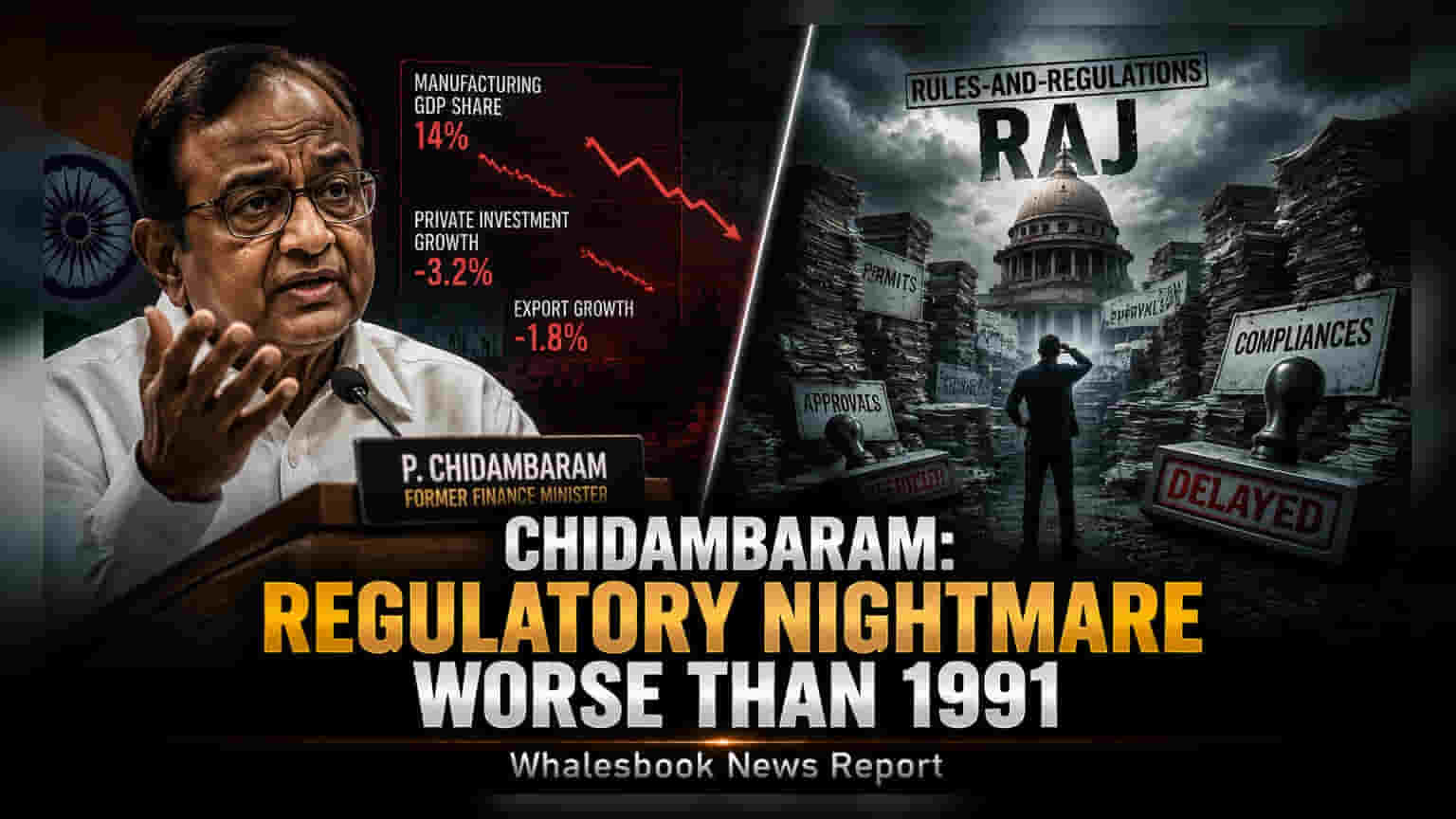
Former Finance Minister P. Chidambaram argued at the Business Today India@100 event that current economic regulations create a restrictive environment even tougher than the 1991 'licence raj.' He questioned the government's heavy reliance on public subsidies for manufacturing and raised concerns about increasing market concentration in key industrial sectors.
Former Finance Minister P. Chidambaram recently delivered a critical assessment of India's current economic landscape, speaking at the Business Today India@100 event. He argued that the present regulatory environment is more restrictive than the pre-liberalization era of 1991, describing it as a 'rules-and-regulations raj.' According to Chidambaram, the economy is currently trapped in a cycle characterized by intense regulation, government investigation, and bureaucratic processes that he believes hinder private business activity.
Manufacturing Subsidies and GDP Contribution
A central point of his critique was the government's push for domestic manufacturing, particularly in high-technology areas like semiconductors. Chidambaram raised concerns regarding the financial structure of these initiatives, noting that public money is currently funding a large share—estimated at 80-85%—of the capital requirements for these semiconductor ventures. He questioned the long-term sustainability of this model, suggesting that such heavy reliance on state support may not foster a truly competitive industrial base.
He also highlighted that the contribution of the manufacturing sector to India’s GDP has remained relatively flat at around 14% for an extended period. For investors, this stagnation point serves as a key economic monitorable, as manufacturing growth is often seen as a prerequisite for sustained job creation and broader economic expansion.
Concerns Over Market Competition
Beyond manufacturing, Chidambaram voiced apprehension regarding market concentration across major sectors. He pointed to telecom, petroleum, cement, and steel as industries that are increasingly dominated by a few large players or oligopolies. This consolidation, he argued, reduces the competitive intensity within the Indian market. He further suggested that the regulatory bodies responsible for maintaining fair competition, such as the Competition Commission of India, may require more robust authority to address the impact of large-scale mergers and acquisitions on the broader market ecosystem.
Foreign Trade and Economic Diplomacy
The former minister also offered a critique of India’s current foreign trade strategy. He expressed disappointment that major trade agreements with significant global economies, including the United States, China, and Germany, have not been finalized. He noted that while India has pursued various trade deals, their limited scope with smaller nations may not provide the economic leverage necessary to address the country's larger trade requirements.
Investors monitoring these issues may track future developments regarding the government's stance on manufacturing subsidies, the pace of trade negotiations with major economies, and any shifts in the regulatory approach to sector consolidation and competition. These factors will likely remain important for understanding the future environment for private sector investment and corporate growth.