

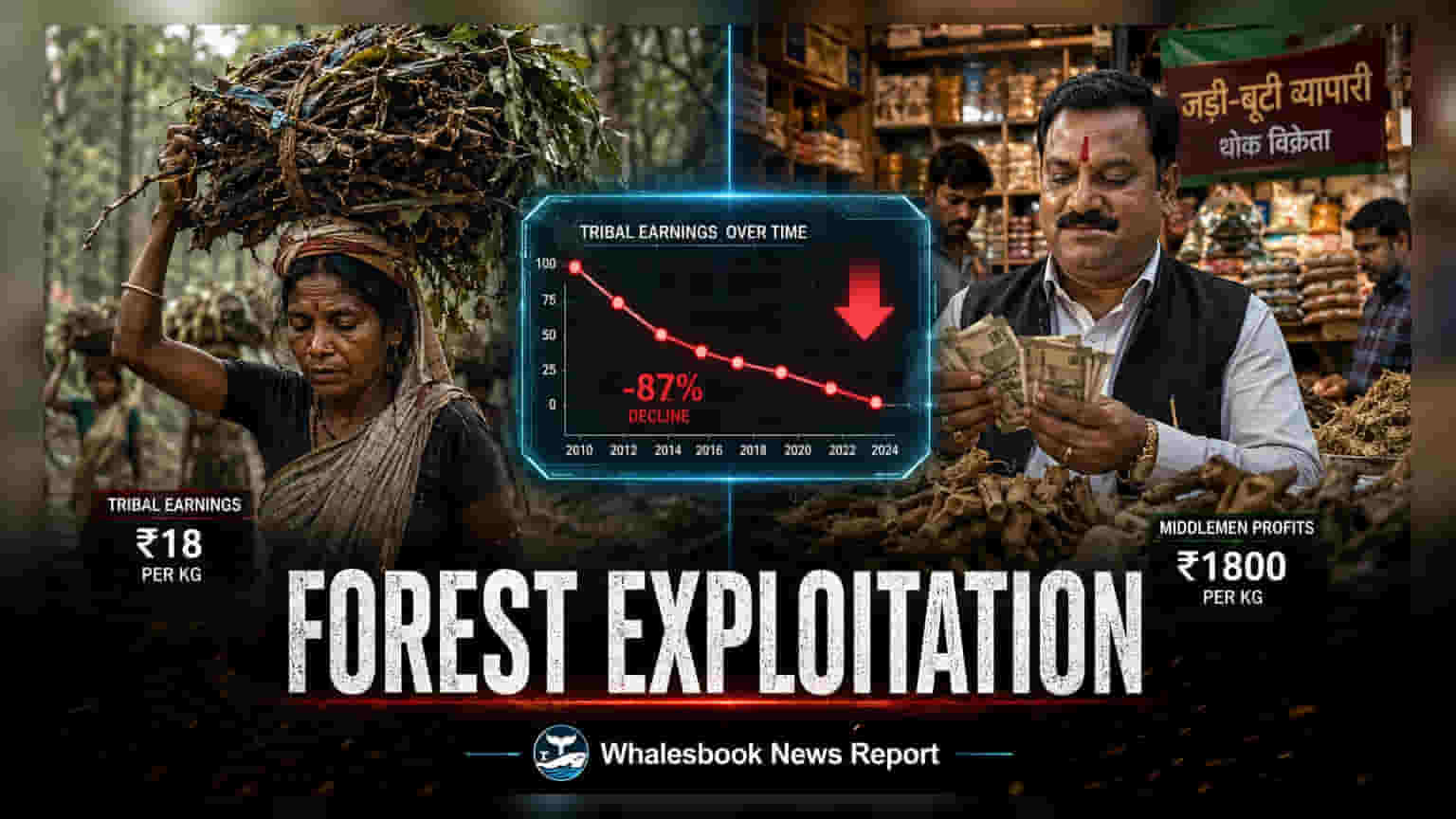
Tribal women in Chhattisgarh’s Nagari block struggle with low earnings from forest produce as government procurement declines. Despite the potential of the minor forest produce market, gaps in supply chain access force collectors to sell to middlemen at distress rates. This highlights the persistent gap between government policy goals and field-level implementation in the tribal economy.
What Happened
In Chhattisgarh’s forest-rich Nagari block, tribal women are facing significant financial distress while collecting minor forest produce (MFP). Despite the high market value of goods like medicinal herbs, tubers, and seeds, these collectors are receiving only a fraction of their worth. In several villages, women report selling produce at minimal prices to middlemen because they lack access to formal government procurement centers. For instance, some collectors receive only ₹40 to ₹50 for five kilograms of medicinal herbs, which would command a much higher price in larger, more accessible markets. This issue is not isolated; it reflects a broader challenge in the local forest produce economy where collectors remain vulnerable to intermediary exploitation.
The MFP Economic Chain
Minor forest produce—ranging from mahua flowers and tendu leaves to medicinal plants and lac—is a critical source of income for millions of tribal families. For many forest-dwelling communities, the sale of these items accounts for a significant portion of their annual earnings, often providing essential cash flow during lean seasons when agricultural work is unavailable. While the government has aimed to formalize this market through the Minimum Support Price (MSP) mechanism and the Van Dhan Yojana, the real economic benefit often fails to reach the primary collectors at the village level. The value chain, from the forest floor to the final commercial market, is frequently broken by high transportation costs and the physical distance to procurement centers, leaving tribal gatherers with little bargaining power.
The Middleman Barrier
Intermediaries often dominate the trade because they provide immediate liquidity and handle the logistics that individual tribal families cannot afford. While government schemes are designed to create 'Van Dhan Vikas Kendras' to aggregate produce and add value, the ground reality shows that many collectors still rely on roadside sales. When procurement centers are distant or inaccessible, as reported in areas like Kamarpara, collectors are forced to trade with whoever is physically present. This dependence prevents them from accessing the support prices set by the government, effectively keeping their income levels suppressed even when the market demand for their produce is high.
Government Policy vs. Ground Reality
Government data indicates that the implementation of procurement schemes has faced inconsistencies. While the MSP for MFP scheme was designed to offer price protection, reported figures from various states show that procurement volumes can fluctuate significantly year-to-year. This lack of stable, consistent procurement infrastructure leaves collectors at the mercy of private traders. Without reliable access to the government's support pricing, the 'value addition' promised by initiatives like the Van Dhan Yojana remains difficult for the average collector to achieve, as they often lack the tools and capital to process their raw findings into higher-value products.
What Investors And Observers Should Track
The core issue for the tribal economy remains the efficiency of the supply chain. Observers and policymakers tracking this sector focus on two main areas: the operational status of local procurement centers and the actual reach of value-addition initiatives. The success of the forest produce economy depends less on the announcement of support prices and more on the logistics of getting the produce from the forest to the aggregator without the need for distressed sales to middlemen. Future monitorables include the number of active, accessible procurement centers and the volume of produce successfully bought at MSP versus the volume sold to private intermediaries.