

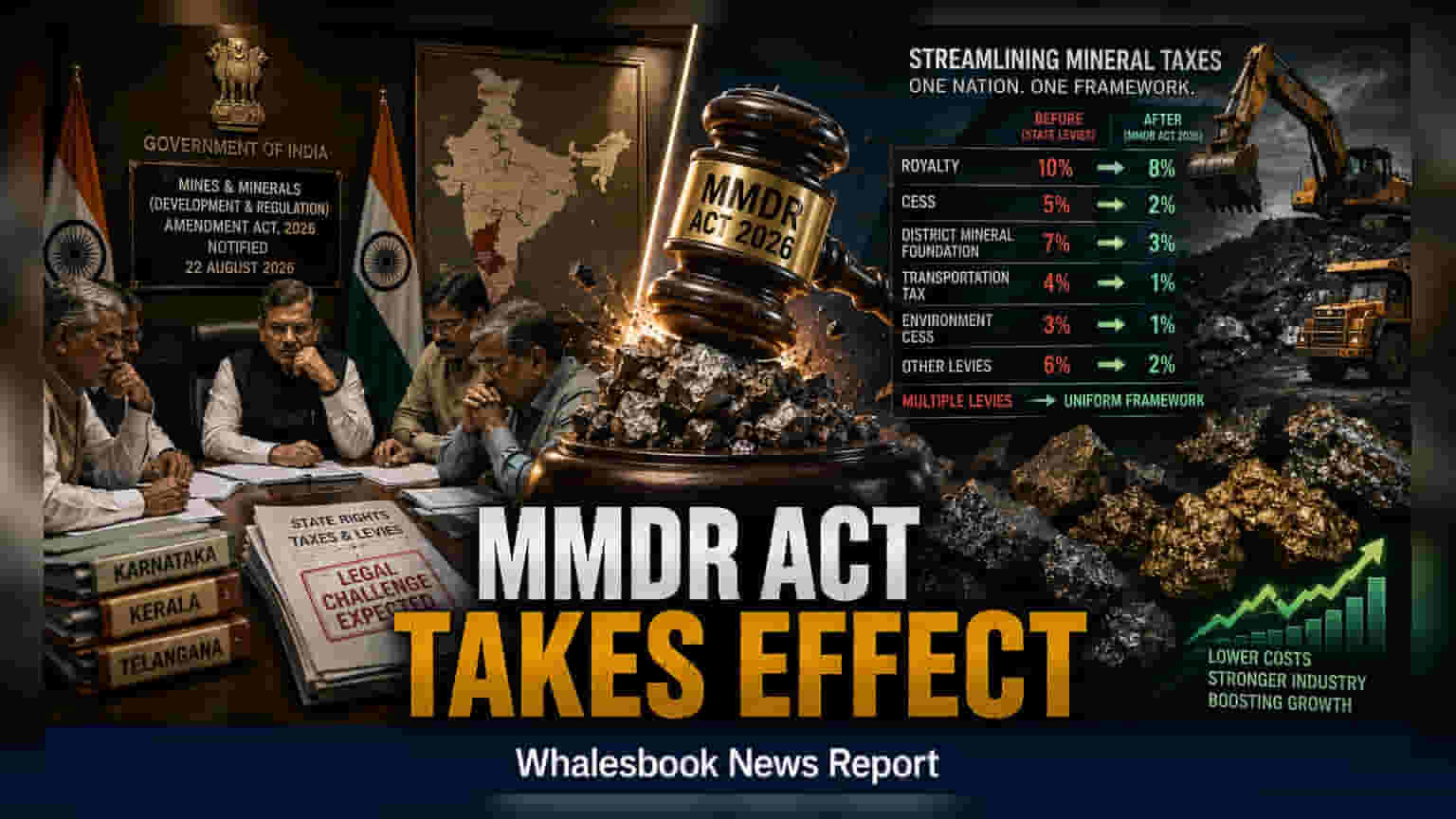
The Indian government has officially notified the Mines and Minerals (Development and Regulation) Amendment Act, 2026, to standardize mineral taxation by limiting state-level levies. While the Centre aims to lower input costs for industries like steel and power, state governments, including Karnataka, Kerala, and Telangana, plan to challenge the act in the Supreme Court. Investors should monitor the potential for legal and regulatory uncertainty.
The Central government officially notified the Mines and Minerals (Development and Regulation) Amendment Act, 2026, on August 22, 2026. This legislation introduces a major change in how mineral rights and mineral-bearing lands are taxed across the country. The Act restricts the authority of state governments to impose their own taxes, cesses, and levies, aiming to replace a fragmented system with a more uniform national framework.
Impact on Industrial Costs
For investors in sectors such as steel, cement, power, and mining, the main goal of this policy is to reduce the cascading effect of multiple state-level taxes. Previously, mining companies had to navigate around 14 different types of state levies, which could account for a significant portion of operating costs. By streamlining these into a more predictable tax structure, the Centre expects to improve the investment climate, boost domestic production of critical minerals, and potentially lower raw material costs for major manufacturing industries.
Legal and Federal Challenges
The implementation of this Act is set against a backdrop of legal friction. The move comes after a 2024 Supreme Court ruling that had previously acknowledged the legislative power of states to tax mineral rights. By overriding the practical implications of that ruling, the Centre has triggered a response from several states. Governments in Karnataka, Kerala, and Telangana have already confirmed their intention to challenge the constitutional validity of the new Act in the Supreme Court.
What Investors Should Monitor
The immediate concern for the market is regulatory uncertainty. As the dispute moves to the Supreme Court, there is a risk of legal hold-ups or conflicting directions that could delay the rollout of the new tax framework. Investors should look out for any interim court orders or central government clarifications that define how existing state dues will be handled.
While the policy is designed to support long-term stability and attract capital, the near-term environment may see tension between the Centre and states regarding revenue rights. The actual benefit to industrial profit margins will depend on how effectively and quickly this uniform framework is implemented without being stalled by ongoing litigation.