

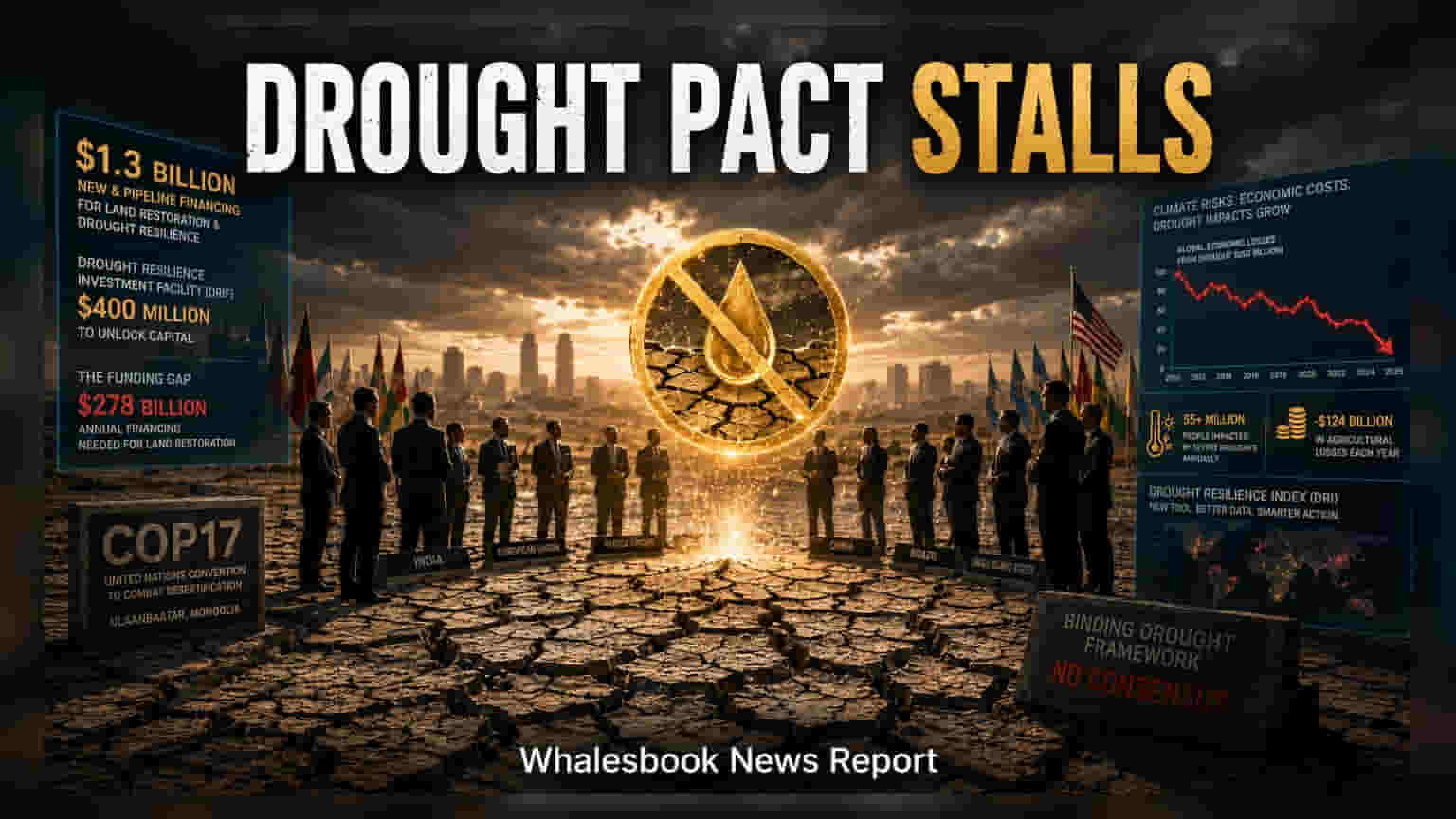
The 17th Conference of the Parties (COP17) in Ulaanbaatar concluded without a binding global drought framework, marking the second consecutive summit to end in a deadlock. Despite the lack of a formal protocol, nations successfully mobilized $1.3 billion in new funding for land restoration. This outcome signals a shift toward voluntary, project-based climate financing, which may influence capital flows into water management and sustainable agriculture sectors.
The 17th Conference of the Parties (COP17) to the UN Convention to Combat Desertification (UNCCD), held in Ulaanbaatar, concluded with a mixed outcome for global climate policy. While negotiators failed to reach a consensus on a binding international drought management framework, the summit did deliver tangible financial results, securing approximately $1.3 billion in new and pipeline financing for land restoration and drought resilience projects.
Financial Flows Amid Policy Gridlock
The inability to formalize a binding drought protocol—largely due to opposition from the United States, which favored domestic and bilateral strategies over multilateral obligations—means that global drought management will remain decentralized for the near future. However, the summit introduced new technical and financial mechanisms to bridge the gap. Key among these is the Drought Resilience Investment Facility (DRIF), which aims to unlock $400 million in capital.
For investors, this suggests that the momentum in the climate space is shifting away from broad, treaty-based mandates toward specific, project-level financing. The existing $278 billion annual funding gap for land restoration remains a significant challenge, but the success in raising over $1 billion indicates that public and private capital is still flowing toward climate adaptation, even in the absence of a unified global rulebook.
Implications for Climate-Sensitive Sectors
For industries exposed to climate risk—such as agriculture, irrigation, water technology, and infrastructure—the failure to secure a binding framework creates a fragmented policy environment. Companies operating in these sectors must navigate a landscape where drought policies vary significantly by region rather than by international standard.
However, the creation of the new Drought Resilience Index (DRI) and the prioritization of drought as a permanent, standalone agenda item for future summits highlight the growing economic importance of soil moisture and water data. As governments increase spending on proactive resilience projects to mitigate future agricultural losses, businesses providing water-saving technology, precision farming tools, and climate-resilient seeds may find more targeted opportunities for growth.
The Path to COP18
The formal discussion on a global drought regime has now been postponed to COP18, scheduled for 2028 in Egypt. Until then, the sector will likely see a continuation of the current 'reactive' funding model, where financial support often arrives as a response to crises rather than as part of a pre-planned, systematic strategy. Investors monitoring the space should look for updates on how the $1.3 billion in committed funding is deployed and whether the new technical initiatives succeed in attracting larger private sector participation in water and soil restoration projects.