

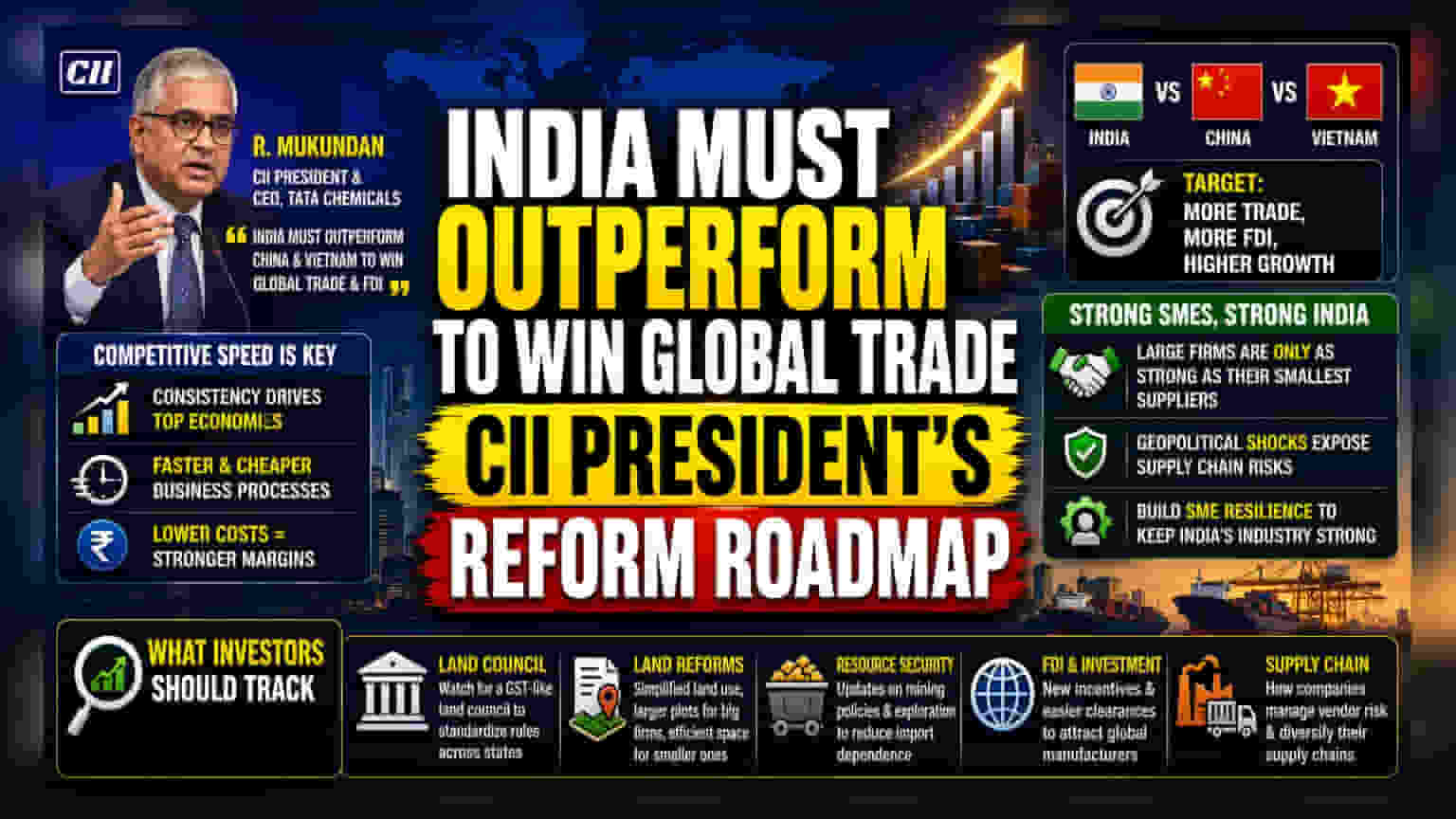
CII President R. Mukundan has urged for faster business reforms and land policy changes to improve India’s competitiveness against manufacturing hubs like China and Vietnam. For investors, the focus remains on how these policy shifts could reduce project execution risks and stabilize supply chains for Indian companies.
What Happened
Confederation of Indian Industry (CII) President R. Mukundan, who also leads Tata Chemicals as its CEO, has called for urgent reforms to boost India’s economic competitiveness. He warned that India must outperform rivals like China and Vietnam to capture a larger share of global trade and attract more Foreign Direct Investment (FDI). The core of his message is that while India’s growth story remains strong, the speed and cost of doing business must improve significantly to sustain this momentum.
The Need For Competitive Speed
Mukundan noted that consistency is the key differentiator for top-performing economies. While China and Vietnam have maintained steady growth for over two decades, India’s goal is to move beyond matching these peers. For investors, this translates into the importance of efficiency. When a country improves the "ease of doing business," it typically lowers operational costs for corporations, helping to protect profit margins. Mukundan emphasized that the country needs continuous, not sporadic, reforms to ensure that processes are fast and cost-effective.
Why SME Stability Matters To Large Firms
One of the critical points raised was the role of Small and Medium Enterprises (SMEs) in the broader industrial value chain. Recent geopolitical events, such as the crisis in West Asia, showed how quickly trade routes and supply lines can be disrupted. Mukundan pointed out that large corporations are often only as strong as their smallest vendors. If a small supplier faces a crisis, it can halt the operations of a large manufacturing company. Consequently, building resilience among SMEs is not just a social goal but a financial necessity for large-cap companies to ensure their production lines keep moving.
Land Policy And Resource Security
CII has proposed structural changes to land policy, including the creation of a 'land council' similar to the GST Council, to standardize rules between central and state governments. For investors, this is a major monitorable. Land acquisition is often the biggest cause of project delays and cost increases in India. If the government succeeds in simplifying land use—by offering larger plots for big firms and better floor space efficiency for smaller ones—it could lead to faster project commissioning and better capital allocation for companies.
Additionally, Mukundan stressed the need for India to rely more on its own domestic resources. He noted that the country remains largely underexplored for minerals and vital raw materials. Relying on domestic mining can reduce import dependence, making Indian industries less vulnerable to global price fluctuations and supply shocks.
What Investors Should Track
Investors may look beyond the headlines and watch for the actual implementation of these suggested reforms. Key monitorables include the formation of a 'land council,' changes in state-level mining policies, and any new incentives for large multinationals looking to set up operations in India. Additionally, watching how large manufacturers manage their vendor risk—ensuring their supply chains are diversified—can be an indicator of operational maturity and risk management.
While these policy changes aim to support long-term growth, the pace of reform remains a variable. Investors should pay attention to whether these proposals translate into tangible improvements in the time taken for companies to start and run their projects.