

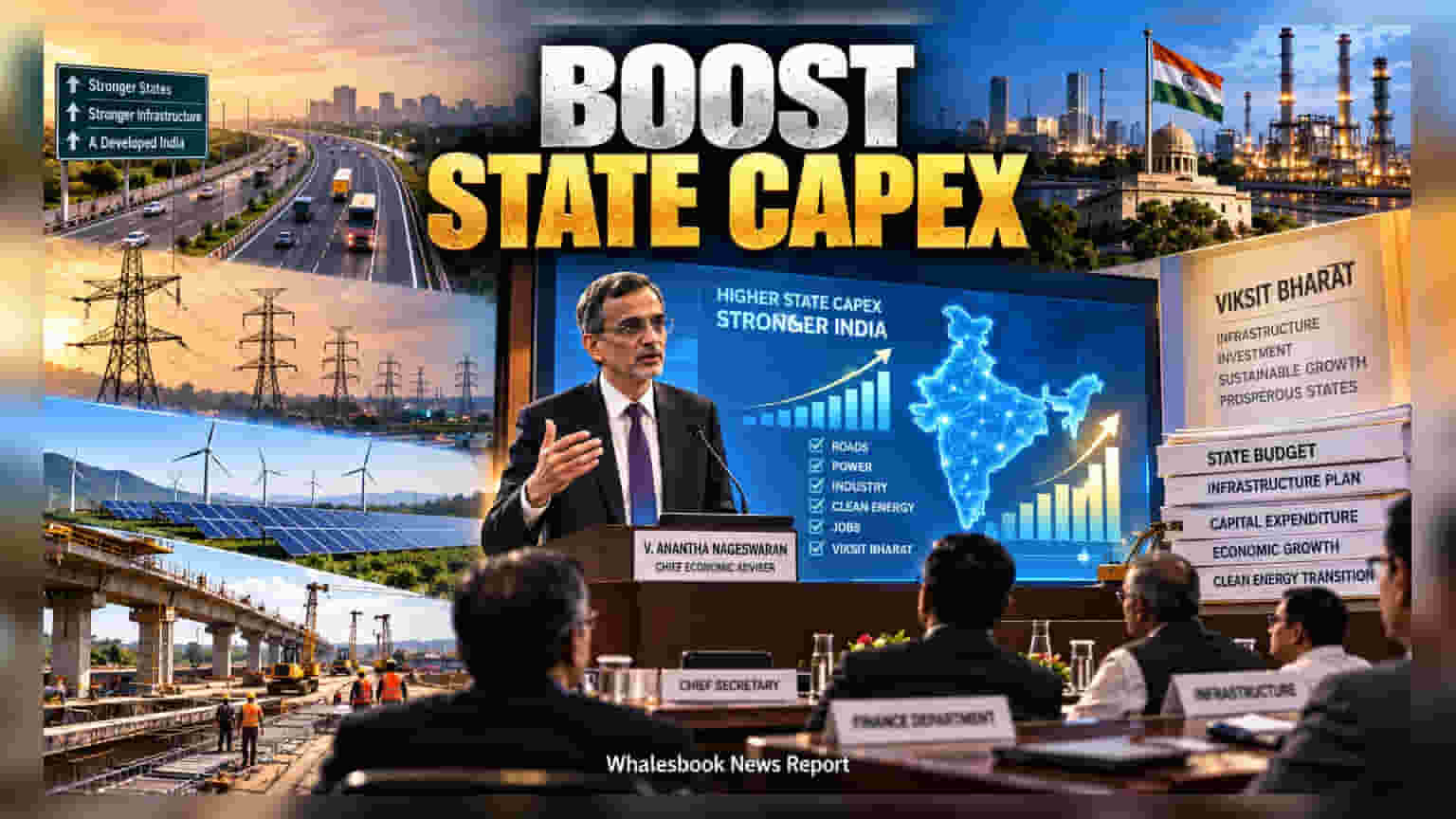
Chief Economic Adviser V. Anantha Nageswaran has asked states to increase their capital spending to 3% of their GSDP by 2031-32. He emphasized that better project preparation and easier land and utility clearances are vital to attract private investment. For investors, this shift highlights a long-term focus on infrastructure and industrial growth, though success depends on state-level fiscal health and project execution.
Chief Economic Adviser V. Anantha Nageswaran has called on Indian states to prioritize spending on capital assets, such as roads, power plants, and industrial infrastructure, to support the country's long-term economic development goal, known as Viksit Bharat. Speaking at a conference on India’s development financing, the CEA stressed that states need to maintain high levels of capital expenditure, even while managing tight state budgets. A key proposal discussed at the event, put forward by former Maharashtra Additional Chief Secretary Sudhir Shrivastava, suggests raising state-level capital spending to 3% of the Gross State Domestic Product (GSDP) by the 2031-32 financial year, up from the current level of approximately 2.4%.
The Link Between State Spending and Private Growth
For investors, the push for higher state capital expenditure is significant because states are responsible for a large share of the country's total infrastructure spending. When state governments build better roads, reliable power grids, and efficient logistics systems, it lowers the cost of doing business for private companies. This phenomenon, often called crowding-in, occurs when government spending creates the necessary environment for private firms to invest their own capital. The CEA noted that improving project preparation—such as having clear, credible project reports—and simplifying clearances for land and power connections are essential to make states more attractive for this private investment.
Fiscal Challenges and Execution Risks
While the goal of hitting 3% of GSDP is ambitious, it faces practical hurdles. Indian states operate under strict fiscal rules that limit how much they can borrow and spend. Many states are already dealing with high debt levels, which limits their ability to increase spending without support from the central government. In recent years, the central government has provided interest-free loans to help states boost their capital spending, but sustainable long-term growth will require states to manage their own revenues and expenses more efficiently.
Investors should also note that the actual impact of such policy pushes often depends on execution. Historically, state-level projects have faced delays due to land acquisition issues, slow regulatory approvals, and funding gaps. Even if a state announces a large infrastructure plan, the benefit to industrial or engineering companies usually appears only when the project actually begins construction and starts using capital.
Sectors to Monitor
The push to upgrade power transmission, improve water and irrigation systems, and expand renewable energy capacity suggests a long-term demand for services from sectors like construction, capital goods, engineering, and power equipment. The conference specifically highlighted energy transition technologies, such as battery storage, pumped storage, and carbon-capture frameworks, as key areas for financing. As working groups from state governments begin to identify their specific financing needs, investors will look for details on which states are managing to speed up their project pipelines and which are facing the most significant financial constraints. Tracking the progress of these specific projects and checking state-level budget reports in the coming months will provide a clearer picture of whether these growth targets are being met.