 Whalesbook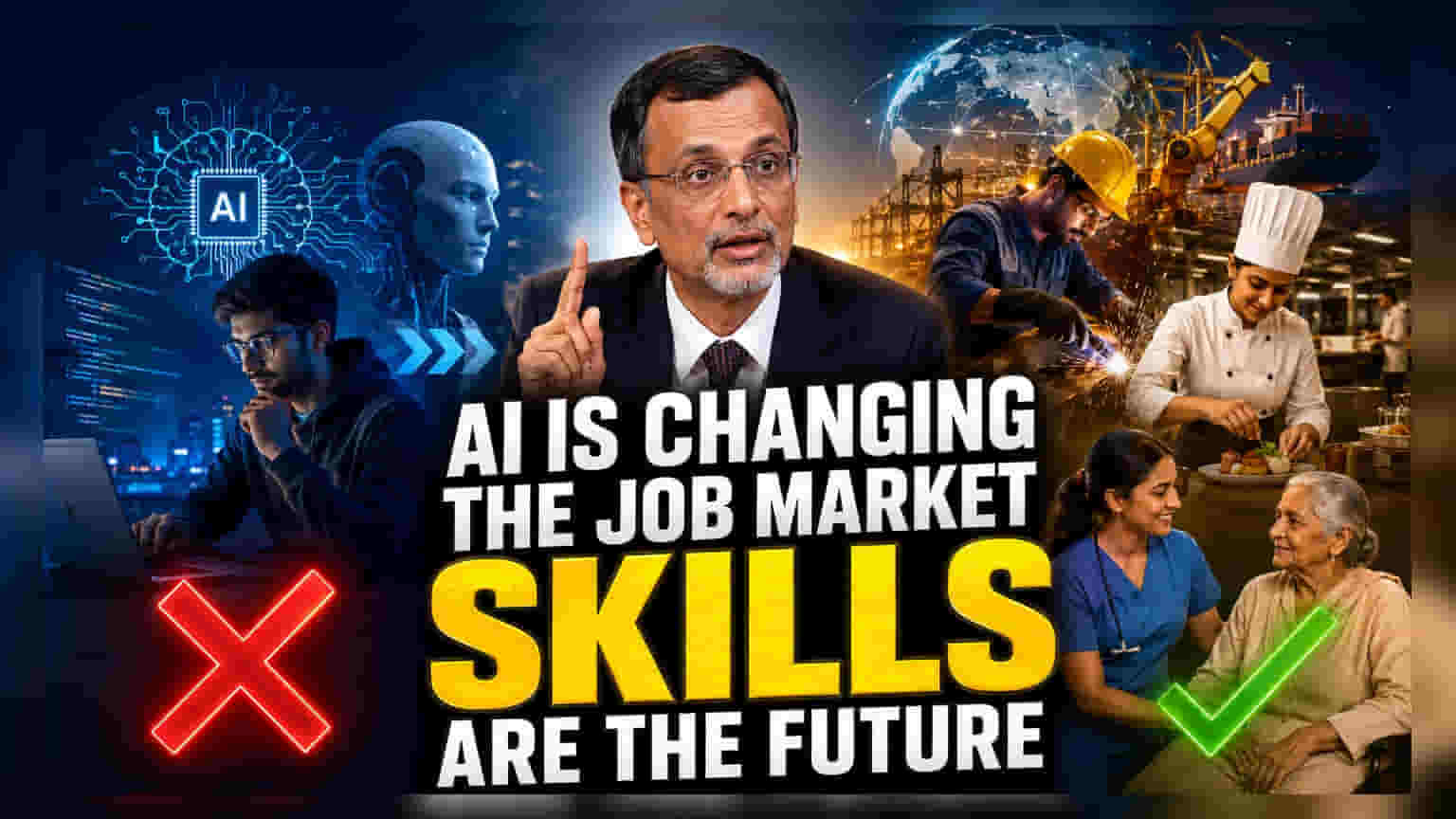


Chief Economic Advisor V. Anantha Nageswaran has warned that the era favoring software and MBA degrees is fading as AI reshapes the job market. He urged Indian youth to pivot toward vocational and human-centric skills, emphasizing that manufacturing and trade expertise are essential for India's future competitiveness. This signals a potential shift in the national focus toward addressing the 'employability' challenge alongside unemployment.
What Happened
Chief Economic Advisor (CEA) V. Anantha Nageswaran has cautioned that the period of prioritizing software and MBA degrees is coming to an end as artificial intelligence fundamentally alters the job market. In a recent interview, he urged Indian youth to shift their focus toward vocational, manual, and human-centric skills that are harder for AI to replace. The CEA highlighted that India faces a significant challenge in balancing both unemployment and employability, and that the country needs a strategic pivot to boost manufacturing competitiveness in a fragmenting global economy.
The Shift in Job Market Dynamics
The CEA’s comments reflect a growing acknowledgment of how AI is disrupting traditional white-collar roles that previously relied on a standard educational template. While India benefited significantly from a globalization-led model in software services, the CEA noted that the world is becoming more protectionist and insular. This shift makes it necessary for India to rely less on service-sector outsourcing and more on domestic manufacturing and skilled trades.
The 'Dual Challenge' of Employment
A central point in the CEA’s analysis is the difference between unemployment and employability. He emphasized that India cannot afford to ignore either. The 'livelihood problem'—or unemployment—cannot be solved using the same capital-intensive growth models seen in Western countries. He argued that while some industries must be capital-intensive to compete globally, there remains immense potential in labor-intensive sectors such as caregiving, hospitality, culinary arts, sports education, and specialized child or elder care. These areas, according to the CEA, are less susceptible to AI-driven displacement and offer significant global demand.
Importance of Vocational Expertise
Drawing comparisons with East Asian and European models, including Japan, South Korea, Switzerland, and China, Nageswaran pointed out a cultural gap in how India views manual labor. He noted that in these nations, vocational expertise is accorded significant respect, whereas in India, roles like plumbing, welding, and electrical work are often viewed as 'unfashionable.' He stated that this attitude must change for India to develop a robust skilled workforce that can underpin a competitive manufacturing sector.
How Investors May Read This
Investors and market participants may view these comments as a signal of evolving government policy priorities. The government's continued emphasis on programs like the Skill India Mission suggests a long-term push to bridge the gap between education and industry requirements.
For the IT and services sectors, the CEA's perspective aligns with broader industry trends showing a shift away from volume-based hiring toward outcome-based models, as firms increasingly integrate AI to improve efficiency. For the manufacturing sector, the focus on 'trade skills' may suggest that policy support will continue to prioritize industrial capability, provided that companies demonstrate productivity and international competitiveness.
What Investors Should Track
As the economic landscape adjusts to these shifts, the following developments will be key to monitor:
- Skill Development Outcomes: Progress in government and private sector initiatives aimed at creating a workforce ready for high-precision manufacturing and specialized services.
- IT Hiring Trends: Whether major IT firms continue to reduce traditional entry-level hiring in favor of specialized, AI-capable talent.
- Manufacturing Growth: Updates on the performance of manufacturing clusters and the success of policies that tie government support to productivity and export competitiveness.
- Policy Initiatives: Any new framework or incentive structures introduced to encourage vocational training or the establishment of specialized technical institutes that align with global manufacturing standards.