 Whalesbook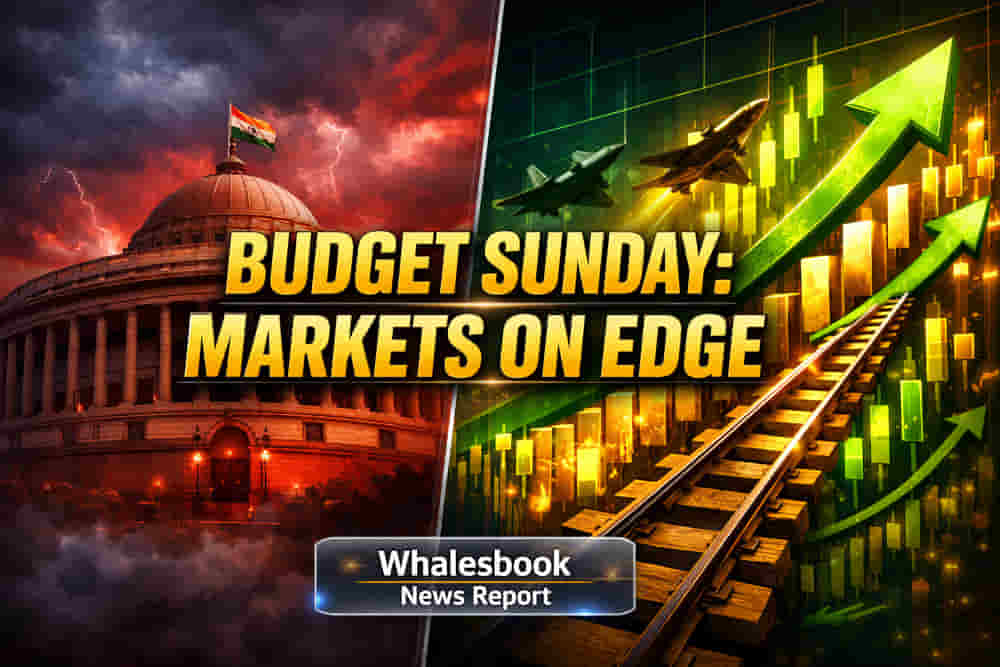
1. THE SEAMLESS LINK
The nation's financial markets are abuzz with activity today, February 1, 2026, as Finance Minister Nirmala Sitharaman prepares to unveil the Union Budget 2026. This significant fiscal event has necessitated an unusual trading session on a Sunday, a market rarity marking only the second instance of Indian stock exchanges operating on a weekend since Independence. The market's anticipation and subsequent reaction are being shaped by a combination of persistent foreign institutional investor (FPI) selling, global economic headwinds, and specific sectoral expectations tied to anticipated government spending. Investors are carefully evaluating the potential for a growth-oriented fiscal policy against the backdrop of ongoing market volatility.
2. THE STRUCTURE (The 'Smart Investor' Analysis)
Budget Day Volatility and Market Retreat
Indian equity benchmarks, the NSE Nifty50 and the BSE Sensex, concluded Friday's trading session with losses, interrupting a three-day winning streak. The Nifty50 saw a dip of 0.39%, closing at 25,320.65 points, while the Sensex declined by 0.36%, settling at 82,269.78 points. This cautious sentiment preceding the budget announcement was amplified by substantial foreign portfolio investor (FPI) outflows, which totaled ₹38,740 crore in January, though analysts noted a moderation in the selling pace towards the month's end. The broader market sentiment throughout January reflected these pressures, with benchmark indices experiencing their weakest performance since 2021. This downturn was attributed to elevated volatility in anticipation of the Budget and increased geopolitical tensions.
Sectoral Focus Amidst Capex Push
Brokerage firm Motilal Oswal projects that the Union Budget 2026 will prioritize significant capital expenditure (capex) allocations across several key sectors. Defence, infrastructure development, affordable housing, the power sector, and capital goods industries are expected to be primary beneficiaries. The budget is also anticipated to introduce measures enhancing credit accessibility for microfinance institutions (MFIs), MSME loans, and housing finance companies, alongside procedural reforms aimed at improving the ease of doing business. Consequently, state-owned railway-linked stocks, including IRCTC and RailTel, along with defence manufacturers such as Bharat Electronics and Hindustan Aeronautics (HAL), are likely to attract heightened investor interest. Companies operating in cement, building materials, electricals, and consumer discretionary segments are also identified as potential gainers due to anticipated boosts in domestic demand and targeted fiscal support.
Economic Backdrop and Global Influences
The market's performance is being evaluated against the prevailing economic climate. Analysts, such as VK Vijayakumar, Chief Investment Strategist at Geojit Investments, suggest that the Economic Survey's optimistic growth outlook for fiscal year 2027, combined with moderating inflation, could foster a supportive environment for corporate earnings. However, global economic uncertainty and signs of a potential slowdown continue to exert pressure on market sentiment. Internationally, U.S. equity markets recorded losses on Friday, influenced by President Trump’s nomination of Kevin Warsh as Federal Reserve Chair and a stronger-than-expected inflation print. This global caution, coupled with domestic FPI withdrawals, reinforces the conservative stance adopted by many investors.
Brokerage Outlooks Signal Nuanced Strategy
Investment strategies are evolving in response to the dynamic market conditions. Nuvama advises a defensive investment bias, recommending overweight positions in telecom, internet, IT, consumer staples, cement, and chemicals sectors. Conversely, they suggest maintaining underweight positions in BFSI, industrials, autos, and power sectors. This approach indicates a preference for stability and less cyclical exposure as investors await definitive policy signals from the Budget. Geojit Investments' analysis notes that foreign institutional investors (FPIs) are likely to hold off on significant investment decisions until Budget cues are clearer, emphasizing the event's role in guiding future capital flows.