

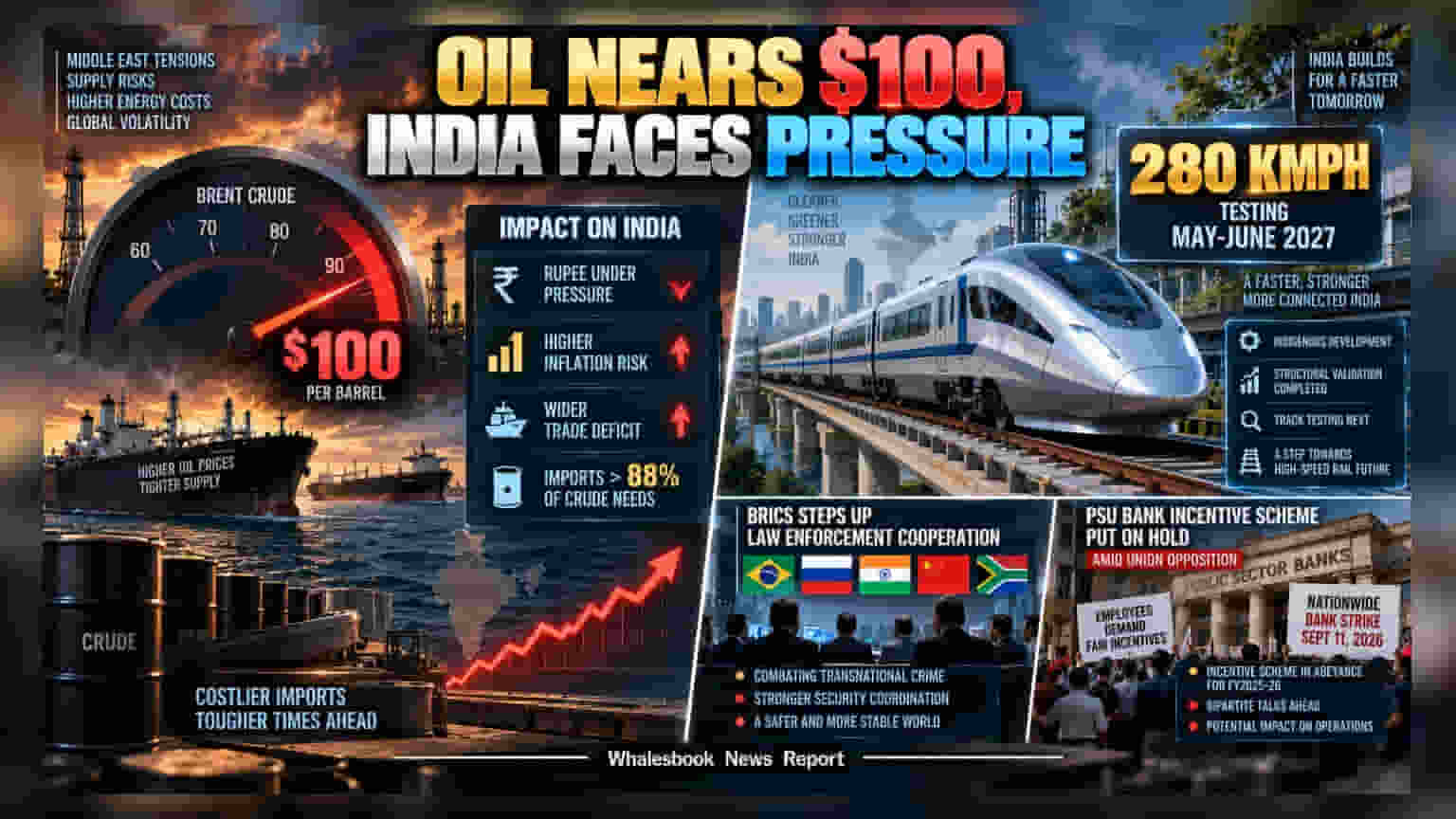
Brent crude has touched nearly $100 per barrel amid geopolitical tensions, raising inflation and trade risks for India. In other developments, BEML is set for bullet train prototype testing in 2027, while public sector banks face potential labor unrest following the suspension of a performance-linked incentive scheme.
Global oil markets are tightening as Brent crude approaches the $100 per barrel mark, driven by escalating supply concerns in the Middle East. For India, which relies on imports for over 88% of its crude requirements, this price surge creates immediate macroeconomic pressure. An extended period of high energy costs typically widens the country's trade deficit, puts downward pressure on the rupee, and introduces fresh inflation risks that can influence the Reserve Bank of India’s monetary policy decisions.
From an equity market perspective, the impact is sector-specific. Oil marketing companies often face margin pressure when fuel costs rise, especially if those costs are not fully passed on to consumers. Conversely, domestic energy producers may see improved realisations, though the overall market sentiment is often dampened by the broader inflationary concerns associated with expensive oil.
BEML advances on high-speed rail
In the infrastructure space, BEML has achieved a key milestone for India’s high-speed rail aspirations. The company’s domestically manufactured eight-coach bullet train prototype is officially scheduled for track testing in May-June 2027. This development follows the successful structural validation of the train's body frame.
For investors, this marks a significant operational step for the state-owned engineering company. While commercial production timelines and order visibility remain the primary long-term factors to watch, the successful movement into the testing phase demonstrates progress in India’s localisation programme for high-speed rail technology.
PSU bank incentive scheme suspended
The government has placed the performance-linked incentive scheme for public sector bank (PSB) employees in abeyance for the 2025-26 financial year. This decision follows growing union opposition and has become a point of contention ahead of a nationwide bank strike scheduled for September 11, 2026. The matter is now expected to undergo further bipartite discussions between bank management and employee unions.
For the banking sector, this labour-relations challenge is a monitorable event. Continued friction between management and employees, particularly if it leads to prolonged strikes, could affect operational efficiency or service delivery in the near term.
Investors are currently balancing these mixed developments. The macro risks posed by rising crude prices remain the dominant theme for the broader market, while the BEML bullet train update offers a more specific, project-driven narrative. Meanwhile, the developing situation regarding the PSB incentive scheme and the upcoming bank strike will be the key operational factor to watch for the banking sector in the coming days.