

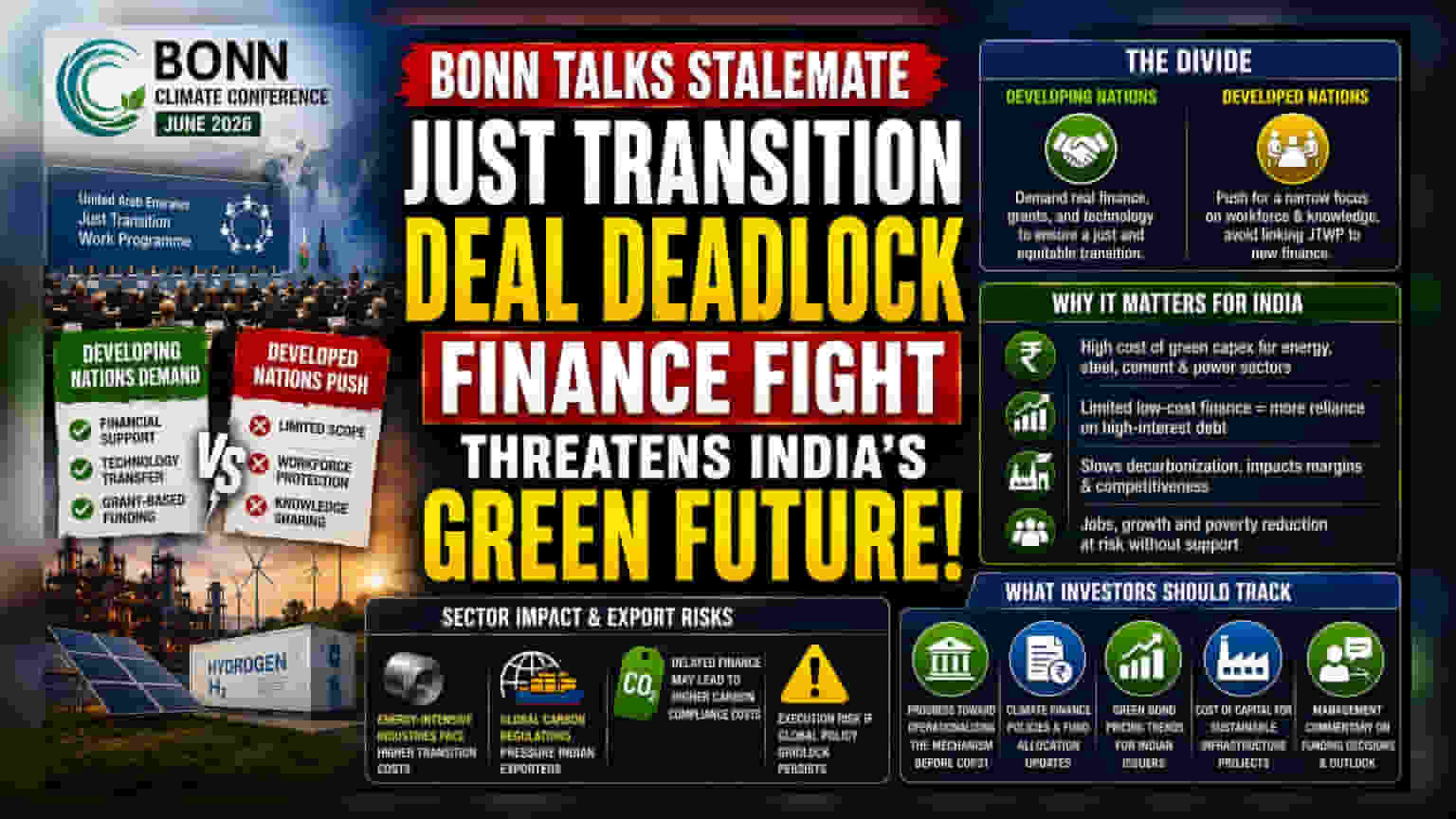
Global climate talks in Bonn have hit a deadlock over how to fund the 'Just Transition' mechanism. Developing nations are demanding grants, while developed countries prioritize workforce training. For Indian investors, this stalemate points to uncertainty in global climate finance, which may impact the cost of capital for Indian companies scaling up green energy and sustainable manufacturing projects.
What Happened
At the Bonn Climate Conference, discussions regarding the United Arab Emirates Just Transition Work Programme (JTWP) have reached a stalemate. The initiative, established during COP28, aims to help nations reduce carbon emissions without harming economic growth or jobs. However, a significant rift has emerged between developing and developed nations. Developing countries, including various emerging economies, are pressing for the mechanism to include substantial financial support, technology transfer, and grant-based funding. Conversely, developed nations, such as the European Union and the UK, are pushing to keep the scope limited, focusing primarily on workforce protection and knowledge sharing rather than direct implementation finance.
Why This Matters For Indian Industry
This debate is not just a diplomatic disagreement; it has clear implications for the cost of doing business in India. Many large Indian conglomerates and utility companies are currently in the middle of massive investments in green energy, hydrogen, and carbon-reduction technologies. These projects require significant capital expenditure, often referred to as green capex. If global climate finance remains trapped in political gridlock and fails to provide concessional or grant-based funding, Indian companies may have to rely more on high-interest market debt to fund their transition. This could lead to higher debt pressure and affect profit margins for companies in energy-intensive sectors like steel, cement, and power utilities.
The Finance Versus Workforce Divide
For investors, the core issue is the type of support expected. Developing nations argue that without grants or low-cost climate finance, the cost of transitioning away from fossil fuels is a burden that could stall poverty reduction efforts. They reject debt-based instruments that increase their national borrowing burden. Developed nations, however, fear that linking the JTWP directly to large-scale finance will duplicate existing international financial structures. This conflict matters because it creates uncertainty. If the international financial architecture for climate action remains fragmented, the expected flow of cheaper, 'green' capital to emerging markets may be slower or more expensive than previously anticipated.
Sector Context and Export Risks
Indian exporters, particularly in manufacturing, are increasingly facing pressure from global carbon regulations, such as the Carbon Border Adjustment Mechanism (CBAM) in Europe. To remain competitive, these companies must decarbonize their production lines quickly. If international climate finance is not clearly defined or accessible, these firms face a dual challenge: they must spend heavily to modernize their factories while navigating a global landscape where climate finance is becoming harder to secure. Investors should be aware that companies relying heavily on international green funding partnerships may face execution risks if these global policy discussions do not yield clear financial pathways.
What Investors Should Track
Investors should monitor developments ahead of COP31 in Türkiye, where the operationalization of the mechanism is a key goal. Specific monitorables include updates on climate finance allocation policies, trends in green bond pricing for Indian issuers, and any changes in the cost of capital for sustainable infrastructure projects. Additionally, management commentary from large power and manufacturing firms regarding their funding sources for decarbonization will provide a clearer picture of how these global policy shifts are affecting corporate balance sheets on the ground.