

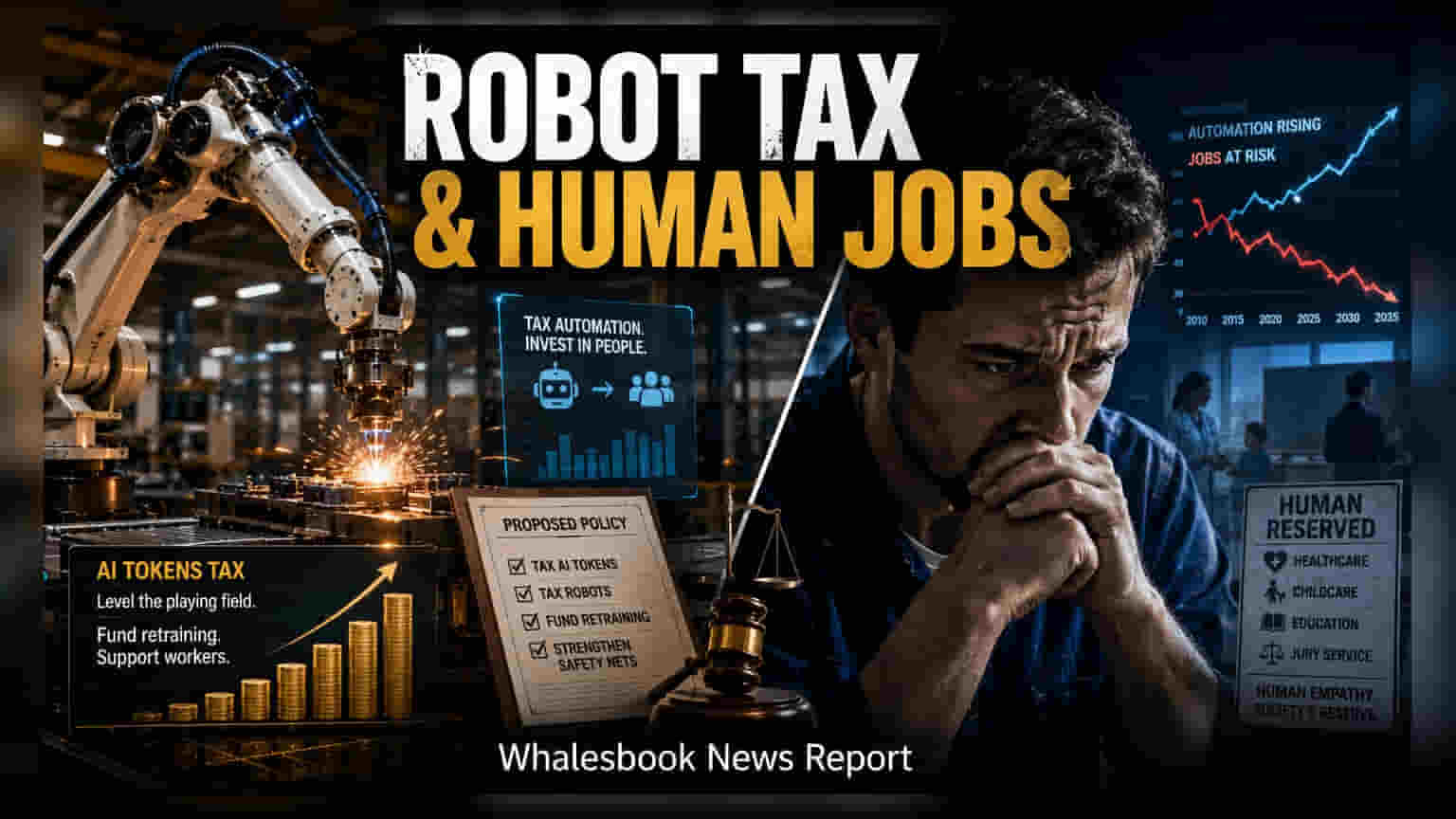
Microsoft co-founder Bill Gates has proposed taxing AI tokens and robots, while suggesting that certain roles should remain 'human reserved.' For investors, this signals potential policy shifts that could impact the cost of business for companies heavily dependent on automation, potentially affecting long-term profit margins.
Microsoft co-founder Bill Gates has released a new 6,000-word essay titled 'The turbulent AI era is here,' proposing major policy changes to manage the rise of artificial intelligence. While these suggestions are not currently government policy, they reflect a significant shift in how industry leaders are thinking about the intersection of technology and the labor market. His proposal focuses on two primary ideas: creating protected job categories for humans and implementing a new tax structure for automation.
The Logic Behind Taxing AI and Robots
Gates argues that the current tax system creates a lopsided incentive structure. In many countries, businesses can deduct the cost of buying robots and software as capital investments, while they pay taxes on human labor. This setup often encourages companies to replace workers with machines not just for efficiency, but to save on tax and payroll costs. To level the playing field, he suggests taxing 'AI tokens'—the units of data processed by AI models—and robots directly. The goal is to use this tax revenue to fund worker retraining programs and strengthen social safety nets for those displaced by automation.
Impact of 'Human Reserved' Zones
The second part of the proposal introduces the concept of 'Human Reserved' domains. Gates compares these to nature reserves, suggesting that society should legally restrict or prohibit AI in certain roles where human empathy is irreplaceable. He highlights sectors such as healthcare, childcare, education, and jury service as areas where human interaction should be prioritized. If adopted as policy, this would place a hard ceiling on the level of AI integration in these sectors, effectively limiting the ability of companies in these fields to automate away costs.
Investor Perspective: Monitoring Policy Risk
For investors, the most immediate takeaway is the potential for future regulatory friction. The rapid growth of generative AI has been fueled by the promise of higher profit margins through automation. If governments were to adopt policies like a 'robot tax' or restrictions on AI usage, the return on investment for automation-heavy projects could decrease. Companies that have heavily invested in AI to cut labor costs might face higher expenses if such taxes are enacted.
It is important to note that these are currently personal recommendations rather than legislative proposals. However, Bill Gates remains a significant voice in policy circles. The key monitorable for investors over the coming months will be whether lawmakers pick up on these ideas. Any movement toward regulating AI via taxation or job reservation would likely be a headwind for the short-term profitability of sectors that are currently rushing to implement automation at scale. Investors may want to keep a close eye on how global regulators and government bodies respond to these arguments in the coming months.