

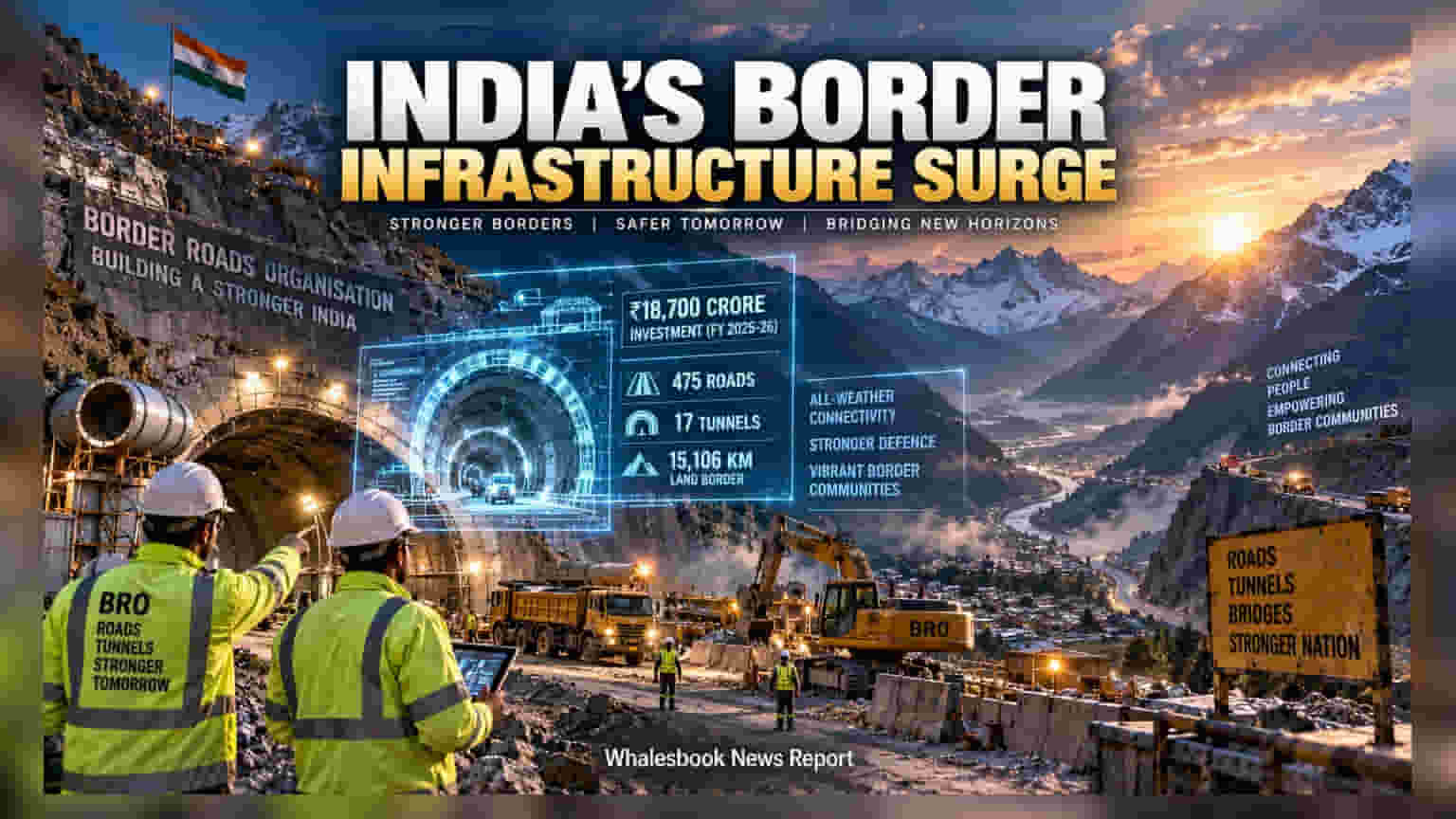
The Border Roads Organisation has announced a record ₹18,700 crore capital spending target for 2025-26 to construct 475 roads and 17 tunnels. This large-scale government outlay is expected to provide a consistent order pipeline for India’s engineering and construction sector. By integrating new technology to speed up projects, the agency aims to overcome historical hurdles like land acquisition and environmental clearances.
The Border Roads Organisation (BRO) has set a major target for the 2025-26 fiscal year, planning to spend ₹18,700 crore on critical border infrastructure. This significant financial commitment aims to strengthen India’s defense logistics by accelerating the construction of 475 roads and 17 tunnels across the nation’s 15,106-km land border. For the Indian markets, this move underscores the government’s continued focus on building essential infrastructure in remote areas, which often serves as a steady source of demand for the domestic engineering, procurement, and construction (EPC) sector.
The agency is moving toward a more tech-enabled approach to manage its vast project list. By replacing manual surveys with airborne geophysical mapping and using AI to streamline project reviews, the BRO is trying to reduce the time taken for approvals. Historically, the infrastructure sector in India has faced execution risks related to land acquisition, forest clearances, and harsh weather conditions in high-altitude regions. These factors have previously led to project delays and cost overruns. The agency’s shift toward faster digital processes is an attempt to mitigate these operational risks.
Modern defense doctrine requires hardened infrastructure capable of withstanding potential threats. Consequently, the BRO is prioritizing subterranean construction, including cavern-type facilities and all-weather tunnels. These structures are vital for ensuring that troop movements and supply lines remain functional even during winter or challenging security situations. Beyond defense, these projects are linked to the government's Vibrant Villages Programme, which focuses on connecting isolated border communities to the national economy by providing better access to markets, health services, and education.
For investors and market participants, the key takeaway is the volume of work being generated in the infrastructure and defense space. Large-scale government spending projects typically benefit established EPC firms that have the technical capacity to operate in difficult terrains like the Himalayas. However, the success of these projects will depend on effective execution and coordination between the BRO and the Ministry of Environment, Forest and Climate Change to resolve regulatory bottlenecks.
The immediate monitorable for the market will be the pace of contract awards and the ability of the agency to maintain its timeline for these projects. While the increased budget is a positive indicator for sector growth, shareholders in construction-related companies will likely keep a close watch on whether these projects can overcome the traditional challenges of land and environment clearances. The integration of advanced logistical planning and drone-supported surveillance also suggests a shift toward higher-tech requirements for contractors, which may favour companies with advanced engineering capabilities.