

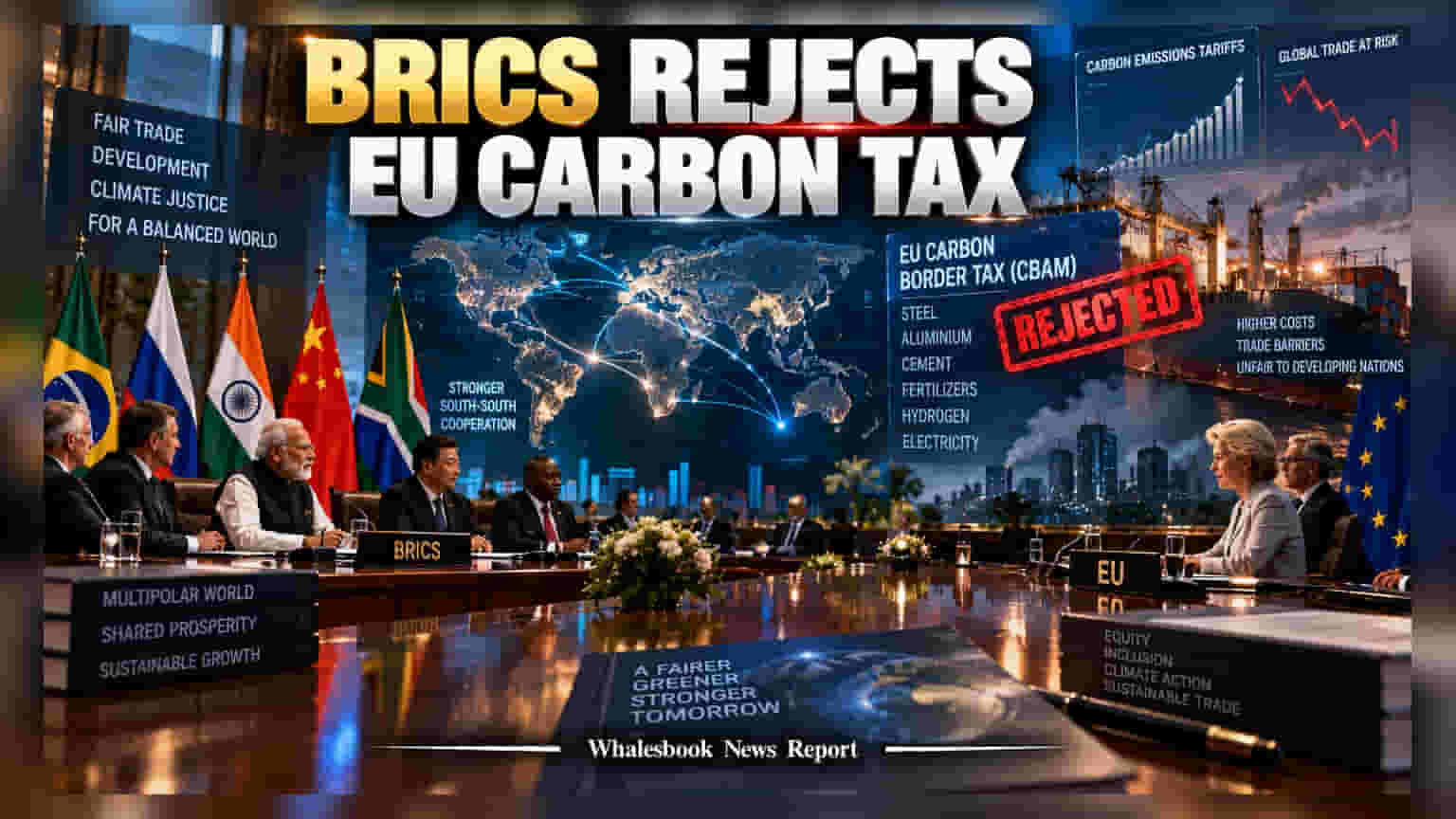
BRICS leaders have formally opposed the European Union’s carbon border tax (CBAM) at the New Delhi summit, labeling it a protectionist threat. For investors, this development signals increased trade uncertainty for Indian companies exporting steel, aluminum, and cement to Europe, as these firms may face higher compliance costs and potential margin pressure.
The BRICS alliance, during its 18th summit held in New Delhi, has issued a formal declaration rejecting the European Union’s Carbon Border Adjustment Mechanism (CBAM). By terming the policy as a unilateral and discriminatory trade barrier, the coalition has signaled a deepening conflict between the trade strategies of emerging economies and the climate-focused import policies of the West.
At the center of this dispute is the EU's carbon tax, which took effect in its definitive phase earlier this year. The mechanism essentially imposes a cost on imported goods based on the carbon emissions generated during their production. This policy directly impacts high-emission sectors, specifically steel, aluminum, cement, fertilizers, hydrogen, and electricity. For Indian exporters in these industries, the tax represents an additional layer of expense that could make their products less price-competitive in the European market.
From an investor perspective, this development adds a layer of complexity for manufacturing companies with significant export exposure to Europe. Companies that have not yet transitioned to greener production methods or those that rely heavily on carbon-intensive energy sources may face difficulty absorbing these additional costs. If exporters are unable to pass these expenses on to their European customers, it could lead to pressure on profit margins. Alternatively, companies might see a drop in export volumes if their products become too expensive compared to those produced within the EU or in regions with lower compliance burdens.
Beyond immediate costs, the diplomatic friction highlighted in the New Delhi Declaration suggests that trade relations regarding environmental standards are becoming more strained. The BRICS bloc argues that such taxes violate international trade rules and ignore the development needs of emerging nations. They are pushing for alternative frameworks that focus on technology transfer and financial support for climate transition, rather than punitive duties.
Looking ahead, investors should monitor how major Indian exporters in the metals and construction materials sectors manage their carbon footprint. The ability of these firms to invest in greener technologies will be a key factor in maintaining their market share in Europe. Additionally, the market will likely track any further official reactions from the World Trade Organization, as the BRICS coalition has hinted at challenging these measures through global trade forums. The long-term risk for shareholders involves potential supply chain shifts, where high-carbon manufacturing might be redirected away from the European market, necessitating a change in sales strategy for major industrial players.