

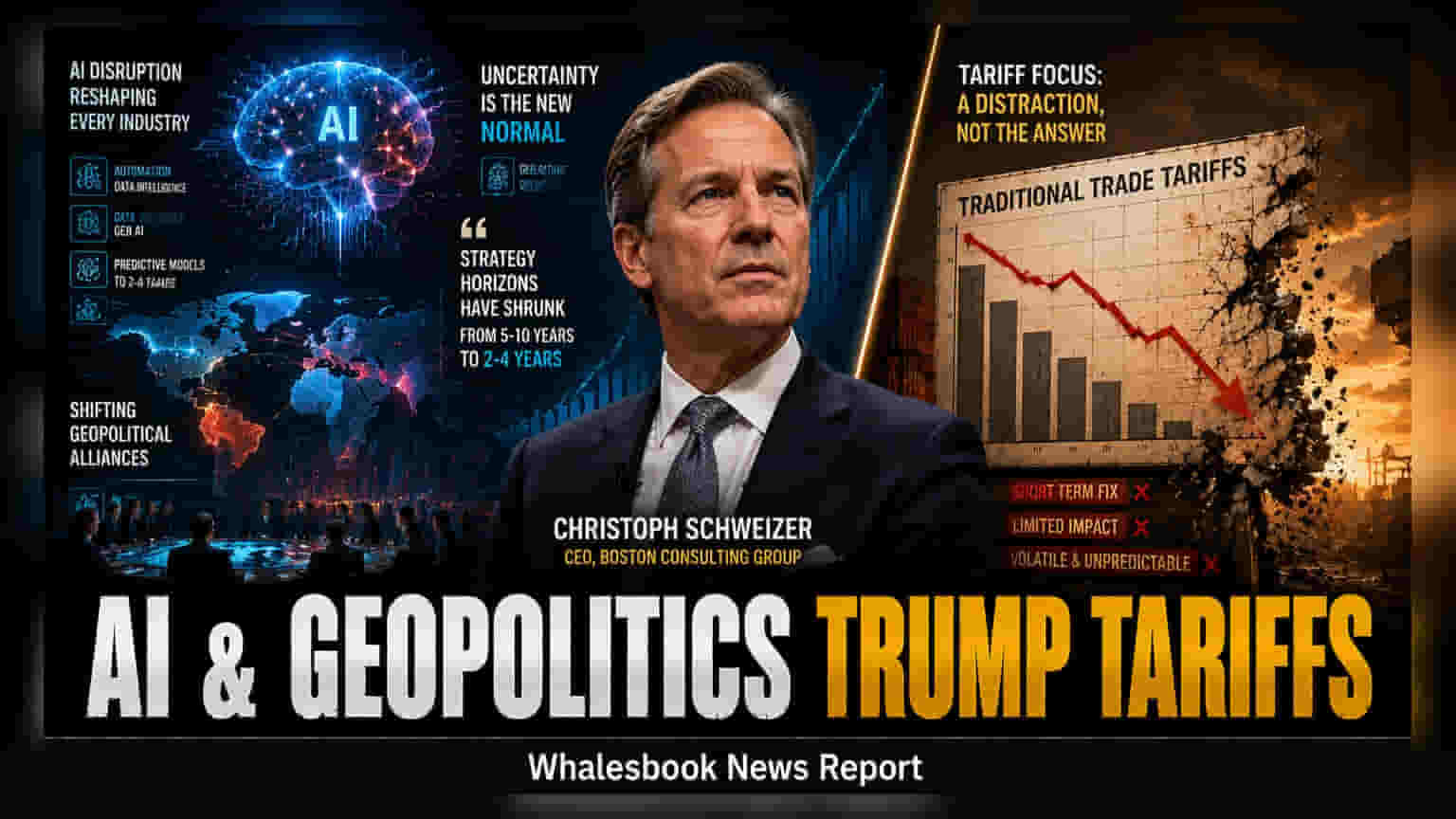
BCG CEO Christoph Schweizer says focusing only on trade tariffs is a distraction for business leaders today. Speaking at the ET World Leaders Forum, he highlighted that global geopolitical shifts and AI adoption are the real challenges. For investors, this shift indicates that companies prioritizing agility and long-term tech investment are better positioned to navigate the current uncertain global landscape than those reacting solely to policy headlines.
Business leaders must move past the obsession with trade tariffs and focus on deeper systemic challenges, according to Christoph Schweizer, CEO of the global consulting firm Boston Consulting Group (BCG). Speaking at the ET World Leaders Forum on August 21, 2026, Schweizer argued that while tariffs are a frequent headline risk, they are often overemphasized by corporate leaders at the expense of more pressing disruptions like artificial intelligence and shifting geopolitical alliances.
Why Strategy Horizons Are Shrinking
One of the most significant changes mentioned by the BCG chief is how long companies can effectively plan. In a more stable global environment, corporations previously looked ahead five to ten years. Schweizer noted that this window has compressed significantly, with many businesses now operating on two-to-four-year planning horizons. This change is not necessarily because companies are failing to plan, but because the global environment has become inherently unpredictable. For investors, this means financial forecasts and long-term projects from corporate management teams may require more frequent updates than in the past.
Tech And Geopolitics As Key Drivers
Schweizer identified artificial intelligence and geopolitical volatility as the primary drivers of this uncertainty. As industries reshape themselves to adopt AI, companies that fail to integrate these technologies risk falling behind. Simultaneously, the global trade landscape is changing as supply chains shift to account for geopolitical friction. For Indian investors, this provides a clear lens to evaluate company performance. Businesses that are investing in digital transformation and diversifying their supply chains—rather than those just complaining about import duties or tariff changes—are likely managing these core risks more effectively.
What Investors Should Monitor
When reviewing company earnings and management commentary, investors can look for signs of this "agility" that Schweizer emphasized. It is less about whether a company can predict the next global policy change and more about how quickly it can adapt when the landscape shifts. Are companies spending capital on improving their tech infrastructure? Are they building resilience into their supply chains to handle geopolitical breaks? These questions are now arguably more important than tracking temporary trade tariff news, which can distract from the fundamental health and adaptability of a business.
Ultimately, the BCG CEO’s message suggests that the new standard for corporate success is the ability to make decisions quickly and effectively. In an environment where the 'easy' world is unlikely to return, companies that build a culture of speed and adaptability are expected to outperform peers who remain focused on navigating short-term policy noise.